
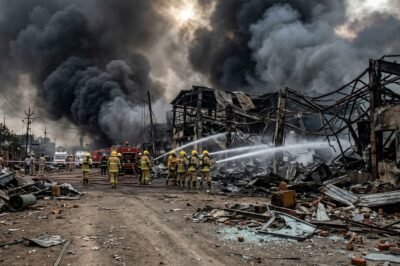
The industrial landscape of Dombivli, situated in the Thane district of Maharashtra, was transformed into a scene of utter devastation on a fateful Thursday afternoon that residents and workers will not soon forget. At approximately 1:40 PM, a massive boiler explosion at a local chemical manufacturing unit, Amudan Chemicals, sent seismic-level shockwaves through the region, shattering the routine of thousands of residents and laborers. The sheer magnitude of the blast was such that windows of residential buildings and commercial complexes over two kilometers away were blown out, and the tremor was initially mistaken by many for a localized earthquake. As a thick, toxic plume of grey and black smoke billowed into the sky, visible from miles across the Mumbai Metropolitan Region, the immediate aftermath revealed a harrowing sight of mangled steel, charred remains, and a desperate scramble for survival among the ruins. Initial reports confirmed at least six fatalities, with the toll expected to rise as search and rescue operations delve deeper into the unstable wreckage of the factory floor. This incident serves as a grim and urgent reminder of the volatile nature of the chemical industry and the precarious balance between rapid industrial growth and the fundamental right to safety in one of India’s most densely populated industrial corridors.
The Anatomy of the Explosion and Immediate Aftermath
The explosion originated in the boiler section of Amudan Chemicals, located in the Phase 2 area of the Dombivli Maharashtra Industrial Development Corporation (MIDC) zone. Eyewitnesses described a sound so deafening it momentarily paralyzed the surrounding neighborhood. Within seconds, the initial blast triggered secondary explosions as nearby chemical containers ignited, creating a chain reaction that engulfed the facility in flames. The force was powerful enough to toss large pieces of machinery into the air, some landing on neighboring units and causing additional structural damage. The heat generated was so intense that it prevented immediate rescue attempts by local workers, who could only watch as the facility was consumed by a fierce inferno.
As the fire spread, it reached at least two or three neighboring industrial units, including those involved in the production of textiles and engineering goods. The rapid escalation of the fire necessitated a massive response from the fire brigade, which declared a ‘Grade 2’ emergency. Over fifteen fire engines were dispatched from Thane, Kalyan, and neighboring municipalities to combat the blaze. However, the presence of hazardous chemicals meant that water alone was insufficient, requiring large quantities of firefighting foam to suppress the chemical-fueled flames. The chaos on the ground was exacerbated by the narrow roads of the industrial estate, which were quickly clogged with emergency vehicles and panicked onlookers.
Casualty Reports and the Heroic Efforts of First Responders
As of the latest briefings from local authorities, six individuals have been confirmed dead, their bodies recovered from the smoldering ruins of the factory. The victims include factory workers who were on their shift at the time of the blast. More than sixty people have been reported injured, suffering from varying degrees of burns, respiratory distress due to smoke inhalation, and trauma caused by flying debris and shattered glass. Local hospitals in Dombivli and Kalyan have been put on high alert, with many of the critically injured being moved to specialized burn centers in Mumbai for advanced treatment. The medical community has mobilized quickly, but the nature of chemical burns poses a significant challenge for long-term recovery.
The National Disaster Response Force (NDRF) was called in to assist local fire and police teams in the search and rescue operation. These specialists, equipped with thermal imaging cameras and structural monitoring tools, have been working tirelessly to ensure that no one is left trapped under the collapsed slabs of the factory. The bravery of the first responders cannot be overstated; they entered the site while secondary fires were still active and the structural integrity of the remaining walls was highly questionable. Their efforts focused not only on recovering the deceased but also on containing the chemical runoff to prevent further environmental contamination of the local water table.
Technical Analysis: Why Do Industrial Boilers Explode?
From a technical perspective, boiler explosions are among the most feared events in industrial settings. A boiler is essentially a high-pressure vessel designed to heat water or other fluids to generate steam. If the pressure exceeds the structural limits of the vessel, or if there is a failure in the pressure relief valves, the result is a catastrophic release of energy. In the case of chemical factories, the risk is multiplied. If the cooling systems fail or if there is a ‘runaway’ chemical reaction within the reactor vessels connected to the boiler system, the temperature and pressure can spike within seconds, far beyond the safety thresholds of the equipment.
Preliminary investigations suggest that the boiler at Amudan Chemicals might not have undergone the mandatory safety audits required by the Directorate of Industrial Safety and Health (DISH). Industrial boilers require rigorous maintenance, including ultrasonic testing of the shell thickness, calibration of pressure gauges, and regular cleaning of the tubes to prevent the buildup of scale, which can lead to localized overheating. Any negligence in these protocols, especially in a facility handling volatile organic compounds, creates a recipe for disaster. Investigators are currently looking into the maintenance logs of the factory to determine if there were prior warnings or leaks that went unaddressed by the management.
The Socio-Economic Impact on the Dombivli MIDC Area
The impact of this explosion extends far beyond the perimeter of the Amudan Chemicals factory. The Dombivli MIDC area is a hub for small and medium-sized enterprises (SMEs), and the destruction of multiple units has led to a significant loss of livelihood for hundreds of workers. Beyond the immediate loss of jobs, the physical damage to surrounding infrastructure—including power lines, telecommunications, and roads—has disrupted the operations of dozens of other factories in the zone. The economic ripple effects will be felt for months as insurance claims are processed and structural repairs are undertaken. Many small business owners in the area, already struggling with the pressures of global supply chain shifts, now face the prospect of permanent closure.
Furthermore, the psychological impact on the local residential population is profound. Dombivli has seen rapid residential growth, with housing complexes now standing in close proximity to hazardous industrial zones. This incident has reignited the long-standing debate over the ‘buffer zones’ between industrial estates and residential neighborhoods. Residents are now demanding the relocation of high-risk chemical units away from populated areas, fearing for their safety and the long-term health effects of living near sites that store toxic substances. The local real estate market in the immediate vicinity is also expected to see a cooling effect as safety concerns become a primary consideration for home buyers.
Regulatory Scrutiny and the History of Industrial Negligence
This is not the first time that the Thane industrial belt has witnessed such a tragedy. History shows a recurring pattern of industrial accidents in Maharashtra, often followed by temporary crackdowns that eventually lose momentum. The Maharashtra Industrial Development Corporation (MIDC) and the State Pollution Control Board are now under intense scrutiny. Critics argue that the enforcement of safety regulations is often lax, with corruption and inadequate staffing levels at regulatory bodies allowing factories to operate without valid ‘Consents to Operate’ or proper fire safety clearances. The government has announced a high-level probe into the blast, promising strict action against the owners of the factory.
The legal repercussions for the factory management are likely to be severe. Cases of ‘culpable homicide not amounting to murder’ are often filed in such instances. However, legal experts point out that the conviction rate in industrial negligence cases remains low, and the compensation provided to the victims’ families—often a few lakh rupees—is woefully inadequate compared to the loss of a breadwinner. There is a growing call for a more robust legal framework that holds not just the factory owners, but also the government inspectors who signed off on safety certificates, personally and financially liable for such catastrophes.
Conclusion: A Turning Point for Industrial Safety
The massive boiler blast in Thane must serve as a turning point for industrial policy in India. It is no longer enough to prioritize ‘Ease of Doing Business’ without equal emphasis on the ‘Safety of Doing Business.’ Moving forward, there must be a mandatory, tech-driven oversight system where boiler pressure and chemical storage levels are monitored in real-time by centralized government servers. Such a system would allow authorities to detect anomalies before they lead to explosions. Additionally, the transition toward ‘Green Chemistry’ and inherently safer industrial processes must be accelerated to minimize the use of high-pressure and high-temperature reactions near residential zones.
In conclusion, the lives lost in Dombivli are a heavy price to pay for industrial progress. As the smoke clears and the families of the victims begin the long process of mourning, the state and central governments must move beyond rhetoric and implement concrete changes in safety enforcement. Stricter zoning laws, transparent safety audits, and a zero-tolerance policy toward regulatory non-compliance are the only ways to ensure that the industrial engines of the economy do not become instruments of destruction for the very people they are meant to employ and support. The future of India’s industrial sector depends on its ability to prove that it can operate safely and responsibly in a modern, urbanizing society.



































Leave a Reply