
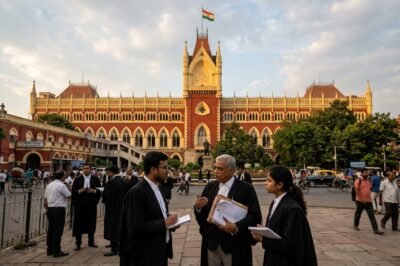
The legal landscape of West Bengal and the broader national discourse on reservation policies have been profoundly reshaped by the landmark verdict of the Calcutta High Court, which recently struck down the Other Backward Classes (OBC) status of several classes in the state. This decision, delivered by a division bench comprising Justice Tapabrata Chakraborty and Justice Rajasekhar Mantha, marks a significant judicial intervention into the executive powers of the state government to define social backwardness. The ruling effectively invalidates thousands of OBC certificates issued after 2010, primarily targeting the West Bengal Backward Classes (Other than Scheduled Castes and Scheduled Tribes) (Reservation of Vacancies in Services and Posts) Act, 2012. For many, this is seen as a necessary correction to ensure that reservation benefits reach the truly marginalized, while for others, it represents a systemic blow to the social inclusion of minority communities. The case centers on the procedural integrity of the state’s identification process, suggesting that the classifications were made with undue haste and without the requisite empirical data mandated by the National Commission for Backward Classes (NCBC) and previous Supreme Court precedents. As the political temperature rises in the wake of this judgment, the decision stands as a critical case study in the tension between populist policy-making and constitutional scrutiny in India’s democratic framework.
The Judicial Mandate and the Core of the Verdict
At the heart of the Calcutta High Court’s ruling is the invalidation of the OBC status granted to 77 classes, most of which were included in the reservation list during the tenure of the Trinamool Congress government. The court specifically targeted the manner in which the state executive exercised its powers under the 2012 Act. According to the bench, the selection of these classes did not follow the rigorous standards established by the Indra Sawhney vs. Union of India judgment, which requires a detailed socio-economic survey to prove backwardness. The court observed that the identification of these classes appeared to be arbitrary and was carried out without proper consultation with the West Bengal Backward Classes Commission. The ruling clarifies that while the state has the power to identify backward classes, this power is not absolute and must be exercised within the bounds of constitutional logic. By striking down these classifications, the court has emphasized that the inclusion of communities in the OBC list cannot be a matter of executive whim or political expediency. Instead, it must be rooted in quantifiable data that demonstrates a clear lack of representation and systemic social disadvantage.
Procedural Lapses and the Role of the Backward Classes Commission
One of the most damning aspects of the judgment is the court’s critique of the West Bengal Backward Classes Commission. The court found that the Commission had failed to act as an independent body and had instead functioned as a mere rubber stamp for the government’s decisions. Under the law, the Commission is tasked with the vital responsibility of conducting field surveys, analyzing demographic data, and holding public hearings before recommending any community for OBC status. However, the evidence presented before the court suggested that many of these steps were bypassed or conducted in a perfunctory manner. The bench noted that the speed with which the 77 classes were added to the list raised serious red flags regarding the depth of the investigation into their social and educational status. Transparency and accountability are the twin pillars of administrative law, and the court found that both were significantly compromised in this instance. The failure to consult the National Commission for Backward Classes (NCBC) or to follow the established criteria for determining backwardness led the court to conclude that the entire process was legally unsustainable. This highlights a broader issue in Indian politics where state commissions often face pressure to align their findings with the ruling party’s electoral strategies, thereby undermining the objective of affirmative action.
Political Implications and the Narrative of Vote Bank Politics
The timing and nature of the Calcutta High Court’s decision have naturally invited intense political scrutiny. Critics of the West Bengal government have long alleged that the inclusion of numerous Muslim groups into the OBC category was a strategic move to secure a consolidated vote bank. The court’s observation that the classification process seemed to focus disproportionately on specific religious groups has bolstered these claims. In West Bengal, where identity politics plays a central role in electoral outcomes, this ruling is a significant setback for the ruling Trinamool Congress (TMC). Chief Minister Mamata Banerjee has already expressed her strong disapproval of the verdict, characterizing it as an affront to the state’s sovereignty and the rights of the marginalized. However, the opposition parties, particularly the BJP, have welcomed the judgment as a victory for the rule of law and a vindication of their stance against “appeasement politics.” This judicial intervention is likely to become a major talking point in future elections, as both sides attempt to frame the narrative around social justice and constitutional propriety. The debate now centers on whether reservation should be used as a tool for genuine social mobility or if it has been weaponized as an instrument for political survival.
Economic Impact and the Fate of Current Certificate Holders
While the court has struck down the status of the affected classes, it has provided a small measure of relief for those who have already entered government service or educational institutions using these certificates. The ruling states that the services of those already appointed and those who have already derived benefits from the reservation will not be terminated. However, the immediate cessation of the reservation benefit for all future recruitments and admissions has created an atmosphere of uncertainty and anxiety among thousands of students and job seekers. The economic implications are profound, as the OBC status was a gateway to secure government jobs and subsidized education in a competitive environment.
- Individuals currently in the process of applying for jobs under the OBC quota now find themselves in a legal limbo.
- Educational institutions must recalibrate their admission lists for the upcoming academic cycles.
- The state government faces the massive administrative task of rectifying the reservation rosters.
The sudden withdrawal of these benefits could lead to social unrest among the affected communities, many of whom have built their career paths around the expectation of reservation. The loss of OBC status means these groups must now compete in the General Category, where the barriers to entry are significantly higher, potentially leading to a widening of the socio-economic gap the policy was originally intended to bridge.
The Constitutional Framework and National Precedents
The Calcutta High Court’s decision does not exist in a vacuum; it is deeply rooted in the evolving constitutional jurisprudence surrounding Article 15 and Article 16 of the Indian Constitution. These articles permit the state to make special provisions for the advancement of socially and educationally backward classes. However, the Supreme Court has consistently held that such provisions must be based on objective criteria. The 50% cap on total reservations and the exclusion of the “creamy layer” are other critical benchmarks that states must respect. In this case, the High Court found that the West Bengal government had overstepped its constitutional mandate by failing to prove that the classes in question were indeed backward enough to warrant special treatment. This ruling aligns with similar judicial actions in other states, such as the Maratha reservation case in Maharashtra, where the judiciary has insisted on the necessity of “extraordinary circumstances” and “solid data” to justify deviations from established norms. The verdict serves as a reminder to all state governments that the judiciary remains a vigilant guardian of the Constitution, ensuring that affirmative action does not devolve into a system of patronage that ignores the principles of equality and merit.
Future Implications: The Road to the Supreme Court
The West Bengal government has already indicated that it will challenge the High Court’s decision in the Supreme Court. This sets the stage for a high-stakes legal battle that will have ramifications far beyond the borders of West Bengal. The Supreme Court’s eventual handling of the case will likely provide further clarity on the limits of state power in identifying backward classes and the role of the NCBC in the post-102nd Amendment era. If the Supreme Court upholds the High Court’s ruling, it will necessitate a complete overhaul of the reservation system in West Bengal, requiring a fresh, scientifically rigorous survey of the state’s population. Conversely, if the ruling is overturned, it would reinforce the state’s authority to define backwardness based on its own internal assessments. Beyond the legalities, the case will force a national conversation on the criteria used for reservation. Should it be purely based on social and educational indicators, or should economic criteria play a more prominent role? As the case moves to the highest court in the land, the focus will remain on balancing the constitutional promise of social justice with the need for a fair, transparent, and data-driven administrative process. The outcome will undoubtedly influence the future of reservation policies across India, potentially leading to more stringent requirements for the inclusion of new communities into the OBC fold.




































Leave a Reply