
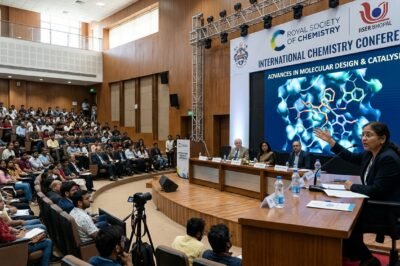
The global scientific community stands at a pivotal juncture where the fusion of traditional chemical principles and cutting-edge technological advancements is no longer a luxury but a necessity for planetary survival. In this context, the announcement of the seventh ChemSci 2026: Leaders in the Field Symposium, hosted by the Royal Society of Chemistry (RSC) in collaboration with the Indian Institute of Science Education and Research (IISER) Bhopal, represents a monumental leap forward for the international research landscape. This prestigious gathering is not merely an academic meeting; it is a meticulously curated intellectual convergence designed to address the most pressing challenges of our time, from climate change and renewable energy to advanced therapeutics and molecular engineering. By choosing IISER Bhopal as the venue, the RSC underscores India’s burgeoning role as a powerhouse of scientific inquiry and a central hub for global R&D investment. As experts from across the globe descend upon central India, the symposium promises to act as a catalyst for transformative breakthroughs, redefining the boundaries of what is possible within the chemical sciences in the mid-21st century.
For decades, the Royal Society of Chemistry has served as a beacon for excellence, fostering an environment where innovation thrives through collaboration. The 2026 iteration of the ChemSci series is particularly significant as it arrives during a period of rapid digital transformation within the laboratory environment. The integration of Artificial Intelligence and Machine Learning into chemical synthesis and drug discovery has created a new frontier, and the leaders gathered at IISER Bhopal are the primary architects of this revolution. This symposium provides a rare opportunity for these visionaries to share proprietary insights, debate methodologies, and establish long-term partnerships that transcend geopolitical borders. The strategic partnership with IISER Bhopal, an institution renowned for its rigorous academic standards and state-of-the-art infrastructure, ensures that the discussions will be rooted in both theoretical depth and practical application, providing a holistic view of the future of the discipline.
The Evolution of ChemSci: A Legacy of Academic Excellence
The ChemSci symposium series has historically been a touchstone for the highest caliber of research dissemination. Since its inception, the series has moved across various global centers of excellence, each time leaving a lasting impact on the local and international scientific communities. The selection of the seventh edition’s focus on “Leaders in the Field” is a deliberate move to highlight the individuals who are not just contributing to science, but are fundamentally shifting its trajectory. By focusing on these luminaries, the RSC ensures that the symposium serves as a high-level briefing on the current state of play in global chemistry, offering attendees a privileged look at the research that will dominate the headlines for the next decade.
Historically, India has been a significant contributor to the global chemical industry, particularly in pharmaceuticals and agrochemicals. However, the ChemSci 2026 symposium signifies a shift from manufacturing dominance to intellectual leadership. The participation of global leaders at IISER Bhopal highlights the recognition of Indian academia as a peer in high-level fundamental research. This evolution is crucial for the global scientific ecosystem, as it integrates diverse perspectives and fosters a more inclusive approach to solving universal problems. The legacy of this symposium will likely be measured by the multi-institutional grants and collaborative papers that emerge in its wake, solidifying the ties between the RSC and the Indian scientific establishment.
Strategic Pillars of the 2026 Symposium at IISER Bhopal
The seventh ChemSci symposium is built upon several strategic pillars that reflect the current priorities of the global scientific community. First and foremost is the theme of molecular complexity. As we move away from simple chemical structures, the ability to synthesize and manipulate complex molecules with high precision is becoming the hallmark of modern chemistry. Presentations at the symposium are expected to delve deep into the mechanics of catalysis, exploring new ways to facilitate reactions with minimal energy input and maximum yield. This is not just a scientific challenge but a financial one, as more efficient processes directly translate to lower costs for industrial applications.
Another critical pillar is the intersection of chemistry and biology. The “Leaders in the Field” are increasingly working at the interface of these two disciplines, developing new chemical tools to probe biological systems. This research has profound implications for the future of medicine, particularly in the development of targeted drug delivery systems and personalized therapies. By bringing together chemical biologists and synthetic chemists, the symposium facilitates a cross-pollination of ideas that is essential for the next generation of medical breakthroughs. The sessions at IISER Bhopal will likely feature groundbreaking work on protein engineering and the chemical basis of cellular signaling, providing a roadmap for future clinical interventions.
Bridging the Gap Between Academia and Industrial Application
One of the most significant aspects of the ChemSci 2026 symposium is its focus on the translational potential of research. In an era where funding agencies are increasingly looking for tangible societal benefits, the ability to move a discovery from the laboratory bench to the commercial market is vital. The leaders attending the symposium are experts at navigating this transition, often holding multiple patents and leading successful spin-off companies. Their insights into the commercialization process will be invaluable for the younger researchers and students at IISER Bhopal, who are the future entrepreneurs of the scientific world.
Furthermore, the symposium acts as a high-level networking event where industry leaders can identify promising new technologies and talent. The financial implications of these interactions are substantial; venture capital interest often follows the trends highlighted at RSC events. By showcasing the latest advancements in materials science and nanotechnology, the symposium effectively sets the investment agenda for the coming years. Companies looking to stay ahead of the curve in terms of product development and sustainable manufacturing will be paying close attention to the proceedings in Bhopal, looking for the next big innovation that can be scaled for global impact.
Sustainable Chemistry and Green Innovation Frontiers
Sustainability is no longer an optional component of chemical research; it is the core around which all new developments must orbit. The ChemSci 2026 symposium places a heavy emphasis on “Green Chemistry,” a movement that seeks to design products and processes that minimize the use and generation of hazardous substances. The leaders in this field are developing revolutionary approaches to waste reduction, atom economy, and the use of renewable feedstocks. These topics are not just ethically important but are becoming central to the regulatory environment in which global chemical companies operate.
At IISER Bhopal, the discussions will likely center on the development of new biodegradable polymers and the search for sustainable alternatives to rare earth metals. As the world moves toward a circular economy, the role of chemistry in recycling and material recovery becomes paramount. The symposium will feature sessions on how to transform industrial byproducts into valuable raw materials, effectively closing the loop on production cycles. This focus on sustainability ensures that the scientific progress discussed is not achieved at the expense of the environment, but rather in harmony with it, providing a blueprint for a more resilient and sustainable future.
Financial and Structural Impact on India’s Research Ecosystem
The hosting of such a prestigious event has significant financial and structural implications for the Indian research ecosystem. It elevates the profile of institutions like IISER Bhopal, making them more attractive to international faculty and high-caliber students. This “brain gain” is essential for maintaining the momentum of India’s scientific growth. Additionally, the influx of international experts leads to a surge in local collaborations, often resulting in joint research centers and shared laboratory facilities funded by both domestic and international agencies.
From a financial perspective, the symposium highlights the ROI (Return on Investment) of public funding in science education and research. The government’s support of the IISER system is validated by its ability to host world-class events in partnership with organizations like the RSC. This, in turn, encourages further investment from the private sector, as companies see the value in being associated with top-tier academic research. The long-term economic impact includes the creation of high-tech jobs, the growth of the local service economy around the research hub, and the development of a highly skilled workforce capable of competing on the global stage.
Global Collaborative Frameworks and Future Projections
The ChemSci 2026 symposium is a testament to the power of international scientific diplomacy. In a world that can often feel fragmented, science remains a universal language that bridges cultural and political divides. The collaborative frameworks established during these sessions at IISER Bhopal will likely lead to the development of global standards for chemical safety, data sharing, and ethical research practices. These frameworks are essential for ensuring that the benefits of scientific progress are distributed equitably across the globe.
Looking toward the future, the projections based on the themes of this symposium suggest a move toward even greater integration of digital tools in chemistry. We are likely to see the rise of autonomous laboratories where robots perform experiments guided by AI, allowing human scientists to focus on high-level conceptual work. The “Leaders in the Field” are already preparing for this shift, and the discussions at ChemSci 2026 will provide a glimpse into this automated future. As these technologies mature, they will drastically reduce the time and cost of research, leading to an acceleration of scientific discovery that was previously unimaginable.
Conclusion: The Future of Chemistry in a Post-Symposium World
As the seventh ChemSci 2026 symposium at IISER Bhopal concludes, the ripple effects of the discussions will be felt throughout the global scientific community for years to come. The event serves as a powerful reminder that the most significant challenges facing humanity—from disease to environmental degradation—can only be solved through collective effort and the relentless pursuit of knowledge. By bringing together the best minds in the field, the Royal Society of Chemistry has not only highlighted the current state of the art but has also laid the groundwork for the next generation of chemical innovations.
The future of chemistry, as envisioned at IISER Bhopal, is one of greater precision, sustainability, and cross-disciplinary integration. It is a future where the molecular sciences are at the heart of the global economy, driving growth while protecting the planet. For India, the success of this symposium marks a coming of age on the international stage, confirming its position as a leader in the global scientific dialogue. As researchers return to their laboratories, they carry with them new ideas, new partnerships, and a renewed sense of purpose, ensuring that the legacy of ChemSci 2026 will be a world transformed by the power of chemistry.






































Leave a Reply