
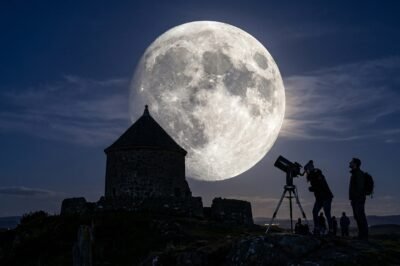
The Celestial Grandeur of the November Full Moon
As the nights draw longer and the autumnal chill settles across the northern hemisphere, the celestial stage is set for one of the year’s most breathtaking astronomical displays: the Beaver Supermoon. In late 2024, skywatchers and professional astronomers alike turned their gaze upward to witness the final supermoon of the year, a radiant orb that appeared significantly larger and more luminous than the standard full moon. This phenomenon, occurring when the moon reaches its closest point to Earth in its elliptical orbit—known as perigee—simultaneously with a full lunar phase, creates a visual spectacle that transcends mere scientific observation. For the general public, it is a moment of connection with the cosmos; for the financial and tourism sectors, it represents a burgeoning market for astrotourism and high-end optical equipment. The Beaver Supermoon is not merely a name but a bridge between historical agrarian traditions and modern astrophysics. Understanding its mechanics requires a deep dive into the lunar cycles that govern our tides, our calendars, and even our cultural narratives. As we analyze the specifics of this lunar event, we explore not only the ‘when’ and ‘how’ but also the profound ‘why’ behind our enduring fascination with the silver satellite that orbits our world.
The convergence of the moon’s perigee with its full phase is a relatively rare occurrence that demands precise orbital alignment. While the moon orbits the Earth roughly every 27.3 days, its path is not a perfect circle but an ellipse. This means there are times when it is further away (apogee) and times when it is much closer. When a full moon occurs within 90% of its closest approach to Earth, it is colloquially termed a ‘supermoon.’ The Beaver Supermoon specifically refers to the full moon of November, a time of transition and preparation in both the natural and human worlds. This year’s event was particularly notable because it marked the conclusion of a series of four consecutive supermoons, making it a grand finale for lunar enthusiasts who have been tracking the satellite’s progression since the late summer months.
The Mechanics of a Supermoon: Perigee and Syzygy
To understand the Beaver Supermoon, one must first grasp the technical concepts of perigee and syzygy. The moon’s orbit is eccentric, varying by about 30,000 miles between its closest and farthest points. When the moon reaches its perigee, it is approximately 226,000 miles from Earth. If this orbital milestone aligns with ‘syzygy’—the straight-line configuration of the Sun, Earth, and Moon—the result is a supermoon. During these events, the moon can appear up to 14% larger in diameter and 30% brighter than a micro-moon (a full moon at apogee). While these differences might be subtle to the untrained eye, the increased luminosity is often sufficient to cast sharp shadows on the ground even in the middle of the night, creating a surreal and high-contrast landscape that has inspired poets and scientists for centuries.
Furthermore, the physical impact of a supermoon extends beyond visual aesthetics. The gravitational pull exerted by the moon at perigee is significantly stronger, leading to what are known as perigean spring tides. These tides are noticeably higher and lower than average, sometimes resulting in minor coastal flooding if combined with local weather systems. For maritime industries and coastal communities, the Beaver Supermoon is not just a photographic opportunity but a geophysical event that requires monitoring. The interplay between the moon’s distance and the Earth’s oceans serves as a constant reminder of the celestial mechanics that dictate the rhythm of life on our planet, highlighting the interconnectedness of our terrestrial environment with the broader solar system.
Etymology and Cultural Significance of the Beaver Moon
The naming of the ‘Beaver Moon’ is rooted in the rich tapestry of North American history and the folklore of Indigenous peoples, particularly the Algonquin tribes. Historically, November was the time when beavers finished building their winter dams and retreated to their lodges. It was also the season when trappers would set their final traps before the waters froze, ensuring a supply of warm fur for the impending winter. In other cultures, this moon is known as the Frost Moon or the Mourning Moon, reflecting the themes of cooling temperatures and the seasonal shift toward the darkness of winter. These names were eventually popularized in the 18th century through the Old Farmer’s Almanac, which integrated Native American, Colonial, and European naming traditions into a cohesive lunar calendar.
In the modern era, these cultural labels have experienced a resurgence, driven by social media and a renewed interest in heritage and nature. The term ‘Beaver Supermoon’ combines these ancient descriptors with modern astronomical terms, creating a compelling narrative that resonates with a global audience. This blending of the old and the new allows people to engage with science through the lens of storytelling. For many, naming the moon provides a sense of continuity and predictability in an increasingly chaotic world. It encourages a seasonal mindfulness, prompting individuals to pause and reflect on the changing environment, much as their ancestors did centuries ago under the same silver light.
Upcoming Lunar Events: The 2025 Calendar
Following the Beaver Supermoon, the celestial calendar continues to offer significant events for stargazers. While the sequence of four supermoons in 2024 has concluded, 2025 promises its own array of astronomical wonders. The next series of supermoons is expected to begin in the later half of next year, with notable dates falling in October and November 2025. Between these peaks, enthusiasts can look forward to the Cold Moon in December and several lunar eclipses that will be visible from various parts of the globe. Tracking these dates is essential for those who wish to plan photography excursions or travel to ‘Dark Sky’ reserves where light pollution is minimal and the lunar details are most vivid.
For those monitoring the long-term patterns, it is important to note that supermoon cycles follow the Saros cycle and the Metonic cycle, which help astronomers predict their recurrence with extreme accuracy. In 2025, we will also see the return of the ‘Blue Moon’ phenomenon in some regions—the second full moon in a single calendar month. Keeping a lunar journal or using astronomical apps has become a popular trend, allowing people to stay synchronized with these events. The 2025 calendar will be particularly interesting for researchers as it coincides with increased solar activity, potentially leading to sightings of the Aurora Borealis during lunar events, a rare and sought-after ‘double feature’ for nighttime observers.
Market Implications: The Rise of Astrotourism
The popularity of events like the Beaver Supermoon has significant economic implications, particularly in the sectors of travel, photography, and education. ‘Astrotourism’ is one of the fastest-growing niches in the travel industry. National parks and remote regions with low light pollution, such as the Atacama Desert in Chile or the rural highlands of Scotland, see a massive influx of visitors during supermoon events. Hotels and tour operators now offer ‘Supermoon Packages’ that include guided telescope sessions, photography workshops, and luxury camping under the stars. This shift highlights a growing consumer desire for ‘experiential travel’ that connects them with the natural world in a profound and educational way.
Furthermore, the high-end camera and optics market experiences surges around these dates. Manufacturers of telescopes, binoculars, and long-range lenses often time their marketing campaigns and product launches to coincide with major lunar events. The ‘Beaver Supermoon’ is a prime time for enthusiasts to upgrade their gear to capture the craters and ‘seas’ of the lunar surface in high definition. Educationally, planetariums and science centers use these events as ‘teachable moments’ to boost ticket sales and engagement, driving funding into space research and public science communication. The financial ripple effect of a single full moon is a testament to how celestial events can drive terrestrial commerce and interest in STEM fields.
Photography Guide: Capturing the Perfect Supermoon
To capture the majesty of a supermoon like the Beaver Moon, photographers must master a combination of technical skill and environmental awareness. One of the most common mistakes is overexposing the moon, which results in a bright white disc without any detail. Because the moon is being hit by direct sunlight, it is actually quite bright; photographers often use the ‘Looney 11’ rule—setting the aperture to f/11 and the shutter speed to the reciprocal of the ISO. A sturdy tripod is non-negotiable, as even the slightest vibration can blur the crisp lines of the lunar topography. Additionally, the most striking photos often include ‘foreground interest,’ such as a city skyline, a lone tree, or a mountain range, to provide a sense of scale and context to the moon’s apparent size.
Modern smartphone technology has also democratized lunar photography. While once the domain of professionals with expensive telephoto lenses, many high-end smartphones now feature specialized ‘Night Mode’ and digital zoom capabilities that can produce respectable images of the supermoon. This accessibility has led to a social media explosion of lunar imagery, where hashtags like #BeaverMoon and #Supermoon2024 trend globally. This digital sharing creates a sense of community, as people from different continents share their unique perspectives of the same celestial body. For the aspiring astrophotographer, the Beaver Supermoon serves as an annual masterclass in lighting, composition, and patience, requiring them to wait for the perfect moment when the moon crests the horizon.
Conclusion: Future Implications for Lunar Exploration
As we look back on the Beaver Supermoon of 2024 and forward to the lunar events of 2025, it is clear that our relationship with the moon is entering a new era. Beyond the visual and cultural appreciation, the moon is once again the focus of international space exploration. Programs like NASA’s Artemis mission aim to return humans to the lunar surface, this time with the intent of establishing a sustainable presence. Every supermoon that captures the public’s imagination serves to build support for these ambitious scientific endeavors. The Beaver Supermoon is a reminder that the moon is not just a distant rock, but a potential gateway to the rest of the solar system, a laboratory for scientific discovery, and a constant companion in our journey through space.
The future implications of our lunar fascination are both scientific and philosophical. As we develop the technology to live and work on the moon, the ‘Full Moon’ will take on a new meaning for the pioneers who will one day look back at a ‘Full Earth’ from the lunar surface. For now, the Beaver Supermoon remains a grounding force—a predictable, beautiful, and unifying event that reminds us of our place in the universe. Whether viewed through a high-powered telescope or simply with the naked eye from a suburban backyard, the supermoon continues to inspire awe, curiosity, and a sense of wonder that is essential to the human spirit. As we wait for the next supermoon to rise, we remain tethered to the ancient rhythms of the sky, ever watchful and ever curious about the secrets the silver moon has yet to reveal.




































Leave a Reply