
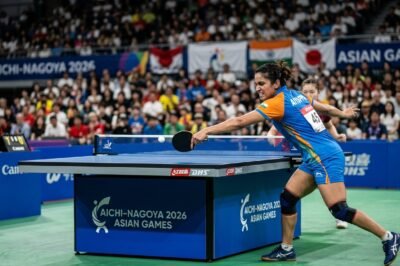
The Asian Games 2026 has officially ignited the continental stage in Aichi-Nagoya, bringing with it the high-octane drama that only multi-sport events of this magnitude can provide. For the Indian contingent, the opening day of the table tennis team events served as a microcosm of the unpredictable nature of elite sport—a day defined by the soaring highs of strategic brilliance and the sobering lows of narrow defeats. As the lights dimmed over the sprawling tables, the narrative of the day was split into two distinct chapters: a commanding performance by the Indian women’s team against a formidable Singaporean side, and a grueling, heartbreak-filled encounter for the men’s team against an inspired Iranian squad. These results do more than just alter the points table; they set the psychological tone for the grueling week ahead. In a sport where split-second reactions and mental fortitude are the currency of success, the Indian athletes found themselves navigating a complex web of tactical chess matches, proving once again that the path to Asian glory is paved with both resilience and relentless challenge. This report delves into the intricate details of these matches, examining the technical mastery and the pressure-cooker moments that defined India’s performance on this momentous day.
The Women’s Masterclass: Overcoming the Singaporean Wall
The Indian women’s team entered the arena with a point to prove, facing off against a Singaporean squad that has historically been a thorn in the side of many top-tier nations. The match was not just a test of skill, but a tactical battleground where India’s top seeds showcased their maturity. Manika Batra, the face of Indian table tennis, led the charge with a display of unconventional long-pimpled rubber play that consistently disrupted the rhythm of her opponents. Her ability to switch between defensive blocks and sudden, aggressive forehand counters left the Singaporean top seeds struggling to find a consistent tempo. This victory was a statement of intent, signaling that the Indian women’s team is no longer just a participant but a serious contender for a podium finish in the 2026 edition.
Supporting Batra was the ever-improving Sreeja Akula, whose speed and precision across the table have become her trademark. In her singles rubber, Akula demonstrated a remarkable ability to take the ball early, effectively neutralizing the spin-heavy serves of her opponent. The synergy between the veterans and the younger players was evident as they communicated through every point, adjusting their court positioning and service variations in real-time. The 3-1 victory over Singapore was not merely a result of individual brilliance but a testament to a well-structured team strategy that prioritized consistency over high-risk play. This win places India in a strong position within their group, easing the pressure for the subsequent preliminary rounds.
Furthermore, the tactical depth shown by the women was bolstered by the coaching staff’s meticulous preparation. Analyzing Singapore’s tendency to struggle against high-toss serves, the Indian paddlers utilized various service trajectories to keep their opponents guessing. The third player in the lineup also played a crucial role, holding her nerve during a tense fifth set in her respective rubber to ensure India maintained its momentum. The victory sends a clear message to the likes of China and Japan: the Indian women’s team has arrived with a more versatile and mentally tougher roster than ever before.
Analyzing the Men’s Setback: The Iranian Challenge
While the women celebrated, the Indian men’s team faced a starkly different reality against an Iranian side that has rapidly ascended the world rankings. Iran’s table tennis program has undergone a revolution, characterized by a highly aggressive, top-spin oriented style of play that catches many traditional powerhouses off guard. The match began with high expectations for India, led by the legendary Sharath Kamal and the technically gifted Sathiyan Gnanasekaran. However, the Iranian players utilized their physical strength and explosive power to dictate the terms of the rallies from the very first serve. The match was a grueling affair, with several sets going into deuce, highlighting the razor-thin margins that separate victory from defeat at this level.
Sharath Kamal, despite his vast experience, found it difficult to contain the relentless forehand loops of the Iranian top seed. The Iranian strategy focused on pinning the Indian players to their backhand corners before opening up the court with wide-angled winners. Sathiyan Gnanasekaran showed flashes of brilliance, particularly with his quick-fire counter-hits, but the consistency required to dismantle the Iranian defense was lacking in the crucial moments of the third and fourth rubbers. The eventual 3-2 defeat in favor of Iran was a bitter pill to swallow, as it places India in a precarious position regarding their knockout stage qualification. The Iranian team’s victory was no fluke; it was a result of a systematic approach that targeted the Indian team’s reliance on rhythm-based play.
The defeat also highlighted some areas of concern for the Indian men’s contingent, particularly their response to raw power. As the game of table tennis becomes increasingly faster, the ability to transition from defense to offense under heavy pressure is paramount. The Iranian paddlers exploited every short return, punishing the Indian team with deep, heavy-spin drives. For the Indian men to recover from this blow, they must quickly adapt their receiving game and find ways to neutralize the initial aggression of their opponents. The road ahead is now significantly tougher, requiring comprehensive wins in their remaining group fixtures to ensure their journey in the 2026 Asian Games continues.
Tactical Breakdown: Spin, Speed, and Psychological Warfare
To understand the disparity in results between the two teams, one must look at the tactical nuances of the day. The Indian women’s team excelled in what can be described as psychological patience. They were willing to engage in long rallies, waiting for the Singaporean players to commit unforced errors. By varying the depth and spin of their returns, they created a sense of uncertainty. This was particularly evident in the way they handled the ‘short-short’ game over the net, often winning the battle of the first three balls, which is critical in modern table tennis. Their use of the entire width of the table forced their opponents into uncomfortable lateral movements, breaking their balance and timing.
Conversely, the men’s team seemed to struggle with the tempo control against Iran. The Iranians dictated the speed of the match, forcing the Indian players into a reactive mode. In table tennis, when a player is constantly reacting rather than initiating, their error rate naturally climbs. The Iranian team also utilized a ‘high-risk, high-reward’ service strategy, frequently opting for long, fast serves that caught the Indian players deep in their court. This prevented the Indians from using their preferred ‘flick’ returns, forcing them into defensive pushes that were easily put away by the Iranian attackers. The psychological impact of losing close sets also seemed to weigh on the men, leading to a visible drop in intensity during the final rubbers.
The Role of Equipment and Surface
Another factor that cannot be ignored is the adaptation to the specific playing conditions in Nagoya. The humidity and the friction of the table surface play a significant role in how the ball reacts to spin. It appeared that the Indian women’s team had adjusted better to the ‘grip’ of the tables, allowing their spin-heavy serves to bite more effectively. In contrast, the Iranian men’s team used the conditions to their advantage by playing a flatter, more direct game that neutralized much of the spin the Indian players tried to generate. Understanding these environmental variables is a core component of elite preparation, and it was clear that on this day, different teams found different levels of comfort with the setup.
Key Performance Indicators: A Statistical Deep Dive
When examining the statistics from the matches, several key trends emerge. In the women’s victory, India won 65% of the points on their second serve, a high percentage that indicates effective follow-up shots. Their unforced error rate was remarkably low, averaging only 4 per set. This disciplined approach allowed them to stay ahead in the scoreline even when Singapore attempted to mount a comeback. Additionally, the conversion rate on ‘game points’ was nearly 90%, showing a clinical edge in the closing stages of each set. These numbers suggest a team that is peak-performing and mentally composed under pressure.
The men’s statistics tell a more complex story. While India won more total points in some sets, they lost the ‘clutch points’—the points played when the score was tied at 9-9 or 10-10. Iran’s success rate in deuce situations was nearly 75%, a statistic that often determines the outcome of team matches. Furthermore, the Indian men struggled with their service returns, with nearly 20% of Iranian serves resulting in direct points or immediate weak returns. This inefficiency at the start of the rally put immense pressure on the subsequent shots, leading to a cascade of tactical failures. Addressing these specific statistical deficits will be the priority for the coaching staff ahead of the next round of fixtures.
The Evolving Landscape of Asian Table Tennis in 2026
The results of the opening day reflect a broader shift in the landscape of Asian table tennis. No longer is the continent a two-horse race between China and Japan. Nations like Iran, India, and South Korea have invested heavily in their youth programs and coaching infrastructure, leading to a much more competitive and unpredictable environment. The 2026 Asian Games are proving to be a showcase for this new era of parity. The fact that the Indian women can dominate a traditional powerhouse like Singapore, while the Indian men can be pushed to the brink by Iran, underscores the high level of preparation across all participating nations.
For India, this evolution is a double-edged sword. On one hand, it provides more opportunities for high-level competition and global recognition. On the other, it means there are no ‘easy’ matches in the draw. Every opponent requires a bespoke tactical plan and a peak physical performance. The 2026 Games are also seeing a greater integration of sports science, with teams using real-time data analytics to scout opponents. The Indian contingent has embraced this, but the loss to Iran suggests that there is still room for improvement in translating data into on-table execution. As the tournament progresses, the ability to adapt to these shifting dynamics will be the hallmark of the eventually successful teams.
Conclusion: Future Implications for Indian Table Tennis
As the Indian contingent reflects on a day of mixed fortunes, the implications for the rest of the Asian Games 2026 are significant. The women’s team has carved out a path toward the quarterfinals and potentially beyond, carrying a momentum that could see them challenge for a historic medal. Their performance has validated the long-term investments made in the women’s circuit, proving that with the right mix of experience and youthful exuberance, they can compete with the best in the world. The focus for them now will be on maintaining this level of consistency and ensuring that physical fatigue does not set in during the latter stages of the tournament.
For the men’s team, the path is more arduous but not impossible. The defeat against Iran serves as a wake-up call, a reminder that reputation alone does not win matches at this level. They must now win their remaining group matches with significant margins to ensure a favorable draw in the knockout rounds. This setback might actually serve as a catalyst for a tactical overhaul, forcing the players to rethink their approach to aggressive opponents. The resilience of veterans like Sharath Kamal will be tested, and the emergence of younger leaders will be necessary to navigate the upcoming challenges. Ultimately, the story of Indian table tennis at the 2026 Asian Games is still being written, and if the opening day is any indication, the journey will be filled with more heart-stopping action and dramatic shifts in fortune.




































Leave a Reply