
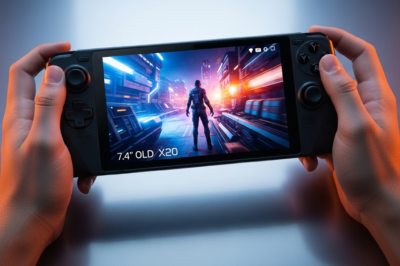
The landscape of portable gaming has undergone a seismic shift today as Asus officially pulled the curtain back on its latest hardware marvel: the Asus ROG Ally X20. Building upon the massive success of the original ROG Ally, which debuted just over a year ago, the X20 (often referred to in enthusiast circles as the Ally X refresh) represents more than just an incremental upgrade; it is a fundamental reimagining of what a high-performance handheld can achieve. With a stunning 7.4-inch OLED screen and the introduction of cutting-edge TMR (Tunnel Magnetoresistance) joysticks, Asus is clearly positioning itself to reclaim the throne from competitors like the Steam Deck OLED and the Lenovo Legion Go. This launch marks a pivotal moment for the ‘Republic of Gamers’ brand, as they transition from being a pioneer in the space to a dominant force that listens intently to user feedback regarding battery life, display quality, and control precision.
The Visual Masterpiece: A 7.4-Inch OLED Revolution
The centerpiece of the Asus ROG Ally X20 is undoubtedly its new 7.4-inch OLED display. For years, handheld enthusiasts have argued that while the original Ally offered superior resolution and refresh rates compared to the early Steam Deck, it lacked the deep blacks and infinite contrast ratios that only OLED technology can provide. Asus has responded with a panel that is not only larger than the previous 7-inch LCD but significantly more vibrant. This new screen supports a 120Hz refresh rate and delivers a peak brightness that makes outdoor gaming a viable reality rather than a squinting struggle. The move to OLED allows for per-pixel dimming, which means that in dark, atmospheric titles like ‘Alan Wake 2’ or ‘Cyberpunk 2077,’ the shadows are truly black, and the neon lights pop with a level of saturation that LCD panels simply cannot replicate.
Furthermore, the 7.4-inch form factor strikes a perfect balance. It provides a more immersive field of view than the standard 7-inch screens without reaching the unwieldy proportions of the 8.8-inch Lenovo Legion Go. The resolution remains at a crisp 1080p, which is the ‘sweet spot’ for the Z1 Extreme processor, ensuring that games look sharp without putting an undue burden on the GPU that a 1440p panel might. This display also features Variable Refresh Rate (VRR) support, a feature that was a standout on the original Ally and continues to be a major advantage over the Steam Deck, eliminating screen tearing and stuttering when frame rates fluctuate during intense gameplay sequences.
Precision Redefined: The Science of TMR Joysticks
One of the most technically impressive upgrades in the ROG Ally X20 is the inclusion of TMR (Tunnel Magnetoresistance) joysticks. While most of the gaming industry is currently shifting toward Hall Effect sensors to combat the dreaded ‘stick drift’ found in traditional potentiometers, Asus has gone a step further. TMR technology is essentially a more advanced version of magnetic sensing. It offers significantly higher sensitivity and lower power consumption compared to standard Hall Effect sensors. In practical terms, this means the X20 provides a level of precision that professional eSports players demand. The dead zones are virtually non-existent, and the physical resistance of the sticks has been tuned to provide a more tactile, premium feel.
The longevity of these joysticks cannot be overstated. By removing the physical contact points that cause wear and tear in traditional analog sticks, Asus has ensured that the Ally X20 will remain as accurate in year five as it was on day one. This is a direct response to the ‘right to repair’ movement and the general frustration gamers have with modern controllers. Along with the TMR sticks, the d-pad has also been overhauled, featuring an 8-way circular design that is perfect for fighting games and retro titles, providing a clicky, responsive feedback that was somewhat lacking in the first-generation model.
Under the Hood: Performance, Cooling, and Thermal Dynamics
While the core APU—the AMD Ryzen Z1 Extreme—remains a powerhouse, the internal architecture of the ROG Ally X20 has been significantly redesigned to optimize performance. The device now features a more robust cooling solution with thinner fan blades and a larger heatsink area. This allows the Ally X20 to maintain higher clock speeds for longer durations without thermal throttling, a common issue in slim handhelds. Asus claims a double-digit percentage improvement in airflow, which not only keeps the internal components cool but also ensures that the touchpoints on the device—the grips and the screen—remain comfortable during marathon gaming sessions.
Memory and storage have also seen a massive boost. The X20 now ships with faster LPDDR5X RAM, which is crucial for integrated graphics performance. Handheld APUs use system RAM as VRAM, so the increase in bandwidth directly translates to higher frame rates in memory-intensive titles. Additionally, Asus has finally moved to a full-sized M.2 2280 SSD slot. This is a monumental change for the modding community. Previously, users were limited to the smaller, more expensive 2230 drives. With the 2280 support, gamers can easily and affordably upgrade their storage to 4TB or even 8TB, allowing them to carry their entire Steam and Xbox Game Pass library on the go.
Battery Life: Solving the Handheld’s Greatest Weakness
The original ROG Ally was often criticized for its lackluster battery life, frequently struggling to last more than 90 minutes in AAA titles. The ROG Ally X20 addresses this head-on by nearly doubling the battery capacity. By leveraging a more efficient OLED panel and optimizing the internal space created by the new chassis, Asus has managed to fit an 80Wh battery into the device. This effectively doubles the playtime compared to the original 40Wh unit. In real-world scenarios, gamers can now expect 3 to 4 hours of high-end gaming and up to 8 or 10 hours in indie titles or media playback.
This battery upgrade transforms the Ally X20 from a device that was tethered to a wall outlet into a true travel companion. Whether you are on a long-haul flight or a daily commute, the anxiety of the ‘low battery’ warning is significantly mitigated. Asus has also optimized the charging speeds, allowing the device to regain 50% of its charge in just under 30 minutes using the included 65W charger, ensuring that even when you do run low, you aren’t out of the game for long.
Ergonomics and the Xbox Ecosystem Integration
The name ‘Xbox Ally X20’ isn’t just a marketing gimmick; it signifies a deep integration with the Microsoft ecosystem. The device comes pre-loaded with a refined version of Armoury Crate SE, which features a UI that feels remarkably similar to the Xbox Dashboard. This makes the transition from console to handheld seamless. Furthermore, the Ally X20 includes three months of Xbox Game Pass Ultimate, giving users immediate access to hundreds of high-quality titles. The hardware itself has been reshaped with deeper, more ergonomic grips that mimic the feel of an Xbox Wireless Controller, reducing wrist fatigue during long sessions.
The I/O ports have also seen a much-needed update. Asus has replaced the proprietary XG Mobile port with two USB4 ports. This is a game-changer for versatility. It allows users to connect to a wide variety of third-party eGPUs, docks, and high-speed peripherals without being locked into Asus’s expensive ecosystem. One port can be used for charging while the other handles high-speed data transfer or video output, making the Ally X20 a viable desktop replacement when docked to a monitor and keyboard.
The Competitive Landscape and Future Outlook
As the handheld market becomes increasingly crowded, the Asus ROG Ally X20 stands out as the most refined ‘Windows’ handheld to date. While the Steam Deck remains the king of value and software optimization through SteamOS, the Ally X20 offers a level of raw power and display quality that Valve’s hardware cannot currently match. The inclusion of Windows 11, while sometimes cumbersome on a small screen, ensures total compatibility with every game launcher, from Epic Games Store to Battle.net and Ubisoft Connect.
Looking forward, the success of the Ally X20 will likely force other manufacturers to adopt OLED and TMR technologies. We are witnessing a spec war in the handheld space that mirrors the early days of the smartphone industry. As battery tech continues to improve and APUs become more efficient, the line between a high-end gaming PC and a portable device will continue to blur. For now, the Asus ROG Ally X20 is the definitive statement of intent from Asus—a premium, powerful, and no-compromise machine that sets a high bar for the next generation of portable gaming.




































Leave a Reply