
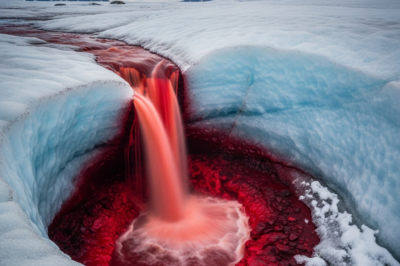
Deep in the heart of East Antarctica’s McMurdo Dry Valleys, a stark and haunting visual anomaly has puzzled the scientific community since its discovery in 1911. Known as ‘Blood Falls,’ this five-story, blood-red waterfall seeps from the Taylor Glacier onto the ice-covered surface of Lake Bonney. For over a century, the origins and the strange coloring of this discharge remained one of geology’s most enduring enigmas. While early explorers and scientists speculated about the presence of microscopic organisms or unique mineral deposits, the lack of sophisticated technology meant the secret remained locked beneath hundreds of meters of solid ice. Recent breakthroughs, however, have finally peeled back the layers of time and ice, revealing a complex ecosystem and a chemical process that challenges our understanding of life on Earth and perhaps even beyond. This discovery is not merely a triumph of glaciology but a profound leap in astrobiology, proving that liquid water and life can persist in the most extreme conditions imaginable for millions of years.
A Century of Chilling Mystery at Taylor Glacier
The story begins in 1911 when the British geographer and explorer Thomas Griffith Taylor first laid eyes on the crimson-stained snout of the glacier that now bears his name. During the ill-fated Terra Nova Expedition, Taylor noted the jarring contrast between the pristine white ice and the deep, gory red liquid oozing from its base. At the time, the phenomenon was so alien that Taylor and his team hypothesized it was the result of red algae. This explanation remained the prevailing theory for decades, as it was a common occurrence in other parts of the world where algae blooms turn water bodies vibrant shades of pink or red. However, as science progressed into the mid-20th century, researchers began to realize that the environment of the McMurdo Dry Valleys was far too hostile for typical surface-level algae to survive in such a manner. The ‘Blood Falls’ were not a biological bloom in the traditional sense, but something far more ancient and subterranean. The mystery deepened as the site was recognized as one of the few places on Earth where a glacier appears to ‘bleed,’ leading to endless speculation about the internal plumbing of the Antarctic ice sheets.
The Initial Misconceptions: Red Algae or Rust?
As the decades passed, the algae theory was eventually debunked. By the 1960s, scientists had shifted their focus toward iron oxides—essentially rust. They theorized that the water was rich in iron, which oxidized and turned red upon contact with the atmosphere. While this was closer to the truth, it didn’t explain where the water came from or why it didn’t freeze solid in the sub-zero temperatures of Antarctica. The McMurdo Dry Valleys are among the coldest and driest places on the planet, with temperatures rarely rising above freezing even in the height of summer. For liquid water to flow at all, there had to be a source of significant heat or a chemical composition that drastically lowered the freezing point. Furthermore, the intermittent nature of the flow suggested that the falls were not a constant stream but a pressurized release from a hidden reservoir. The technology of the 20th century could only scratch the surface, literally, of the Taylor Glacier, leaving the source of the brine a matter of educated guesswork until the turn of the millennium.
Revolutionizing Glaciology: Radio-Echo Sounding Technology
The turning point in the investigation came with the advent of advanced geophysical imaging techniques. A team of researchers from the University of Alaska Fairbanks and Colorado College utilized a method known as Radio-Echo Sounding (RES) to peer through the thick ice of the Taylor Glacier. RES works similarly to radar; it sends electromagnetic pulses into the ice, which bounce back when they hit different materials, such as liquid water or rock. The results were staggering. The researchers discovered a massive, interconnected network of subglacial rivers and a large reservoir of brine trapped under 400 meters of ice. This reservoir had been isolated for approximately 1.5 to 2 million years. The data revealed that the water was not melting from the surface but was being forced upward through the glacier’s internal cracks. This ‘plumbing system’ was kept liquid not by heat, but by the extreme salinity of the water. The brine was found to be two to three times saltier than seawater, which, combined with the immense pressure from the ice above, allowed it to remain liquid even at -7 degrees Celsius. This was the ‘how’ of the movement, but the ‘what’ of the color still held a final secret.
The Nanosphere Breakthrough: Why the Water Turns Red
While the iron-rich nature of the water was known, a 2023 study led by Kenivi and a team of materials scientists used powerful transmission electron microscopes to examine the brine at a molecular level. They discovered something entirely unexpected: the iron was not present in a mineral form like traditional rust (hematite or goethite). Instead, it was found in the form of nanospheres—tiny, spherical particles that are 1/100th the size of a human red blood cell. These nanospheres are rich in iron, but they also contain silica, calcium, aluminum, and magnesium. Because these particles are amorphous (meaning they lack a crystalline structure), they remain suspended in the water differently than minerals do. Crucially, these nanospheres are clear when they are under the glacier in an anaerobic (oxygen-free) environment. The moment they are expelled from the glacier and hit the Antarctic air, they oxidize instantly. It is this rapid transition from clear liquid to oxidized nanospheres that creates the dramatic ‘bleeding’ effect. This revelation explained why previous mineralogical tests had failed to identify the exact cause; scientists were looking for crystals, but the secret was in the amorphous, non-crystalline nanospheres.
An Ancient Ecosystem: Life Without Light or Oxygen
Beyond the chemistry of the color, Blood Falls has revealed a biological miracle. The brine reservoir is home to a unique community of microbes that has been evolved in total isolation for nearly two million years. Living in complete darkness with no oxygen and under crushing pressure, these extremophiles have developed a metabolic process that is virtually unheard of elsewhere. Instead of photosynthesis, these organisms survive by cycling iron and sulfur. They use sulfate as a catalyst to ‘breathe’ with iron, breaking down the organic matter that was trapped with them millions of years ago when the area was a coastal fjord. This ecosystem is a ‘time capsule’ from the Pliocene epoch, offering scientists a direct look at how life might persist in the absence of the sun. The presence of these microbes suggests that the subglacial environment of Antarctica is not a dead zone, but a vast, hidden biome that could harbor countless undiscovered species.
Beyond Earth: What Blood Falls Tells Us About Alien Life
The implications of the Blood Falls discovery extend far beyond the borders of Antarctica. Astrobiologists are now looking at this site as a primary analog for conditions on other celestial bodies, most notably Mars and Jupiter’s moon, Europa. Mars is known to have vast reserves of subsurface ice and evidence of ancient, salty water. If life can thrive in the briny, lightless depths of the Taylor Glacier, it is plausible that similar microbial life could exist beneath the Martian permafrost or within the liquid oceans hidden under the icy crust of Europa and Enceladus. The discovery of nanospheres also changes how we search for life; if we are looking for specific crystalline minerals as ‘biosignatures’ on other planets, we might miss the amorphous nanospheres that characterize life-supporting environments like Blood Falls. NASA and other space agencies are now incorporating the lessons learned from Taylor Glacier into the design of future rover missions and subsurface probes.
Conclusion: The Future of Polar and Space Research
The mystery of Blood Falls, which began as a curious observation by an explorer over a century ago, has evolved into a cornerstone of modern scientific inquiry. It serves as a reminder that Earth still holds profound secrets, often hidden in plain sight or beneath layers of ice we are only now beginning to penetrate. The combination of glaciology, microbiology, and materials science has solved the riddle of the crimson water, revealing a world of ancient brine, nanospheres, and resilient life. As climate change continues to impact the Antarctic ice sheets, understanding these subglacial systems becomes even more critical. Blood Falls is no longer just a ‘strange waterfall’; it is a window into the deep history of our planet and a beacon for the search for life in the cosmos. The next century of research will likely build on these findings, as we use the secrets of the Taylor Glacier to explore the furthest reaches of our solar system, looking for the tell-tale signs of life in the cold, dark, and salty depths of the universe.





































Leave a Reply