
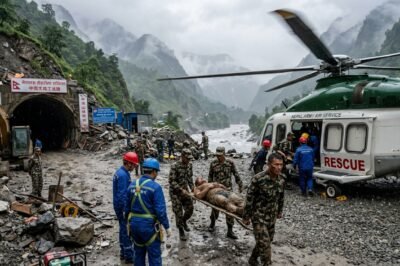
In a display of human endurance that defies the very laws of biological probability, a Chinese national has been rescued alive from a construction tunnel in Nepal, ten days after a catastrophic flash flood swept through the region. The incident, which has captured international attention, underscores not only the extreme vulnerabilities of infrastructure projects in the fragile Himalayan ecosystem but also the profound resilience of the human spirit when pushed to the absolute brink of existence. For ten agonizing days, the worker remained entombed in total darkness, isolated from the world by tons of debris, mud, and the icy remnants of a glacial surge that had claimed the lives of colleagues and leveled surrounding structures. This rescue is being hailed as a miracle by local authorities and medical experts alike, as the window for survival in such oxygen-depleted and damp environments typically closes within the first seventy-two hours. As the survivor was airlifted to a medical facility in Kathmandu, the focus now shifts from the immediate joy of his recovery to the deeper questions regarding worker safety, geological stability, and the inherent risks associated with large-scale engineering projects in some of the world’s most treacherous terrain. This long-form analysis dives into the mechanics of this survival story and the broader implications for the region.## The Anatomy of a Himalayan DisasterThe disaster began with a sudden, localized cloudburst that triggered a massive surge in the river systems feeding the hydroelectric project where the worker was stationed. Nepal, a nation defined by its verticality and complex hydrology, is no stranger to flash floods, but the intensity of this event was unprecedented for the season. When the water hit, it carried with it a slurry of boulders and uprooted timber, effectively sealing the tunnel entrance within seconds. The Chinese national, whose identity has been protected during the initial stages of recovery, was working deep within the auxiliary shaft when the deluge occurred. While several others managed to escape or were tragically swept away, he was caught in a section that, by sheer luck, became a pocket of survivable space. The geological composition of the tunnel—predominantly hard rock with reinforced concrete supports—prevented a total collapse, though it also served as a tomb that blocked all light and sound from the outside world. This initial phase of the disaster set the stage for a search and rescue operation that would test the limits of local and international coordination.## Ten Days in the Dark: The Science of SurvivalSurviving for ten days in a subterranean environment requires a perfect storm of environmental conditions and mental fortitude. Medical professionals explain that the survivor likely benefited from a slow-moving but present air current filtered through small fissures in the rock, preventing carbon dioxide buildup. Furthermore, the presence of dripping groundwater, while posing a risk of hypothermia, likely provided the necessary hydration to keep his vital organs functioning. In the absence of food, the human body enters a state of ketosis, burning fat stores to maintain brain function, but it is the psychological toll that is often the most lethal. To survive 240 hours of sensory deprivation, the individual had to maintain a level of cognitive focus that prevented the onset of panic-induced shock. Rescuers noted that when they finally breached the final barrier of silt and stone, the survivor was in a state of extreme lethargy but remained conscious and capable of responding to verbal cues. This suggests a remarkable level of physical health prior to the incident and an extraordinary capacity for emotional regulation under pressure.## The Rescue Operation: A Race Against Time and SiltThe rescue effort was a grueling, around-the-clock operation involving the Nepal Army, local police, and technical experts from the construction firm. The primary challenge was the instability of the mud and debris blocking the tunnel. Every meter of progress required manual excavation and the careful placement of structural shoring to prevent secondary collapses that could have buried the rescue teams as well. Heavy machinery was used where possible, but the final fifty meters had to be cleared by hand to ensure the safety of any potential survivors. Local villagers and fellow workers joined the effort, driven by a sliver of hope that had dwindled with every passing day. The use of specialized ground-penetrating radar and acoustic sensors initially yielded no results, leading many to believe they were engaged in a recovery mission rather than a rescue. When a faint rhythmic tapping was detected on the ninth day, the atmosphere at the site shifted from somber duty to frantic, calculated urgency. The moment the first light from a rescuer’s headlamp hit the survivor’s eyes marked the successful conclusion of one of the most difficult subterranean rescues in Nepalese history.## Infrastructure and Environmental Risks in the HimalayasThe rescue brings into sharp focus the contentious debate over the rapid expansion of hydroelectric and infrastructure projects in the Himalayas. These mountains are geologically young and seismically active, making any large-scale construction inherently risky. Climate change has further exacerbated these risks by increasing the frequency and intensity of extreme weather events, such as the flash flood that triggered this incident. While these projects are vital for Nepal’s economic development and energy independence, they often proceed without sufficient hydrological modeling or robust emergency evacuation protocols for workers. The vulnerability of Chinese-backed projects in the region is of particular note, as they often involve deep tunneling in areas where the geological data is incomplete. This incident serves as a wake-up call for engineers to incorporate more advanced early-warning systems and to design tunnels with dedicated survival chambers equipped with emergency supplies, a practice more common in the mining industry but often overlooked in civil engineering.## Geopolitical and Economic Context of the ProjectThe project where the incident occurred is part of a broader network of Chinese-funded or contracted infrastructure developments in Nepal. These initiatives are a cornerstone of the bilateral relationship between Kathmandu and Beijing, representing billions of dollars in investment. However, the safety of Chinese nationals working abroad has become a sensitive political issue for the Chinese government. Following this rescue, there will likely be increased pressure from Beijing to ensure that its citizens are working under the highest safety standards. For Nepal, balancing the need for foreign investment with the responsibility of safeguarding workers—both domestic and foreign—is a delicate task. The successful rescue is a testament to the cooperation between the two nations during crises, but it also highlights the need for a more formalized framework for disaster response that transcends national borders. The economic impact of such disasters is significant, often leading to project delays, increased insurance premiums, and a chilling effect on future investments in high-risk zones.## Future Implications for Mountain Safety ProtocolsAs the survivor continues his recovery in a Kathmandu hospital, the legacy of his ten-day ordeal will likely be felt in the halls of policy-making and engineering schools. There is an immediate need for the standardization of ‘Refuge Chambers’ in all long-distance tunneling projects, regardless of their primary use. Furthermore, the integration of real-time environmental monitoring that can detect upstream water surges and trigger automatic alarms could save countless lives in the future. The incident also highlights the importance of training local rescue teams in specialized subterranean techniques, moving away from a reliance on general military units. In the long term, the survival of the Chinese national will be studied as a case study in human resilience, but for the industry, it should remain a stark reminder of the power of nature and the heavy price of progress. The mountains are unforgiving, and as humans continue to carve paths through them, the safety of those doing the work must become as paramount as the completion of the structures themselves. This miracle in Nepal is a rare happy ending in a region that has seen too many tragedies, providing a unique opportunity to learn and improve before the next flood comes.
Chinese National Rescued from Nepal Tunnel 10 Days After Flash Flood: A Tale of Extraordinary Survival
Posted by
Stories





-

Hunkkaar Teaser Analysis: Aneet Padda’s Gritty Transformation and the Evolving Landscape of Indian Thrillers
-

Mithila Palkar: The Relatable Queen of Indian Web Series and Her Meteoric Rise
-

Wamiqa Gabbi: The Meteoric Rise of Indian Web Series’ Most Versatile Leading Lady
-

Triptii Dimri Biography: The Evolution of India’s Newest Cinematic Sensation and Web Series Star
-

Wamiqa Gabbi: The Rise of India’s New Digital Icon and the Future of OTT Stardom
-

Mithila Palkar: The Unstoppable Evolution of India’s Digital Darling and Her Journey to the Silver Screen
-

Mithila Palkar: The Comprehensive Journey of India’s Web Series Sensation and Digital Pioneer
-

Mithila Palkar: The Relatable Queen of Indian Web Series and Her Inspiring Journey to Stardom
-

Sobhita Dhulipala Biography: The Meteoric Rise of India’s Most Versatile Web Series Star
-

Mithila Palkar: The Unstoppable Journey of India’s Digital Darling and Web Series Queen
-

Triptii Dimri: The Complete Biography of India’s Newest Cinematic Sensation and Web Series Icon
-

Wamiqa Gabbi: The Ethereal Rise of India’s Most Versatile Web Series Star
-

Sobhita Dhulipala: The Unstoppable Rise of India’s Most Versatile Web Series Icon
-

Wamiqa Gabbi: The Meteoric Rise of the New Queen of Indian Web Series and Her Unstoppable Journey to Stardom
-

Triptii Dimri: The Meteoric Rise of India’s New Cinema Sweetheart and Web Series Icon
-

Wamiqa Gabbi: The Versatile Queen of Indian OTT and Her Phenomenal Rise to Stardom
-

Tripti Dimri Biography: The Rise of India’s New National Crush and Her Journey from Laila Majnu to OTT Stardom
-

Wamiqa Gabbi Biography: The Meteoric Rise of India’s Newest OTT Sensation and Versatile Powerhouse
-

Wamiqa Gabbi Biography: The Meteoric Rise of the Digital Queen of Indian Web Series
-

The Rise of Wamiqa Gabbi: A Deep Dive into the Journey of India’s Most Versatile OTT Sensation
-

The Meteoric Rise of Triptii Dimri: Biography, Acting Prowess, and the Journey of India’s Newest Cinema Sensation

Launching Soon: The Future of News with Our E-Newspaper
In the ever-evolving landscape of media and technology, we are thrilled to announce the upcoming launch of our innovative e-newspaper, set to redefine the way news is consumed in the digital age. Embracing the convenience and accessibility that the digital world offers, our e-newspaper aims to deliver real-time news updates, insightful articles, and interactive features directly to your devices. With a commitment to journalistic integrity and a passion for storytelling, we are dedicated to keeping you informed, engaged, and connected, no matter where you are. Stay tuned for the launch of our e-newspaper, where the future of news awaits at your fingertips.
Recent News
- Death toll in Tamil Nadu spurious liquor tragedy climbs to 37 in Kallakurichi district

- Nvidia Overtakes Microsoft to Become the World’s Most Valuable Public Company

- Sensex and Nifty Hit Record Highs as Indian Markets Extend Winning Streak Led by Bank Stocks

- Putin’s Strategic Ultimatum: The Geopolitical Fallout of Warning South Korea Over Ukraine Aid

- Patna High Court Quashes Bihar Government’s Decision to Increase Reservation to 65%: A Landmark Judicial Intervention

- Education Ministry cancels UGC-NET exam following paper leak concerns; CBI probe ordered

Politics
- Putin’s Strategic Ultimatum: The Geopolitical Fallout of Warning South Korea Over Ukraine Aid
- Patna High Court Quashes Bihar Government’s Decision to Increase Reservation to 65%: A Landmark Judicial Intervention
- Education Ministry cancels UGC-NET exam following paper leak concerns; CBI probe ordered
- Netanyahu Orders West Bank Closure Following Attack on Israelis Ahead of Elections

- Court Convicts Medha Patkar in Defamation Case: A Deep Dive into the Legal Battle with Delhi LG V K Saxena

- In Abhijeet Dipke’s Message To “Cockroaches”, Pause In Protests And A “Real Leaders” Reveal – NDTV

Categories
- Art & Culture 106
- Auto 85
- Beauty 15
- Blog 307
- Books 7
- Business 372
- Celebrities 217
- Crime Files 139
- Democracy 308
- Education 84
- Entertainment 154
- Environment 133
- epaper 1
- Fashion 37
- Food 59
- Gadgets 89
- Guide 150
- Handicrafts 14
- Health 281
- Healthy Living 108
- History 5
- incidents 170
- Lifestyle 41
- Music 7
- Photography 15
- Politics 463
- Science & Technology 160
- Sports 283
- Tech 142
- Television 4
- Travel 68
- Travel & Tourism 30
- Trends 57
- Weather 9
- Web Series 97
- Workout 4
- World 665
Leave a Reply