
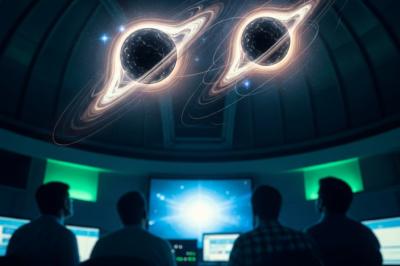
In a groundbreaking revelation that has sent ripples through the global scientific community, a team of astronomers, led by researchers from India, has identified a celestial phenomenon of extraordinary rarity and significance. Deep in the expanse of our galaxy, two white dwarf stars—the dense, cooling embers of stars that were once like our Sun—have been found locked in a frantic, gravity-driven embrace. This binary system is not merely notable for its existence, but for the staggering speed at which these two stellar remnants revolve around one another. Completing a full orbit in just six minutes, these stars are spiraling inward at a rate that provides a vivid, real-time laboratory for testing the fundamental laws of physics, specifically Albert Einstein’s General Theory of Relativity. The discovery, led by scientists from the Tata Institute of Fundamental Research (TIFR) in collaboration with international partners, represents a monumental achievement for Indian space science and enhances our understanding of the terminal stages of stellar evolution.
Understanding the Nature of White Dwarfs: The Universe’s Dense Embers
To appreciate the magnitude of this discovery, one must first understand what a white dwarf is. When a star like our Sun exhausts its nuclear fuel, it does not explode in a violent supernova. Instead, it sheds its outer layers, leaving behind a core that is incredibly dense and roughly the size of Earth but with a mass comparable to the Sun. A single teaspoon of white dwarf material would weigh as much as an elephant on Earth. These objects are essentially ‘dead’ stars; they no longer undergo nuclear fusion. Instead, they glow with residual heat, slowly cooling over billions of years. In the case of the newly discovered system, we are looking at two such objects. These are not just isolated remnants but a binary pair. Binary systems are common in the universe, but systems where two white dwarfs are so close that they orbit each other in minutes are exceptionally rare. These systems are known as ultra-compact binaries, and they represent some of the most extreme environments in the cosmos. The immense gravity between these two dense objects creates a high-stakes physical environment where time, light, and matter behave in ways that challenge our observational capabilities.
The Six-Minute Waltz: A Record-Breaking Orbit
The core of this discovery lies in the incredible orbital period of the two stars. Most planets or stars take days, months, or years to complete a single orbit. In contrast, this pair completes a full revolution every 360 seconds. This ‘six-minute waltz’ indicates that the stars are physically very close to one another, separated by a distance much smaller than the diameter of our Sun. This proximity is what makes the system so dynamic. Because they are so close and so massive, they exert a colossal gravitational pull on each other. This discovery was made possible through high-cadence observations and sophisticated data analysis techniques. The researchers utilized data from the Zwicky Transient Facility (ZTF) in California, but the intellectual leadership and the rigorous analysis required to identify this specific signal from a sea of cosmic noise were spearheaded by Indian astronomers. By monitoring the periodic dimming of light as one star passed in front of the other—a process known as eclipsing—the team was able to calculate the orbital period with pinpoint accuracy. The sheer speed of this system places it among the top tier of the fastest-known binary systems in the Milky Way galaxy, making it a ‘gold mine’ for astrophysical research.
General Relativity in Action: The Reality of Gravitational Waves
Perhaps the most significant aspect of this discovery is its alignment with Albert Einstein’s General Theory of Relativity. According to Einstein, massive objects moving at high speeds should create ripples in the fabric of space-time itself. These ripples are known as gravitational waves. As these two white dwarfs orbit each other so closely and so quickly, they radiate energy away in the form of these waves. As they lose energy, they must spiral closer together, causing their orbital period to shorten over time. This process is known as orbital decay. This specific binary system serves as a perfect ‘clock’ to measure this effect. Because the orbit is so short, the rate of decay is relatively fast and potentially measurable within a human lifetime. This provides a direct, empirical validation of the existence of gravitational waves and the predictive power of General Relativity. While gravitational waves were first directly detected by LIGO in 2015 from colliding black holes, this white dwarf system provides a different perspective: a continuous, low-frequency source of waves that can be studied over long periods. This discovery isn’t just about finding stars; it is about witnessing the fundamental mechanics of the universe as predicted by its greatest minds.
The Role of Indian Scientific Institutions and Global Synergy
This discovery highlights the growing prominence of Indian astrophysics on the world stage. The study was led by researchers from the Tata Institute of Fundamental Research (TIFR) in Mumbai, working with the National Centre for Radio Astrophysics (NCRA) in Pune. These institutions have long been the backbone of Indian scientific inquiry, but this specific find showcases their ability to lead international collaborations. By utilizing global data sets like the Zwicky Transient Facility and combining them with specialized indigenous computational models, the Indian team demonstrated a high level of technical proficiency. The involvement of Indian astronomers in such high-impact research reflects the strategic investments India has made in basic sciences and space research. Furthermore, this discovery paves the way for future projects, such as the Laser Interferometer Space Antenna (LISA), a future space-based gravitational wave detector. Systems like this six-minute binary are precisely the types of sources LISA is designed to ‘hear.’ By identifying them now through optical telescopes, Indian scientists are creating a roadmap for the next generation of space exploration, ensuring that India remains at the forefront of the upcoming era of multi-messenger astronomy.
Future Fate: A Cataclysmic Merger or a New Stellar Entity?
What happens next for these two stars? The laws of physics dictate a dramatic conclusion. As they continue to spiral inward, the distance between them will eventually vanish. Within a few million years—a blink of an eye in cosmic terms—they will collide. The outcome of such a merger depends on the combined mass of the two stars. If their total mass exceeds a specific limit known as the Chandrasekhar Limit (about 1.4 times the mass of the Sun), the merger could trigger a Type Ia Supernova. This is a massive explosion so bright it can outshine an entire galaxy and is used by astronomers as a ‘standard candle’ to measure the expansion of the universe. Alternatively, if the combined mass is lower, they might merge to form a single, more massive, and highly magnetized white dwarf, or perhaps a rare type of star known as an R Coronae Borealis star. Watching this system allows scientists to simulate these outcomes with greater accuracy. Every second they spend in their six-minute orbit, they are shedding light on how these massive cosmic explosions are born. This study provides the ‘pre-game’ footage for one of the most violent events in the universe, allowing us to understand the precursors to supernovae in a way that was previously impossible.
Why This Discovery Redefines Modern Astrophysics
In conclusion, the discovery of this six-minute binary system by Indian astronomers is more than just a record-breaking observation; it is a vital piece of the cosmic puzzle. It bridges the gap between traditional optical astronomy and the new frontier of gravitational wave physics. By finding these stars in our own galactic backyard, we gain a laboratory to test the limits of matter under extreme pressure and gravity. It reinforces the fact that the universe is a dynamic, changing place, governed by laws that we are only beginning to fully comprehend. For India, it is a point of national pride, signaling that its scientists are not just participants but leaders in decoding the mysteries of the stars. As we look toward the future, this discovery will serve as a foundational reference for how we detect, analyze, and understand the terminal dances of stars, providing insights that will resonate through the scientific community for decades to come. The six-minute orbit of these dead stars is a heartbeat of the universe, and thanks to this dedicated team of researchers, we have finally learned how to listen to it.






































Leave a Reply