
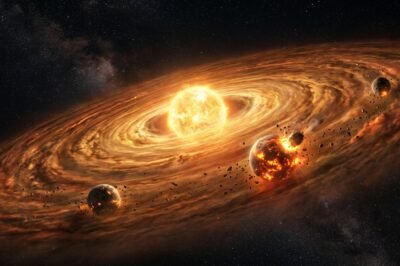
The vast expanse of our solar system has always been a subject of profound curiosity, acting as a cosmic puzzle where every planet serves as a unique piece of a grand narrative. For decades, the prevailing question among planetary scientists has been why Earth and Mars, two neighboring rocky worlds, ended up so vastly different despite their proximity and shared history. A groundbreaking study recently highlighted by The Economic Times has shed new light on this celestial mystery, confirming that while Earth and Mars were born from the same foundational cloud of gas and dust—known as the solar nebula—the intricate processes of their formation diverged significantly. This revelation not only reshapes our understanding of our own planetary home but also provides a vital blueprint for searching for life elsewhere in the galaxy. The story of their birth is a complex tale of chemical signatures, gravitational tug-of-wars, and the violent early days of a young Sun that dictated the fates of its orbiting children.
Understanding the common origin of these two planets requires a deep dive into the earliest milliseconds of the solar system’s life. Roughly 4.6 billion years ago, a massive molecular cloud collapsed under its own gravity, giving rise to the Sun and a surrounding disk of debris. Within this swirling protoplanetary disk, tiny grains of dust collided and stuck together, eventually forming larger bodies known as planetesimals. Recent isotopic analysis suggests that the raw materials used to build Earth and Mars were remarkably similar, drawing from a reservoir of inner solar system matter. However, the study points out that the ‘recipe’ for each planet involved slightly different proportions of these ingredients, combined with distinct timing in their accretion phases. This nuance is where the divergence began, turning one world into a lush, blue marble and the other into a cold, red desert.
The Protoplanetary Cradle: A Shared Chemical Heritage
The core of the study revolves around the analysis of isotopes—variants of chemical elements that serve as cosmic fingerprints. By examining the isotopic composition of meteorites from Mars and comparing them with terrestrial rocks, researchers have been able to trace the lineage of the material that formed these planets. It was discovered that both Earth and Mars are primarily composed of material that originated in the inner solar system, specifically from a region close to the Sun where temperatures were high enough to boil off volatile gases. This shared heritage suggests that the building blocks of the inner rocky planets were not as diverse as previously thought, but rather drawn from a relatively homogenous pool of silicate-rich dust.
Despite this shared start, the research indicates that the accretion process—the way these planets gathered mass—was not identical. Earth, being larger and more massive, continued to grow for a longer period than Mars. This extended growth phase allowed Earth to sweep up a wider variety of materials, including a significant contribution from the outer solar system beyond the ‘snow line.’ These outer solar system materials were rich in water and organic compounds, which were crucial for the eventual development of life. Mars, on the other hand, appears to have finished its primary growth much earlier, effectively becoming a ‘planetary embryo’ that stopped developing before it could reach the size or complexity of Earth.
Isotopic Variance and the Fingerprints of Formation
One of the most fascinating aspects of the study is the focus on specific isotopes of elements like oxygen, titanium, and chromium. These isotopes provide a timeline of when and where specific materials were added to the growing planets. The research highlights that while the bulk of both planets came from the same ‘inner’ reservoir, Earth shows a higher enrichment of certain isotopes that are associated with carbonaceous chondrites—meteorites that originate from the outer, colder regions of the solar system. This suggest that Earth was more efficient at ‘mixing’ materials from across the protoplanetary disk than its smaller neighbor.
This mixing was likely driven by the gravitational influence of giant planets like Jupiter. As Jupiter moved through the early solar system, its massive gravity acted as a stir-stick, flinging water-rich asteroids and comets into the inner solar system. Earth, with its larger gravitational footprint, was able to capture more of this material. Mars, situated further out but being much smaller, lacked the gravitational ‘muscle’ to attract as much of this late-stage enrichment. This explains why Earth has such a vast amount of surface water compared to the relatively desiccated state of Mars today. The study emphasizes that the difference in mass was not just a matter of size, but a defining factor in chemical evolution.
Mars as a Planetary Embryo: The Growth Stunt
A central finding of the research is the classification of Mars as a ‘planetary embryo.’ In the early solar system, thousands of these embryos formed within a few million years. Most of them either collided to form larger planets like Earth and Venus or were ejected from the system. Mars, however, survived as a relic of this early stage. The study suggests that Mars completed about 90% of its growth within a mere 2 to 10 million years after the solar system’s birth. In contrast, Earth took much longer—upwards of 100 million years—to reach its final mass, punctuated by the cataclysmic impact that formed the Moon.
This rapid formation meant that Mars cooled down much faster than Earth. Its internal heat, driven by the decay of radioactive isotopes, dissipated before it could sustain a long-term global magnetic field or plate tectonics. Without a magnetic field to protect it, the Martian atmosphere was slowly stripped away by solar winds, turning a once potentially habitable world into a frozen wasteland. This ‘stunted growth’ is the primary reason why Mars and Earth, despite being made of the same dust, have such radically different geological and atmospheric profiles today. The study underscores that the timing of planetary birth is just as important as the materials available.
Thermal Evolution and the Core-Mantle Divide
The study also delves into the thermal history of the two planets, explaining how their internal structures diverged. Earth’s larger size meant it retained more heat from its formation and from the impacts of late-stage planetesimals. This heat kept Earth’s interior molten for longer, facilitating the process of differentiation, where heavier elements like iron sank to the center to form a massive core, while lighter silicates formed the mantle and crust. This sustained heat is what powers the mantle convection and plate tectonics that still reshape Earth’s surface today, recycling carbon and maintaining a stable climate.
Mars, being smaller, had a different thermal trajectory. Its smaller core solidified much earlier. The study indicates that the Martian mantle did not experience the same level of vigorous convection as Earth’s. As a result, Mars never developed a system of plate tectonics. Instead, it became a ‘one-plate’ planet, where volcanic activity was concentrated in a few massive areas like the Tharsis Bulge. The Economic Times report notes that understanding these thermal differences is key to explaining why Earth remains geologically active while Mars has become largely dormant. The shared dust provided the same elements, but the planetary volume dictated how that energy was spent over billions of years.
The Impact of the Outer Solar System
Another layer of the study focuses on the role of ‘volatile’ delivery. Volatiles are elements and compounds that evaporate easily, such as water, nitrogen, and carbon dioxide. While the ‘inner’ dust cloud was poor in these substances, the ‘outer’ cloud was rich in them. The research confirms that Earth received a ‘veneer’ of this outer material late in its formation. This late accretion was vital for creating the oceans and the atmosphere. Because Earth and Mars were born in the same general vicinity, it was previously assumed they would have similar volatile budgets, but the study proves otherwise.
The isotopic signatures show that Earth’s ‘outer’ material contribution was significantly higher in proportion than that of Mars. This suggests that the dynamics of the early solar system were highly chaotic, with ‘pockets’ of material being distributed unevenly. The study posits that Earth’s position and its larger mass allowed it to better sample the diversity of the solar nebula. This finding is revolutionary because it suggests that the habitability of a planet is not just determined by its distance from its star (the ‘Goldilocks Zone’) but by the specific sequence of material accretion it experiences during its formative millions of years.
Implications for the Search for Life and Future Exploration
The conclusions of this study have far-reaching implications for astrobiology and the future of space exploration. By proving that Earth and Mars formed from the same material but reached different ends due to growth dynamics, scientists can better predict the habitability of exoplanets. We now know that finding a planet of Earth’s size in the habitable zone is only part of the equation; we must also consider its accretion history and whether it had the opportunity to incorporate volatile-rich material from its outer system. This research provides a new set of criteria for identifying ‘Earth 2.0’ among the thousands of planets discovered orbiting other stars.
Furthermore, this study bolsters the importance of upcoming Mars sample return missions. By bringing Martian rocks back to Earth, scientists can perform even more precise isotopic analyses to confirm these findings and further unravel the history of our solar system. Understanding why Mars failed to become another Earth helps us appreciate the rare and delicate balance of factors that make our own planet hospitable. As we look toward colonizing Mars or exploring the icy moons of Jupiter, these insights into our shared origins provide the essential context for our place in the universe. The shared dust of our birth reminds us that all planets in our system are part of one family, yet their individual journeys have made them worlds apart.






































Leave a Reply