
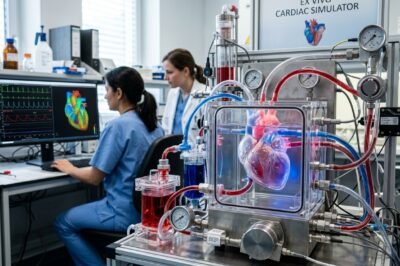
The human heart is perhaps the most sophisticated and resilient pump ever designed, beating approximately 100,000 times a day to sustain life. Yet, despite decades of medical advancement, cardiovascular diseases remain the leading cause of mortality worldwide, claiming millions of lives annually. Traditionally, the approach to cardiac intervention has been a complex mixture of high-resolution imaging, clinical intuition, and standardized procedures that, while effective, often fail to account for the minute anatomical nuances of the individual patient. However, a seismic shift is occurring in the field of cardiology. As reported by the European Medical Journal (EMJ), the emergence of ex vivo cardiac simulators (EVCS) is poised to redefine the boundaries of personalized medicine. These sophisticated systems allow for the functional replication of a patient’s heart outside the body, providing a bridge between theoretical diagnosis and precision surgical execution. By simulating the unique hemodynamic and biomechanical environment of a specific individual, medical professionals can now rehearse interventions with a level of fidelity that was previously relegated to the realm of science fiction. This article explores how these simulators are transforming the landscape of cardiovascular care, offering a deeper look into the technology, its clinical applications, and the future it promises.
The Technological Foundation of Ex Vivo Cardiac Simulators
Ex vivo cardiac simulators represent a convergence of fluid mechanics, bioengineering, and high-performance computing. At their core, these systems are designed to maintain a heart—or a high-fidelity synthetic replica of one—in a functional state that mimics the physiological conditions found within the human chest. Unlike static 3D models or simple computer simulations, EVCS systems provide a dynamic environment where pulsatile blood flow, pressure gradients, and metabolic demands are meticulously controlled. This is achieved through a complex network of pumps, sensors, and oxygenators that circulate blood-mimicking fluids through the cardiac chambers and vascular structures.
The engineering behind these devices is nothing short of extraordinary. Researchers use advanced polymers and hydrogels to create heart models that possess the same tensile strength and elasticity as human tissue. These models are often integrated with actual biological components, such as porcine or human valves, to test the interaction between synthetic implants and living tissue. By replicating the exact resistance and compliance of the systemic circulation, EVCS systems allow clinicians to see how a heart responds to stress, medication, or surgical modification in real-time. This dynamic feedback loop is essential for understanding the functional impact of structural heart diseases, such as hypertrophic cardiomyopathy or complex valvular regurgitation.
Precision Planning: The Rise of the Digital and Physical Twin
The true power of ex vivo cardiac simulators lies in their ability to facilitate patient-specific modeling. In current clinical workflows, a patient undergoes CT or MRI scans, which provide a static snapshot of their anatomy. While 3D reconstruction of these images is helpful, it does not show how the heart functions under different physiological loads. EVCS technology changes this by allowing for the creation of a “physical twin.” Using data from high-resolution imaging, engineers can 3D-print an anatomically exact replica of a patient’s heart, including any calcifications or structural abnormalities, and place it into the simulator.
This allows surgeons to perform a “dry run” of a procedure before the patient ever enters the operating room. For instance, in complex transcatheter aortic valve replacements (TAVR), the exact placement of the device is critical. A few millimeters of deviation can lead to paravalvular leakage or obstruction of the coronary arteries. By testing multiple device sizes and positions within the simulator, the surgical team can identify the optimal strategy tailored to that specific patient’s anatomy. This reduces the time spent under anesthesia, minimizes intraoperative complications, and significantly improves long-term outcomes. The ability to predict a patient’s response to an intervention with near-perfect accuracy is the cornerstone of the next generation of cardiovascular care.
Accelerating Innovation in Medical Device Development
Beyond individual patient care, ex vivo cardiac simulators are revolutionizing the way medical devices are developed and approved. Traditionally, the path from concept to clinical use for a new heart valve or stent involves extensive animal testing and large-scale clinical trials. While animal models provide valuable biological data, their anatomy and hemodynamics are often significantly different from those of humans. This discrepancy can lead to unforeseen failures when a device is finally transitioned to human subjects. EVCS systems offer a more reliable and ethically sound alternative by providing a high-fidelity human-centric testing platform.
Manufacturers can now subject their devices to thousands of cycles of use in a simulated environment that perfectly mimics the human cardiovascular system. This allows for the identification of fatigue points, flow disturbances, and potential thrombogenic issues early in the design phase. Furthermore, regulatory bodies like the FDA and EMA are increasingly recognizing the data generated by these simulators as valid evidence for safety and efficacy. By reducing the reliance on animal models and streamlining the testing process, EVCS technology is significantly shortening the development cycle for life-saving technologies, ensuring that the latest innovations reach the bedside faster than ever before.
Integrating Artificial Intelligence and Machine Learning
The integration of Artificial Intelligence (AI) into ex vivo cardiac simulators is the next frontier in this technological evolution. While the hardware provides the physical environment, AI provides the analytical brain. Machine learning algorithms are now being used to analyze the vast amounts of data generated during a simulation session. These algorithms can identify subtle patterns in fluid dynamics or wall stress that might be invisible to the human eye. For example, AI can predict the long-term risk of heart failure by analyzing how a simulated heart responds to varying degrees of arterial stiffness.
Moreover, AI-driven simulations can explore thousands of different surgical scenarios in a matter of minutes. By combining the physical feedback from the EVCS with the computational power of AI, clinicians can receive real-time recommendations on the best course of action. This synergy between physical simulation and digital intelligence creates a comprehensive diagnostic ecosystem. As these AI models become more refined through the ingestion of global clinical data, their predictive power will only grow, making them indispensable tools for both routine and complex cardiac cases. The transition from reactive treatment to proactive, data-driven prevention is becoming a reality through this technological convergence.
Economic Impact and the Future of Healthcare Systems
Implementing ex vivo cardiac simulation technology into standard hospital workflows does carry a significant initial cost, but the long-term economic benefits are substantial. Cardiovascular complications are among the most expensive events for healthcare providers, often involving prolonged ICU stays, repeat surgeries, and lifelong medication. By improving the success rate of the initial intervention and reducing the incidence of complications, EVCS can lead to massive savings for healthcare systems. Hospitals that adopt these technologies can expect shorter patient recovery times and a more efficient use of operating room resources.
Furthermore, as the technology matures and becomes more widespread, the cost of manufacturing simulators and 3D-printing patient-specific models is expected to decrease. We are moving toward a future where every major cardiac center will have an in-house simulation lab. In this future, the “standard of care” will involve a personalized simulation for every complex procedure. This democratization of advanced technology will ensure that high-quality, personalized cardiovascular care is not just a luxury for elite institutions but a baseline expectation for patients worldwide. The shift toward value-based care, where outcomes are prioritized over the volume of procedures, aligns perfectly with the capabilities of ex vivo simulators.
Conclusion: The Dawn of a New Era in Cardiology
The insights provided by the European Medical Journal highlight a pivotal moment in medical history. Ex vivo cardiac simulators are no longer just experimental tools; they are the precursors to a more humane, precise, and effective form of medicine. By allowing us to visualize, simulate, and refine our approach to the heart, these devices are removing the guesswork from some of the most critical decisions a doctor can make. The journey from general treatments to truly personalized care is fraught with challenges, but the path is now clearly illuminated by the glow of simulator screens and the steady rhythm of ex vivo pulses.
As we look forward, the potential for these simulators to integrate with regenerative medicine and gene therapy offers even more exciting possibilities. Imagine a world where a patient’s own stem cells are used to grow a heart patch, which is then tested and perfected in a simulator before being implanted. The possibilities are as vast as the human imagination. Ultimately, the goal of ex vivo cardiac simulators is to ensure that every heart has the best possible chance to keep beating, supported by the full weight of modern technology and the precision of personalized science. The era of personalized cardiovascular care has arrived, and it is beating with more strength and clarity than ever before.






































Leave a Reply