
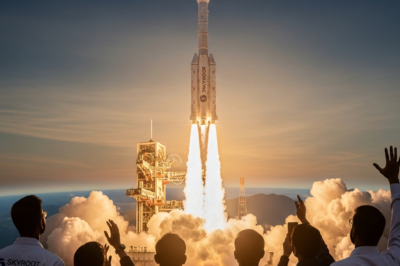
In a historic moment that marks a paradigm shift in the global space economy, India has successfully launched its first privately developed orbital-class rocket, Vikram-1. Developed by the Hyderabad-based startup Skyroot Aerospace, the Vikram-1 mission represents more than just a successful flight; it signifies the definitive arrival of the Indian private sector on the world stage of high-stakes aerospace engineering. For decades, space exploration in India was the exclusive domain of the Indian Space Research Organisation (ISRO). However, following the 2020 space sector reforms initiated by the Government of India, the doors were flung open for private enterprise. This successful deployment of technology payloads and symbolic postcards into orbit is the culmination of years of rigorous engineering, 3D-printing breakthroughs, and a vision to democratize access to the stars. The roar of the Vikram-1 engines over the Satish Dhawan Space Centre (SDSC-SHAR) at Sriharikota was not merely a sound of propulsion but a signal of India’s burgeoning capability to provide low-cost, reliable, and high-frequency access to Low Earth Orbit (LEO). As the rocket pierced the atmosphere, it carried the dreams of thousands of engineers and the strategic aspirations of a nation looking to capture a significant share of the multi-billion-dollar global space market.
The Evolution of Skyroot Aerospace and the Path to Vikram-1
The journey of Skyroot Aerospace is a testament to the power of innovation and the changing landscape of Indian tech entrepreneurship. Founded in 2018 by former ISRO scientists Pawan Kumar Chandana and Bharath Daka, Skyroot has moved with unprecedented speed in the aerospace sector. To understand the significance of Vikram-1, one must look back at the ‘Prarambh’ mission in November 2022. That mission saw the successful launch of Vikram-S, a sub-orbital technology demonstrator that proved the company could manage the complexities of ignition, separation, and trajectory. However, the transition from a sub-orbital flight to an orbital mission like Vikram-1 is an exponential leap in complexity. An orbital rocket must achieve significantly higher velocities (approximately 28,000 km/h) to maintain a stable orbit, requiring sophisticated multi-stage separation and precise guidance systems. Vikram-1 was designed as a multi-stage launch vehicle capable of carrying payloads of up to 300 kilograms to Low Earth Orbit. This capability places Skyroot in a select group of global private entities, alongside the likes of SpaceX and Rocket Lab, that possess the technical prowess to deliver functional satellites into space.
Engineering a Marvel: Technical Specifications and 3D-Printing Innovation
What sets Vikram-1 apart from traditional rockets is its extensive use of cutting-edge materials and manufacturing techniques. The rocket is an all-carbon-fiber-bodied vehicle, which significantly reduces its structural mass compared to traditional aluminum or steel-based designs. This weight efficiency allows for a higher payload-to-weight ratio, a critical factor in the economics of space launch. One of the most remarkable features of Vikram-1 is its propulsion system. The rocket utilizes the ‘Kalam’ series of solid-fuel motors for its initial stages, which are known for their reliability and ease of handling. The upper stage, however, features the ‘Raman’ engines, named after the Nobel laureate Sir C.V. Raman. These engines are 3D-printed using advanced metal alloys, allowing for complex internal cooling channels that would be impossible to manufacture using traditional methods. This 3D-printing capability not only speeds up production time but also drastically reduces the number of components, thereby minimizing the potential points of failure. The mission also tested the integration of the ‘Dhruva-1’ payload interface, showcasing a modular approach that can accommodate various satellite sizes and configurations, making Vikram-1 a versatile choice for the rapidly growing small-satellite market.
The Payload Symphony: Technology Demonstrators and Cosmic Postcards
The successful mission was not just about the vehicle, but the precious cargo it carried into the silence of space. The payload for Vikram-1 included several technology demonstrators from domestic and international partners, showcasing the commercial viability of the platform. Among the most heartwarming and socially significant payloads were the thousands of postcards sent by students as part of an initiative by Space Kidz India. These postcards, collected from children across the country, were sent into orbit to inspire the next generation of scientists, engineers, and dreamers. Beyond the symbolism, the mission successfully deployed functional tech payloads that will conduct experiments in microgravity and test new communication protocols. These satellites are designed to monitor environmental changes, improve connectivity in remote areas, and test the resilience of new-age electronics in the harsh radiation environment of space. By successfully placing these payloads into their precise target orbits, Skyroot has demonstrated its ability to provide ‘last-mile’ delivery services in space, a capability that is in high demand as the world moves toward mega-constellations of satellites for global internet and earth observation.
Strategic Impact on the Global Space Economy and the Role of IN-SPACe
The success of Vikram-1 is a massive win for India’s strategic positioning in the global space economy. Currently, the global space market is valued at over $400 billion, and India’s share is estimated at around 2-3%. The Indian government aims to increase this to 10% or more by 2030. Achieving this target requires more than just ISRO’s heavy-lift capabilities; it requires a fleet of private launch providers that can offer rapid-turnaround missions for the burgeoning Small Satellite Launch Vehicle (SSLV) market. The role of the Indian National Space Promotion and Authorization Centre (IN-SPACe) cannot be overstated in this achievement. As a single-window nodal agency, IN-SPACe provided Skyroot with access to ISRO’s world-class facilities, including launch pads and tracking stations, while also facilitating the necessary regulatory clearances. This public-private partnership model is becoming the gold standard for how nations can accelerate their space programs. By lowering the barriers to entry, India is attracting venture capital into the deep-tech sector, creating high-value jobs, and ensuring that the country remains at the forefront of the Fourth Industrial Revolution.
Future Outlook: Scaling to Vikram-2, Vikram-3, and Beyond
Skyroot Aerospace is not resting on the laurels of the Vikram-1 success. The company has already unveiled an ambitious roadmap that includes the development of Vikram-2 and Vikram-3. These upcoming iterations will feature even greater payload capacities and more advanced propulsion systems, including cryogenic engines that use liquid oxygen and methane as propellants. These “green” propellants are more efficient and leave less of a carbon footprint, aligning with global trends toward sustainable space exploration. Furthermore, Skyroot is exploring reusability technologies, aiming to land its first-stage boosters back on Earth to be refurbished and flown again. This approach, pioneered by SpaceX, is essential for driving down the cost of space access even further. The success of Vikram-1 also paves the way for India to become a global hub for small satellite launches, offering a cost-effective alternative to European and American providers. As Skyroot scales its operations, we can expect to see more frequent launches, perhaps even reaching a cadence of one launch per month, which would revolutionize how Indian startups and international companies look at deploying space-based assets.
Conclusion: A New Chapter for Indian Innovation
The successful orbital flight of Vikram-1 is a defining moment in India’s technological history. It proves that the spirit of innovation, when backed by supportive government policy and world-class heritage, can achieve the impossible. This mission has shattered the glass ceiling for private aerospace companies in the Global South, proving that space is no longer the final frontier only for superpowers, but a domain where agile, tech-driven startups can thrive. As Vikram-1 circles the Earth, carrying the aspirations of a billion people, it serves as a reminder that the sky is no longer the limit. The success of Skyroot Aerospace will undoubtedly inspire a wave of new startups in sectors ranging from space-based manufacturing to lunar logistics. For India, the journey has just begun, and the successful placement of payloads and postcards into orbit by Vikram-1 is the first of many steps toward a future where India is a dominant, sustainable, and innovative force in the celestial arena.






































Leave a Reply