
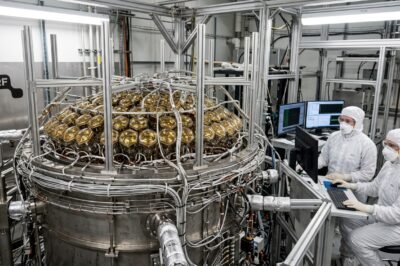
The universe is a vast expanse of mystery, where the visible matter—the stars, planets, and galaxies we see—accounts for a mere five percent of the total mass-energy content. The remaining ninety-five percent is divided between dark energy and the enigmatic substance known as dark matter. For decades, physicists have sought to catch a glimpse of this invisible glue that holds the cosmos together. The LUX-ZEPLIN (LZ) experiment, a collaborative marvel of modern science, has recently announced the detection of a mysterious event that offers a tantalizing new hint of dark matter’s true nature. Located 4,850 feet beneath the surface in the Black Hills of South Dakota, the LZ detector is designed to be the world’s most sensitive instrument for finding Weakly Interacting Massive Particles (WIMPs). This latest finding, detailed in a report from AZoQuantum, represents a significant milestone in our quest to solve one of the greatest puzzles in science. As the scientific community pores over the data, the excitement is palpable; we may be on the verge of a breakthrough that would fundamentally alter our understanding of the laws of physics and the history of the universe itself. The sheer precision required to detect these interactions is mind-boggling, requiring an environment almost entirely free of terrestrial radiation. SUBHEADING: The Engineering Marvel of the LUX-ZEPLIN Experiment – The LUX-ZEPLIN detector is not just a piece of equipment; it is a masterpiece of modern engineering and physics. At its core, the LZ experiment utilizes seven tonnes of ultra-pure liquid xenon contained within a massive titanium cryostat. Xenon is used because it is a noble gas with a high atomic number, providing a dense target for potential dark matter particles to hit. When a particle interacts with a xenon atom, it produces a tiny flash of light and releases a few electrons. These signals are then picked up by 494 photomultiplier tubes (PMTs) that line the top and bottom of the xenon chamber. To protect the experiment from the constant barrage of cosmic radiation that hits the Earth’s surface, the entire apparatus is buried nearly a mile underground in the Sanford Underground Research Facility (SURF). This depth provides a natural shield of rock, reducing the interference from cosmic rays by a factor of several million. Additionally, the xenon vessel is submerged in a 238-tonne tank of pure water and surrounded by an outer detector designed to identify and ‘veto’ any signals caused by known particles like neutrons or gamma rays. This multi-layered approach makes the LZ experiment the ‘quietest’ place on Earth for particle detection. SUBHEADING: Dissecting the Mysterious Low-Energy Signal – The recent announcement centers on a series of low-energy electron recoil events that the LZ detector has observed. In the world of particle physics, data is often divided into ‘nuclear recoils,’ which are expected from WIMPs, and ‘electron recoils,’ which can be caused by a variety of sources, including solar neutrinos or background radiation. The detection of an excess of these electron recoil events is particularly intriguing because it mirrors a signal previously reported by the XENON1T experiment. While the origin of this signal remains a mystery, it could point toward several exciting possibilities. It might be evidence of solar axions—hypothetical particles produced in the Sun that are candidates for dark matter—or it could indicate an unexpected property of neutrinos, such as a magnetic moment larger than predicted by the Standard Model. The statistical significance of this detection is being scrutinized with extreme care. Physicists use a rigorous ‘blind’ analysis method, where the data is kept hidden from the researchers until the software and selection criteria are finalized. This prevents any human bias from influencing the results. The fact that LZ has confirmed a potential anomaly in this energy range suggests that we are looking at a real physical phenomenon rather than a statistical fluke. SUBHEADING: The Search for Weakly Interacting Massive Particles (WIMPs) – While the mysterious low-energy signal has captured headlines, the primary mission of LZ remains the search for WIMPs. These theoretical particles are ‘weakly interacting’ because they rarely collide with normal matter, and ‘massive’ because they are heavy enough to explain the gravitational effects observed in galaxies. The current run of the LZ experiment has set the most stringent limits to date on the interaction cross-section of WIMPs. Essentially, LZ has narrowed the ‘hiding place’ for dark matter more than any other experiment in history. By failing to see a definitive WIMP signal in the nuclear recoil channel, scientists can rule out a vast range of theoretical models, forcing theorists to refine their ideas about what dark matter could be. The sensitivity of LZ is so high that it is now approaching the ‘neutrino floor’—a point where the detector will become so sensitive that it will start picking up the background noise of neutrinos from the sun and distant supernovae. This threshold represents the ultimate limit of current detection technology, and reaching it will require new methods to distinguish between dark matter and the constant ‘fog’ of neutrinos. SUBHEADING: Theoretical Implications and the Standard Model – The detection of an anomaly that doesn’t fit perfectly into our current theories is exactly what physicists hope for. The Standard Model of particle physics, while incredibly successful, is known to be incomplete. it does not account for gravity, and it offers no explanation for dark matter or dark energy. If the signal detected by LZ is indeed linked to axions or a new neutrino property, it would represent the first direct evidence of physics ‘Beyond the Standard Model’ (BSM). Axions, in particular, are a favorite among theorists because they solve two problems at once: they provide a viable candidate for dark matter and they explain the ‘strong CP problem’ in quantum chromodynamics. If LZ can confirm the existence of axions, it would be a Nobel Prize-level discovery. Furthermore, the mysterious signal could suggest that dark matter is more complex than a single type of particle. Some models propose a ‘dark sector’ with its own forces and multiple particle types, much like the visible world. This would explain why simple WIMP searches have yet to produce a ‘smoking gun’ result. SUBHEADING: Global Collaboration and the Future of Discovery – The success of the LUX-ZEPLIN experiment is a testament to the power of international scientific collaboration. The project involves over 250 scientists and engineers from 35 institutions across the United States, the United Kingdom, Portugal, and South Korea. This global effort is necessary to manage the immense costs and technical challenges associated with such a high-stakes experiment. As LZ continues its science run, which is expected to last for several more years, the volume of data will grow, allowing for even more precise measurements. The competition in this field is fierce but productive, with other experiments like XENONnT in Italy and PandaX-4T in China also pushing the boundaries of sensitivity. This ‘friendly rivalry’ ensures that results are cross-checked and verified by independent teams, which is a cornerstone of the scientific method. Looking ahead, the next generation of experiments, such as the proposed XLZH (a merger of the LZ and XENON collaborations), aims to build even larger detectors to explore the neutrino floor and beyond. SUBHEADING: Conclusion on Future Implications – The mysterious events detected by the LUX-ZEPLIN experiment represent the frontier of human knowledge. Whether these signals turn out to be the first evidence of axions, a new property of neutrinos, or an unexpected background, they provide a vital roadmap for the future of physics. Every data point collected by LZ brings us closer to understanding the invisible framework of our universe. If we can eventually identify the dark matter particle, we will finally be able to map the distribution of mass in the cosmos with total accuracy and understand how galaxies formed in the early universe. This search is about more than just particles; it is about answering the fundamental question of what the universe is made of and how we fit into its grand design. The mystery remains for now, but with LZ leading the charge, the darkness is beginning to reveal its secrets. As we look toward the next decade of research, the potential for a paradigm-shifting discovery has never been higher, promising a new era of astro-particle physics.
Stories





-

Hunkkaar Teaser Analysis: Aneet Padda’s Gritty Transformation and the Evolving Landscape of Indian Thrillers
-

Mithila Palkar: The Relatable Queen of Indian Web Series and Her Meteoric Rise
-

Wamiqa Gabbi: The Meteoric Rise of Indian Web Series’ Most Versatile Leading Lady
-

Triptii Dimri Biography: The Evolution of India’s Newest Cinematic Sensation and Web Series Star
-

Wamiqa Gabbi: The Rise of India’s New Digital Icon and the Future of OTT Stardom
-

Mithila Palkar: The Unstoppable Evolution of India’s Digital Darling and Her Journey to the Silver Screen
-

Mithila Palkar: The Comprehensive Journey of India’s Web Series Sensation and Digital Pioneer
-

Mithila Palkar: The Relatable Queen of Indian Web Series and Her Inspiring Journey to Stardom
-

Sobhita Dhulipala Biography: The Meteoric Rise of India’s Most Versatile Web Series Star
-

Mithila Palkar: The Unstoppable Journey of India’s Digital Darling and Web Series Queen
-

Triptii Dimri: The Complete Biography of India’s Newest Cinematic Sensation and Web Series Icon
-

Wamiqa Gabbi: The Ethereal Rise of India’s Most Versatile Web Series Star
-

Sobhita Dhulipala: The Unstoppable Rise of India’s Most Versatile Web Series Icon
-

Wamiqa Gabbi: The Meteoric Rise of the New Queen of Indian Web Series and Her Unstoppable Journey to Stardom
-

Triptii Dimri: The Meteoric Rise of India’s New Cinema Sweetheart and Web Series Icon
-

Wamiqa Gabbi: The Versatile Queen of Indian OTT and Her Phenomenal Rise to Stardom
-

Tripti Dimri Biography: The Rise of India’s New National Crush and Her Journey from Laila Majnu to OTT Stardom
-

Wamiqa Gabbi Biography: The Meteoric Rise of India’s Newest OTT Sensation and Versatile Powerhouse
-

Wamiqa Gabbi Biography: The Meteoric Rise of the Digital Queen of Indian Web Series
-

The Rise of Wamiqa Gabbi: A Deep Dive into the Journey of India’s Most Versatile OTT Sensation
-

The Meteoric Rise of Triptii Dimri: Biography, Acting Prowess, and the Journey of India’s Newest Cinema Sensation

Launching Soon: The Future of News with Our E-Newspaper
In the ever-evolving landscape of media and technology, we are thrilled to announce the upcoming launch of our innovative e-newspaper, set to redefine the way news is consumed in the digital age. Embracing the convenience and accessibility that the digital world offers, our e-newspaper aims to deliver real-time news updates, insightful articles, and interactive features directly to your devices. With a commitment to journalistic integrity and a passion for storytelling, we are dedicated to keeping you informed, engaged, and connected, no matter where you are. Stay tuned for the launch of our e-newspaper, where the future of news awaits at your fingertips.
Recent News
- India vs Malaysia LIVE score, Asian Games 2026 men’s hockey final: Harmanpreet Singh’s Early Lead and Tactical Masterclass

- Comprehensive Analysis: Asian Games 2026 Wrestling – India’s Schedule, Medal Prospects, and Global Standings

- Jr. NTR Takes Stand Against AI Misuse: A Comprehensive Analysis of the ‘Chuttamalle’ Deepfake Controversy

- Stroke Care Delays Increased Globally During COVID-19 Pandemic – European Medical Journal Analysis

- Deep Analysis: Nayara Energy Hikes Petrol and Diesel Prices Amid 2026 Global Energy Shifts

- Asian Games 2026 Wrestling Day 3 Live: Susaki, Sujeet, Zare in Action – United World Wrestling

Politics
- Deep Analysis: Nayara Energy Hikes Petrol and Diesel Prices Amid 2026 Global Energy Shifts
- Mamata Banerjee Allegations: A Deep Dive into the ‘Hijacking’ of the Electoral Process

- Trump to Host Zuckerberg and AI Titans: A Seismic Shift in Tech Governance and Global Strategy

- 9 Pak Soldiers Killed After First Woman Unit Of Baloch Rebels Attack Convoy: A Deep Dive Analysis

- Donald Trump At UN General Assembly: Make Deal Or Drive Iran Into Hell? – A Comprehensive Geopolitical Analysis

- Supreme Court Critiques ‘Machine-Generated’ Delhi SIR Notices: A Deep Dive into Judicial Concerns over Automated Governance

Categories
- Art & Culture 103
- Auto 85
- Beauty 15
- Blog 292
- Books 7
- Business 359
- Celebrities 217
- Crime Files 139
- Democracy 308
- Education 84
- Entertainment 154
- Environment 133
- epaper 1
- Fashion 37
- Food 59
- Gadgets 87
- Guide 150
- Handicrafts 11
- Health 278
- Healthy Living 107
- History 5
- incidents 163
- Lifestyle 41
- Music 7
- Photography 15
- Politics 441
- Science & Technology 160
- Sports 264
- Tech 133
- Television 2
- Travel 68
- Travel & Tourism 30
- Trends 50
- Weather 8
- Web Series 97
- Workout 4
- World 661
Leave a Reply