
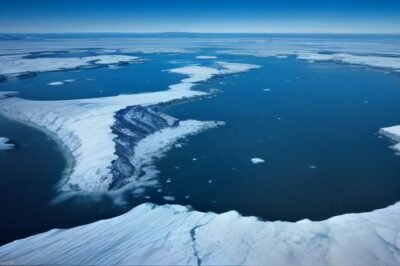
The Arctic circle has long been regarded as the sentinel of global climate stability, a frozen expanse that regulates temperatures and oceanic currents across the entire planet. However, the silence of this icy frontier was recently shattered by a geological event of staggering proportions: the calving of a Manhattan-sized ice island from the Petermann Glacier in North Greenland. This event is not merely a localized phenomenon but a loud, clear signal of the accelerating shifts within our biosphere. For decades, the Petermann Glacier has been one of the primary conduits through which the Greenland Ice Sheet drains into the sea, but the frequency and scale of these calving events have reached a critical threshold. As this massive slab of ice, spanning roughly 50 square miles, drifts into the Nares Strait, it carries with it significant implications for sea-level rise, ocean salinity, and the future of glaciology. This analysis delves deep into the mechanics of this detachment, the historical context of the Petermann Glacier, and what this portends for the global community as we navigate an era of unprecedented environmental flux. The scale of the loss is hard to visualize for the average person, but when compared to one of the most densely populated urban centers on Earth, the gravity of the situation becomes undeniably stark. This introduction marks the beginning of a comprehensive examination into the fracturing of our northern ice shields. The Petermann Glacier serves as a massive floating tongue of ice that extends from the interior of Greenland into the ocean, acting as a natural brake that slows the flow of inland ice. When this tongue fractures and releases large islands, the ‘braking’ effect is diminished, allowing the glacier to flow faster into the sea. The 2012 event, and subsequent fractures, highlight a pattern of instability that scientists have been tracking with increasing concern. To understand the scale of the Petermann Glacier disruption, one must look at the dimensions of the ice involved. The recent calving produced an island approximately 130 square kilometers in size. For context, Manhattan is roughly 59 square kilometers, making this ice island more than twice the size of the iconic New York City borough. Such a massive loss of ice volume is a direct consequence of both atmospheric warming and, perhaps more critically, the warming of the ocean waters that circulate beneath the glacier’s floating shelf. This dual-threat mechanism creates a feedback loop where the ice is being attacked from both above and below. Satellite imagery from NASA and the European Space Agency has captured the precise moment of the rift, showing how a long-standing crack finally propagated across the entire width of the glacier. The detachment of such a large mass can lead to a surge in the velocity of the remaining glacier, as the physical resistance provided by the ice shelf is removed. This acceleration is a primary driver of the Greenland Ice Sheet’s contribution to global sea-level rise, which currently accounts for a significant percentage of the annual increase in ocean height. Understanding the mechanisms of glacial calving requires a look at the ‘grounding line,’ the point where the glacier transitions from sitting on the bedrock to floating on the ocean. As warmer Atlantic water penetrates deep into the fjords of Greenland, it erodes the base of the glacier at this grounding line. This process, known as basal melting, thins the ice shelf from below, making it much more susceptible to fracturing. In the case of Petermann, the floating shelf was once much more extensive, but decades of thinning have rendered it fragile. When ocean tides and internal pressures from the glacier’s downward flow combine, the structural integrity of the ice fails. This isn’t just about ‘melting’ in the traditional sense; it is about mechanical failure driven by thermal stress. The historical precedents for this event are equally alarming. In 2010, the Petermann Glacier lost an even larger chunk of ice, roughly 250 square kilometers, which was four times the size of Manhattan. The fact that another massive event has occurred relatively soon after suggests that the glacier is entering a period of rapid retreat. Historically, large calving events at Petermann occurred every few decades; however, the interval between these events is shrinking, suggesting a shift from a stable state to a state of chronic instability. Data correlation between these events and rising global mean temperatures shows a tight relationship, proving that the Arctic is warming at more than twice the global average. The role of ocean-ice interaction cannot be overstated. The Arctic Ocean is no longer the isolated, frigid reservoir it once was. Instead, it is being increasingly influenced by ‘Atlantification,’ a process where warmer, saltier water from the Atlantic Ocean moves northward. This warm water is denser and sinks below the surface layer of cold Arctic water, placing it in direct contact with the underside of floating glaciers like Petermann. This hidden erosion is often more destructive than surface melting because it occurs year-round, regardless of the seasonal air temperature. Global implications of these calving events extend far beyond the borders of Greenland. As more freshwater enters the North Atlantic, it threatens to disrupt the Atlantic Meridional Overturning Circulation (AMOC), the system of currents that brings warmth to Europe and regulates weather patterns in the Western Hemisphere. A massive influx of freshwater can ‘freshen’ the surface water, preventing it from sinking and thereby slowing the entire conveyor belt of ocean currents. This could lead to more extreme weather events, including colder winters in Europe and more intense hurricanes in the Atlantic. Furthermore, the loss of Arctic ice reduces the ‘albedo effect,’ where white ice reflects sunlight back into space. Darker ocean water absorbs more heat, further warming the planet. Satellite monitoring has become our most vital tool in studying these changes. Instruments such as ICESat-2 and the GRACE-FO mission allow glaciologists to measure changes in ice height and mass with millimeter precision. These tools have revealed that Greenland is losing billions of tons of ice annually, a rate that was unthinkable just fifty years ago. The future of glaciology now relies on real-time data to predict when the next major calving event will occur and how much it will contribute to the rising tides that threaten coastal cities from Miami to Shanghai. In conclusion, the Manhattan-sized ice island that broke away from the Petermann Glacier is a physical manifestation of a changing world. It is a reminder that the boundaries of our environment are fluid and that the stability we have enjoyed for millennia is under threat. The future implications are clear: we must expect more frequent and more severe calving events as the climate continues to warm. This requires not only a global commitment to reducing greenhouse gas emissions but also a strategic approach to coastal adaptation. The Petermann Glacier is a giant in retreat, and its movement is a harbinger of the challenges that lie ahead for humanity in an age of rising seas and shifting ice.
Massive Calving Event: Analyzing the Manhattan-Sized Ice Island Detachment from Greenland’s Petermann Glacier
Posted by
Stories





-

Hunkkaar Teaser Analysis: Aneet Padda’s Gritty Transformation and the Evolving Landscape of Indian Thrillers
-

Mithila Palkar: The Relatable Queen of Indian Web Series and Her Meteoric Rise
-

Wamiqa Gabbi: The Meteoric Rise of Indian Web Series’ Most Versatile Leading Lady
-

Triptii Dimri Biography: The Evolution of India’s Newest Cinematic Sensation and Web Series Star
-

Wamiqa Gabbi: The Rise of India’s New Digital Icon and the Future of OTT Stardom
-

Mithila Palkar: The Unstoppable Evolution of India’s Digital Darling and Her Journey to the Silver Screen
-

Mithila Palkar: The Comprehensive Journey of India’s Web Series Sensation and Digital Pioneer
-

Mithila Palkar: The Relatable Queen of Indian Web Series and Her Inspiring Journey to Stardom
-

Sobhita Dhulipala Biography: The Meteoric Rise of India’s Most Versatile Web Series Star
-

Mithila Palkar: The Unstoppable Journey of India’s Digital Darling and Web Series Queen
-

Triptii Dimri: The Complete Biography of India’s Newest Cinematic Sensation and Web Series Icon
-

Wamiqa Gabbi: The Ethereal Rise of India’s Most Versatile Web Series Star
-

Sobhita Dhulipala: The Unstoppable Rise of India’s Most Versatile Web Series Icon
-

Wamiqa Gabbi: The Meteoric Rise of the New Queen of Indian Web Series and Her Unstoppable Journey to Stardom
-

Triptii Dimri: The Meteoric Rise of India’s New Cinema Sweetheart and Web Series Icon
-

Wamiqa Gabbi: The Versatile Queen of Indian OTT and Her Phenomenal Rise to Stardom
-

Tripti Dimri Biography: The Rise of India’s New National Crush and Her Journey from Laila Majnu to OTT Stardom
-

Wamiqa Gabbi Biography: The Meteoric Rise of India’s Newest OTT Sensation and Versatile Powerhouse
-

Wamiqa Gabbi Biography: The Meteoric Rise of the Digital Queen of Indian Web Series
-

The Rise of Wamiqa Gabbi: A Deep Dive into the Journey of India’s Most Versatile OTT Sensation
-

The Meteoric Rise of Triptii Dimri: Biography, Acting Prowess, and the Journey of India’s Newest Cinema Sensation

Launching Soon: The Future of News with Our E-Newspaper
In the ever-evolving landscape of media and technology, we are thrilled to announce the upcoming launch of our innovative e-newspaper, set to redefine the way news is consumed in the digital age. Embracing the convenience and accessibility that the digital world offers, our e-newspaper aims to deliver real-time news updates, insightful articles, and interactive features directly to your devices. With a commitment to journalistic integrity and a passion for storytelling, we are dedicated to keeping you informed, engaged, and connected, no matter where you are. Stay tuned for the launch of our e-newspaper, where the future of news awaits at your fingertips.
Recent News
- A Century-Old Physics Effect Just Got a New Dimension – SciTechDaily

- US Open 2026: Elena Rybakina wins her first title and rises to world No. 1 – olympics.com

- Neena Gupta’s Empowerment Masterclass: Navigating Body-Shaming and Intrusive Life Questions

- Why Apple’s iPhone Duo Costs Nearly Rs 1 Lakh More in India Than in the US: A Deep Dive

- Kiara Advani joins viral 1980s AI trend: 5 ChatGPT prompts to create retro Bollywood photos – The Indian Express

- Scientists Unveil the Microscopic Masterpiece: How a Tiny Protein Region Orchestrates the Strength of Tooth Enamel

Politics
- Sanjeev Sanyal’s Stand: Why ‘Dhurandhar’ Is a Cultural Narrative, Not Propaganda

- Strategic Reshuffle: Analyzing the Impact of Sachin Pilot Replacing Bhupesh Baghel in Punjab

- The Pentagon’s High-Stakes Hunt: Mass Polygraph Tests and the Investigation into the Iran War Data Leak

- PM Modi Recycles Half Water-Half Air Line At Shri Ram College, 13 Years After Big Launch Speech – NDTV
- The India-Iran-USA Triad: Deciphering the Geopolitical Fallout of the Modi-Pezeshkian Meeting

- Rupee gains 47 paise as record FCNR inflows boost forex liquidity – The Times of India

Categories
- Art & Culture 101
- Auto 85
- Beauty 15
- Blog 270
- Books 7
- Business 359
- Celebrities 217
- Crime Files 139
- Democracy 308
- Education 84
- Entertainment 154
- Environment 133
- epaper 1
- Fashion 37
- Food 58
- Gadgets 86
- Guide 150
- Handicrafts 11
- Health 268
- Healthy Living 107
- History 5
- incidents 158
- Lifestyle 40
- Music 6
- Photography 15
- Politics 433
- Science & Technology 160
- Sports 243
- Tech 124
- Television 2
- Travel 68
- Travel & Tourism 30
- Trends 44
- Weather 8
- Web Series 97
- Workout 4
- World 655
Leave a Reply