
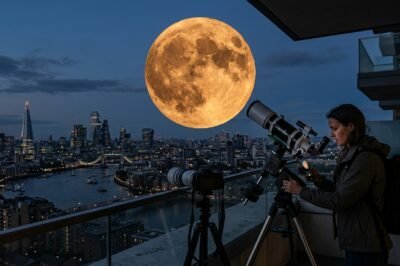
As we cast our gazes toward the infinite velvet canvas of the night sky, few celestial bodies command as much reverence and scientific curiosity as the Moon. On September 25, 2026, the lunar cycle reaches a breathtaking crescendo that promises to captivate both professional astronomers and casual stargazers alike. This date marks a significant moment in the 2026 astronomical calendar, as it coincides with the emergence of the Full Harvest Moon. Historically, the Harvest Moon is the full moon that occurs closest to the autumnal equinox, providing farmers with extra light during the late summer and early autumn evenings to bring in their crops. In the modern era, however, this event serves as a focal point for global scientific observation and a moment of quiet reflection for humanity. The sheer brilliance of the lunar disk on this night is not merely a visual delight; it is a testament to the precise clockwork of our solar system. Understanding what the Moon will look like on this specific date requires a deep dive into orbital mechanics, atmospheric conditions, and the historical context that makes the September lunar display a perennial favorite. For those who track the lunar phases with meticulous detail, September 25, 2026, represents a pinnacle of natural beauty, offering a clear view of our closest neighbor in its most luminous state. This analysis explores the technical and aesthetic dimensions of the moon as it prepares to illuminate the world once more.
The Astronomical Majesty of the Full Harvest Moon
On September 25, 2026, the Moon will be in its full phase, meaning its entire earth-facing side will be fully illuminated by the Sun. This phenomenon occurs when the Moon is positioned exactly opposite the Sun from the perspective of an observer on Earth. The result is a perfect circle of light that dominates the night sky from sunset to sunrise. Scientifically, this alignment is known as syzygy, a term that describes the linear configuration of three celestial bodies. In the case of the Full Moon, the Earth sits between the Sun and the Moon, allowing the solar rays to strike the lunar surface directly without any shadowing from the perspective of our planet.
What makes the September 2026 Full Moon particularly special is its designation as the Harvest Moon. Unlike most full moons that rise approximately 50 minutes later each day, the Harvest Moon rises closer to the time of sunset for several consecutive evenings in the Northern Hemisphere. This is due to the angle of the Moon’s orbit relative to the Earth’s horizon during the autumnal equinox. In 2026, observers will notice a shorter-than-average delay between sunset and moonrise, creating a sense of prolonged twilight and early evening brightness. This unique timing is a major factor in the moon’s cultural legacy, as it historically provided the luminosity necessary for agricultural labor long after the sun had dipped below the horizon. On this specific night, the moon will reach 100% illumination, casting deep shadows across the lunar maria and highlighting the rugged textures of its cratered landscape.
Understanding the Mechanics: Why September 25, 2026, Matters
The mechanics behind the moon phase on September 25, 2026, are rooted in the complex dance of the lunar cycle, which lasts approximately 29.5 days. By the time we reach this date, the moon will have transitioned through its waxing phases—crescent, first quarter, and gibbous—to reach its maximum brightness. The specific timing of the full moon on this day is calculated with extreme precision by agencies like NASA and the Royal Observatory. For the 2026 cycle, the moon will reach its exact point of opposition at a specific UTC time, though to the naked eye, it will appear full for nearly three days. This period of peak visibility is critical for scientists who utilize the full moon to study lunar albedo, which is the measure of how much light the moon reflects.
Furthermore, the position of the Moon in its elliptical orbit significantly influences its appearance. While every full moon is beautiful, some are larger and brighter due to being at perigee (the closest point to Earth), while others are smaller at apogee. On September 25, 2026, the Moon will be at a distance that provides a standard yet exceptionally clear visual profile. Detailed spectroscopic analysis during this phase allows researchers to identify mineral compositions within the lunar soil, as the direct sunlight provides the necessary energy for reflective signatures. For the general public, understanding these mechanics transforms a simple observation into a profound appreciation for the gravitational forces that dictate the tides of our oceans and the stability of our planet’s axial tilt.
The Visual Spectacle: Surface Features and Illumination
When looking at the Moon on September 25, 2026, observers will be treated to a vivid display of lunar geography. Because the moon is fully illuminated, the shadows that usually define the edges of craters are largely absent, making the lunar maria—the large, dark basaltic plains—the most prominent features. These regions, such as the Sea of Tranquility (Mare Tranquillitatis) and the Sea of Rain (Mare Imbrium), contrast sharply against the lighter, rugged highlands. During this full phase, the moon’s surface takes on a flatter, more two-dimensional appearance, which actually highlights the variations in mineral color and reflectivity across the entire disk.
Another striking visual element on this night will be the rays of the Tycho crater. Tycho is a relatively young crater, and during a full moon, the bright streaks of ejecta that fan out from its center become highly visible. These rays stretch across thousands of kilometers of the lunar surface, looking like white spokes on a giant wheel. To see these details, one does not necessarily need a high-powered telescope; even a standard pair of binoculars will reveal the intricate patterns of the moon’s crust. The sheer brightness of the moon on September 25 will also affect the surrounding sky, often washing out the light from fainter stars and nebulae, making the moon the undisputed monarch of the nocturnal firmament. It is a time when the lunar surface becomes a map of history, documenting billions of years of cosmic impacts.
Practical Observation: Navigating the 2026 Night Sky
For those planning to witness the moon phase today on September 25, 2026, preparation is key to a rewarding experience. The moon will rise in the east shortly after sunset and will reach its highest point in the sky around midnight. To get the best view, it is recommended to find a location with a clear eastern horizon, away from the intense light pollution of major urban centers. While the moon is bright enough to be seen from almost anywhere, the true depth of its features is best appreciated in darker skies where atmospheric clarity is higher. High altitudes or open coastal areas often provide the most stable air for viewing, reducing the “twinkling” effect caused by atmospheric turbulence.
Photographers looking to capture the 2026 Harvest Moon should consider several technical factors:
- Exposure Settings: Because the full moon is surprisingly bright, a fast shutter speed is required to avoid overexposure.
- Lens Choice: A focal length of at least 300mm is recommended to fill the frame with lunar detail.
- Stabilization: A sturdy tripod is essential, especially when using long lenses or slower shutter speeds for landscape-lunar shots.
- The Moon Illusion: Capturing the moon as it rises near the horizon can make it appear much larger than it does when it is high in the sky, a psychological phenomenon that makes for stunning photography.
By utilizing these techniques, enthusiasts can document the specific atmospheric colors—ranging from deep orange to pale white—that the moon exhibits as it climbs through the Earth’s atmosphere.
The Intersection of Culture, History, and Lunar Cycles
The significance of the moon on September 25, 2026, extends beyond pure science into the realm of human culture and history. Since the dawn of civilization, the lunar cycle has served as the foundation for calendars, religious festivals, and navigational systems. The Harvest Moon, in particular, holds a special place in the folklore of many Northern Hemisphere cultures. In East Asia, this time corresponds with the Mid-Autumn Festival, a period of family reunions and the sharing of mooncakes. In Western traditions, the Harvest Moon has been immortalized in song and literature as a symbol of abundance and the transition from summer’s warmth to autumn’s chill.
Historically, the study of the moon’s phases was the first step toward modern astronomy. Ancient civilizations in Mesopotamia, Egypt, and Mesoamerica recorded the movements of the moon with startling accuracy, using its cycles to predict seasonal changes. The event on September 25, 2026, is a continuation of this human tradition of sky-watching. It serves as a reminder that despite our technological advancements, we are still intrinsically linked to the rhythms of the natural world. In an age dominated by digital screens, the simple act of looking up at the full moon provides a shared global experience, connecting people across borders and time zones through a single, universal visual reference.
Future Implications: Beyond the 2026 Lunar Observation
Looking ahead from the lunar phase of September 25, 2026, the implications for lunar science are more profound than ever. This date falls within a critical window for international space agencies as they ramp up efforts for the Artemis program and other lunar exploration missions. Observations of the full moon are not just for aesthetics; they provide essential data for landing site selection and the study of the lunar environment. As we move closer to establishing a permanent human presence on the Moon, understanding the nuances of the lunar cycle becomes a matter of operational necessity. The light levels observed during a full moon like the one in September 2026 are vital for calibrating solar panels and visual sensors for autonomous lunar rovers.
Furthermore, the 2026 Harvest Moon serves as a precursor to future lunar eclipses and rare celestial alignments. Scientists will use the data collected during this period to further refine our models of the Earth-Moon system’s evolution. As we continue to develop more sophisticated ground-based and space-based telescopes, our ability to resolve finer details on the lunar surface during full illumination will only improve. The moon remains our most accessible laboratory for understanding the history of the solar system, and every full moon cycle provides a fresh opportunity to unlock its secrets. Ultimately, the view of the moon on September 25, 2026, is a bridge between our storied past and a future where the moon may one day become a second home for humanity, ensuring that its phases remain a central focus of our collective curiosity for generations to come.






































Leave a Reply