
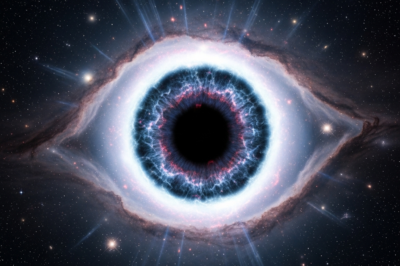
In a groundbreaking revelation from the James Webb Space Telescope (JWST), NASA researchers have identified a puzzling new class of celestial objects that appear as intense red dots across the deep expanse of space. These objects, which have captivated the scientific community, defy current astrophysical models. Most strikingly, one specific formation has been described as a ‘Huge Evil Eye,’ a haunting visual that suggests a structure far more complex than a standard star or galaxy.
The Discovery of the Red Dots
Initial data suggests that these red dots represent a previously unknown class of objects from the early universe. While some astronomers theorize they could be supermassive black holes shrouded in thick cosmic dust, others believe they might be ultra-compact galaxies containing hundreds of millions of stars packed into a tiny area. The ‘Evil Eye’ appearance is likely the result of gravitational lensing or unique light-refraction patterns, but the sheer scale and intensity of the crimson hue remain a subject of intense debate.
What Are These Unknown Objects?
This discovery challenges our fundamental understanding of how the first structures in the cosmos were formed and evolved over billions of years. As NASA continues to analyze the light signatures from these objects, the scientific world waits for confirmation on whether these represent a new phase of stellar evolution or something entirely unexpected. The ‘Evil Eye’ is not just a visual curiosity; it is a gateway to understanding the raw, unpolished history of our universe.
The Future of Deep Space Observation
Continued observations with the JWST are expected to shed more light on these crimson mysteries, potentially rewriting the textbooks on cosmic history. As we peer further into the darkness, the appearance of these unknown objects reminds us that the universe still holds secrets that are as terrifying as they are beautiful.






































Leave a Reply