
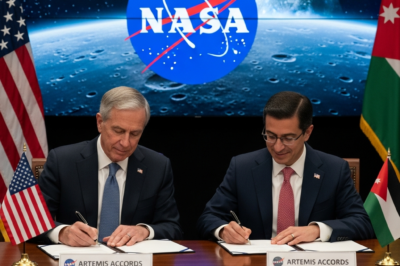
In a move that underscores the burgeoning international interest in lunar exploration and the expansion of the global space community, NASA has officially extended an invitation to members of the media to witness the formal signing of the Artemis Accords by the Hashemite Kingdom of Jordan. This significant event, set to take place at NASA Headquarters in Washington, D.C., represents a pivotal moment for Middle Eastern diplomacy and scientific advancement. As the world pivots toward a sustainable human presence on the Moon, the inclusion of Jordan highlights a strategic shift in NASA’s approach to coalition-building. The Artemis Accords, which serve as a non-binding set of principles designed to guide civil space exploration and use in the 21st century, are increasingly becoming the bedrock of international space law and cooperation. By joining this elite group of nations, Jordan not only signals its commitment to the peaceful use of outer space but also positions its domestic scientific and educational institutions at the forefront of the next great era of human discovery. This ceremony is more than just a formal signing; it is a testament to the power of shared vision and the universal appeal of reaching for the stars.
The Artemis Accords: A Blueprint for the Future of Space
Established in 2020 by NASA in coordination with the U.S. Department of State, the Artemis Accords are built upon the foundation of the 1967 Outer Space Treaty. Their primary objective is to create a safe, transparent, and predictable environment for space activities as NASA and its partners work to return humans to the lunar surface through the Artemis program. The accords cover a wide range of essential principles, including the public release of scientific data, the protection of lunar heritage sites, the mitigation of orbital debris, and the interoperability of systems. Interoperability is particularly crucial; as multiple nations and private entities develop lunar hardware, ensuring that different technologies can work together is vital for safety and efficiency. Furthermore, the accords emphasize the importance of emergency assistance, mandating that signatories provide aid to astronauts in distress, regardless of their nationality. By formalizing these expectations, NASA aims to prevent the types of territorial disputes and environmental degradation that have historically plagued terrestrial exploration. The addition of Jordan brings a fresh perspective to these discussions, ensuring that the development of space norms is truly a global endeavor rather than a project limited to a few traditional spacefaring powers.
Jordan’s Strategic Entry into the Lunar Coalition
Jordan’s decision to sign the Artemis Accords is the culmination of years of quiet but steady investment in its technological and educational sectors. Under the leadership of King Abdullah II and the Crown Prince Foundation, Jordan has actively promoted STEM education and fostered partnerships with international space agencies. The nation has already seen its students participate in prestigious internships at NASA, and its universities have begun incorporating space science into their curricula. By joining the Artemis Accords, Jordan is opening doors for its researchers to collaborate on high-stakes missions, such as the development of lunar habitats or the analysis of lunar regolith. This move also serves as a beacon for other nations in the Levant and beyond, demonstrating that size and historical involvement in space are not barriers to participation in the Artemis era. Jordan’s involvement is expected to catalyze a new wave of innovation within the kingdom, attracting venture capital to its growing tech startups and providing a platform for Jordanian engineers to solve the unique challenges of the lunar environment, such as radiation shielding and life-support systems.
The Role of NASA and International Diplomacy
NASA Administrator Bill Nelson has been a vocal advocate for expanding the Artemis Accords, viewing space exploration as a unique tool for soft power and international bridge-building. Under his tenure, the number of signatories has grown rapidly, spanning every continent and representing a diverse array of economic and political systems. The U.S. Department of State plays a critical role in this process, working through diplomatic channels to explain the benefits of the accords and ensure that they align with international law. For Jordan, the signing ceremony is a high-profile validation of its status as a key regional partner for the United States. It reinforces the bilateral relationship between the two nations, extending their cooperation from traditional security and economic issues into the high-tech frontier of space. The invitation to the media signifies NASA’s intent to maximize the visibility of this partnership, showcasing the broad, inclusive nature of the Artemis program. This transparency is a key tenet of the accords themselves, as it builds public trust and fosters a sense of global ownership over the mission to return to the Moon and eventually journey to Mars.
Technical and Scientific Implications of the Partnership
From a technical standpoint, Jordan’s participation in the Artemis Accords opens up numerous avenues for scientific exchange. One of the core tenets of the accords is the commitment to share scientific data openly. This means that Jordanian scientists will have unprecedented access to the data generated by NASA’s lunar missions, allowing them to conduct independent research on lunar geology, atmosphere, and resource availability. This data sharing is a two-way street; Jordan may contribute specific expertise in areas such as remote sensing, communications, or materials science. Furthermore, the accords address the sensitive issue of space resources. As nations look to extract water ice from the lunar south pole for life support and fuel, the accords provide a framework for doing so in a way that respects the rights of others and avoids conflict. Jordan’s involvement in these discussions ensures that the voices of non-traditional space actors are heard as the rules for resource utilization are written. This is essential for the long-term sustainability of the lunar economy, which many experts believe will eventually include mining, manufacturing, and even tourism.
Strengthening the Middle Eastern Presence in Space
Jordan follows in the footsteps of other Middle Eastern nations like the United Arab Emirates, Saudi Arabia, and Bahrain, which have also signed the Artemis Accords. This trend indicates a regional realization that the future of economic competitiveness and national prestige is inextricably linked to the space sector. The UAE, for instance, has already made significant strides with its Mars Hope Probe and its lunar rover project. Jordan’s entry into this coalition adds another layer of regional stability and cooperation. It creates opportunities for intra-regional partnerships, where Middle Eastern nations can share resources and expertise to pursue joint space objectives. This “space rush” in the Middle East is not just about competition; it is about transformation. It is about moving economies away from a reliance on fossil fuels and toward high-tech, knowledge-based industries. The Artemis Accords provide the legal and ethical scaffolding for this transformation, ensuring that as these nations reach for the Moon, they do so in a manner that is consistent with international peace and security.
Looking Ahead: The Artemis Mission Roadmap
The signing of the accords by Jordan comes at a critical juncture in the Artemis mission timeline. With the success of Artemis I, which tested the Space Launch System (SLS) rocket and the Orion spacecraft in an uncrewed flight around the Moon, NASA is now focused on Artemis II. This mission will carry a crew of four astronauts around the Moon, marking the first time humans have left Earth’s orbit in over half a century. Following that, Artemis III aims to land the first woman and the first person of color on the lunar surface. Jordan’s involvement starts at a time when the focus is shifting from testing to operations. As NASA builds the Gateway—a small space station that will orbit the Moon and serve as a communication hub and temporary home for astronauts—international partners will play an increasingly vital role. Whether through contributing components, providing scientific payloads, or assisting in ground operations, nations like Jordan will be integral to the mission’s success. The ultimate goal is to use the lessons learned on the Moon to prepare for the first human mission to Mars, a journey that will require the collective effort of all humanity.
Conclusion: A Universal Mission
In conclusion, the invitation for the media to attend the Jordan Artemis Accords signing ceremony is a significant milestone in the history of space exploration. It marks the expansion of a global vision that transcends national borders and cultural differences. By signing these accords, Jordan is not just joining a NASA program; it is joining a global movement dedicated to the responsible exploration of the cosmos. The principles of transparency, peace, and cooperation enshrined in the accords are essential for ensuring that the benefits of space exploration are shared by all of humanity. As we look toward a future where humans live and work on other worlds, the inclusion of diverse voices and talents is our greatest strength. Jordan’s step onto the global space stage is a reminder that the stars belong to everyone, and that by working together, we can overcome the greatest challenges of our time, both on Earth and in the vast expanse of the universe.






































Leave a Reply