
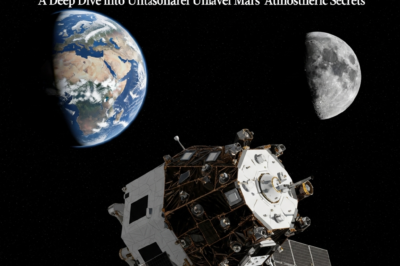
In an age where space exploration is becoming increasingly routine, every so often, a mission provides a perspective that stops us in our tracks. NASA’s latest endeavor, the Escape and Plasma Acceleration and Dynamics Explorers (ESCAPADE) mission, has done just that. While on its long journey toward the Red Planet, the spacecraft turned its sophisticated gaze back toward home, capturing a breathtakingly rare view of Earth and the Moon. These images, captured in both visible and thermal infrared spectrums, are not merely aesthetic achievements; they represent a critical milestone in the mission’s health checks and a profound reminder of our place in the cosmic neighborhood. As the twin spacecraft, affectionately named Blue and Gold, hurtle through the void of space, this family portrait serves as a testament to human ingenuity and the burgeoning field of cost-effective, high-impact planetary science. This article delves into the technical specifics of the ESCAPADE mission, the significance of these infrared captures, and the high-stakes science that awaits at Mars.
The ESCAPADE Mission: A New Paradigm in Martian Research
The ESCAPADE mission represents a significant shift in how NASA approaches planetary exploration. Traditionally, Martian missions have been massive, multi-billion-dollar undertakings involving car-sized rovers or bus-sized orbiters. ESCAPADE, however, belongs to the class of SmallSat missions. It consists of two identical spacecraft, Blue and Gold, developed by the University of California, Berkeley’s Space Sciences Laboratory in partnership with Rocket Lab. This dual-satellite approach is vital for the mission’s primary objective: understanding the dynamic response of the Martian magnetosphere to the solar wind. By having two vantage points, scientists can perform multi-point measurements, allowing them to distinguish between spatial changes and temporal variations in the plasma environment around Mars. This is a first for Martian research. The mission is part of NASA’s Heliophysics Division and is a key component of the Small Innovative Missions for Planetary Exploration (SIMPLEx) program. The choice of two satellites allows for a stereo view of the Martian environment, which is essential because the solar wind is a highly variable and turbulent stream of charged particles that interacts with the planet in unpredictable ways. By utilizing two identical platforms, the mission can observe how a single solar wind event affects different parts of the Martian atmosphere simultaneously, providing a level of detail that single-spacecraft missions simply cannot match.
The Cosmic Snapshot: Earth and Moon in a New Light
The recently released images were captured using the spacecraft’s star trackers and thermal infrared imaging systems. While many are familiar with visible light photography, thermal infrared offers a unique window into the temperature profiles and composition of celestial bodies. By viewing Earth and the Moon in this spectrum, the ESCAPADE team was able to verify the calibration of their instruments. These sensors are designed to detect the faint signatures of plasma and the heat signatures of the Martian atmosphere. Seeing the Earth as a glowing orb of heat against the absolute cold of space provides a high-contrast environment perfect for testing sensor sensitivity. The visible light images, on the other hand, provide a classical Blue Marble perspective, but from a distance few human-made objects ever reach. These photographs were taken while the spacecraft were in their cruise phase, thousands of miles away from Earth, demonstrating that the systems are functioning exactly as intended after the rigors of launch. The infrared data is particularly interesting because it highlights the heat retained by the Earth’s atmosphere and the stark temperature difference on the Moon’s surface between the illuminated and shadowed sides. For the science team, these images are more than just pictures; they are data points confirming that the spacecraft’s thermal management systems and scientific detectors are ready for the extreme environment of Mars. The clarity of the images suggests that the optics have remained pristine despite the vibrations of the launch process, which is a major relief for the mission engineers.
Technological Marvels: Rocket Lab and the SmallSat Revolution
One cannot discuss ESCAPADE without mentioning the role of Rocket Lab. The California-based company provided the Photon spacecraft buses that house the scientific instruments. This partnership highlights the increasing reliance of NASA on the private sector to provide reliable, low-cost platforms for scientific research. The Photon bus is a highly versatile platform that handles power, communications, and propulsion, allowing the UC Berkeley team to focus entirely on the scientific instruments. This commercial-off-the-shelf approach significantly reduces the cost of entry for planetary missions, potentially opening the door for a fleet of small satellites to explore every corner of the solar system. The successful capture of Earth and the Moon by these buses confirms that private-sector technology can meet the stringent requirements of deep-space navigation and imaging. Furthermore, the integration of high-gain antennas and advanced propulsion systems into such a small form factor is a triumph of modern engineering. Rocket Lab has demonstrated that it can move from Earth-orbit missions to interplanetary trajectories, positioning itself as a key player in the future of space logistics. The ESCAPADE spacecraft are equipped with monopropellant engines that will allow them to perform the critical Mars Orbit Insertion (MOI) burn. The success of this mission will validate the Photon platform for future deep-space endeavors, including potential missions to Venus or the asteroid belt.
The Martian Atmospheric Mystery: Why We Study Plasma Escape
Why go to Mars to study plasma? The answer lies in the history of the Martian atmosphere. Scientists believe that billions of years ago, Mars was a much warmer, wetter world with a thick atmosphere that could have supported life. Today, it is a frozen desert with an atmosphere less than 1% as thick as Earth’s. The primary culprit for this transformation is the solar wind. Because Mars lacks a global magnetic field like Earth’s, its atmosphere is directly exposed to the sun’s high-energy particles. Over eons, the solar wind has stripped the atmosphere away, causing it to leak into space. ESCAPADE’s mission is to observe this process in real-time. By measuring how energy and momentum are transferred from the solar wind to the Martian ionosphere, the mission aims to provide a comprehensive model of how the Martian climate has evolved over 4 billion years. This process of atmospheric escape is not unique to Mars, but because Mars provides a simplified laboratory without a complex global magnetosphere, it is the perfect place to study the physics of plasma interactions. The data from Blue and Gold will be used to create high-fidelity simulations of how planetary atmospheres are eroded. This research is crucial for understanding not only our own solar system but also the thousands of exoplanets we have discovered orbiting other stars. If a planet cannot hold onto its atmosphere, it cannot sustain liquid water, and therefore, it cannot support life as we know it.
The Journey Ahead: Trajectory and Launch Mechanics
The journey to Mars is never simple. ESCAPADE’s trajectory involves complex orbital mechanics to ensure that both Blue and Gold arrive at the Red Planet simultaneously but in slightly different orbital positions. The spacecraft are currently in their cruise phase, a period of several months where they travel through interplanetary space. During this time, mission controllers at UC Berkeley and Rocket Lab are constantly monitoring the health of the onboard systems. The Earth-Moon image was part of a de-risking strategy. By testing the cameras and thermal sensors now, the team ensures that they will be ready to go the moment the spacecraft enter Martian orbit. The mission is also a trail-blazer for the launch vehicle, being slated for one of the early flights of Blue Origin’s New Glenn rocket. This underscores the mission’s role at the cutting edge of the new space economy, where new rockets and new satellite platforms converge. The orbital insertion at Mars is particularly tricky because the two satellites must be placed into a specific elliptical orbit that allows them to pass through the same plasma structures at different times. This string-of-pearls configuration is what enables the multi-point measurement strategy. Engineers must account for the gravitational pull of Mars, the pressure of the solar wind on the spacecraft’s solar panels, and the precise timing of engine burns to ensure the mission’s success.
Global Implications for Space Exploration and Planetary Defense
The implications of ESCAPADE extend beyond just Mars. The data gathered will help scientists understand the habitability of planets orbiting other stars. If we can understand why Mars lost its atmosphere, we can better predict which exoplanets might be able to retain their own. Furthermore, the technology demonstrated by ESCAPADE—the use of twin SmallSats for deep space—will likely become a blueprint for future missions. It proves that we don’t always need massive, expensive missions to answer the biggest questions in science. The image of our Earth and Moon, seen through the eyes of two small probes on their way to another world, is a poignant symbol of this new era of exploration. It bridges the gap between our home and our future destination, reminding us that every step we take into the dark is powered by the light of our own world. In addition to scientific discovery, the mission provides valuable data for planetary defense and space weather forecasting. The interaction between the solar wind and planetary magnetic fields is what causes geomagnetic storms on Earth, which can disrupt power grids and satellite communications. By studying these interactions at Mars, we gain a more generalized understanding of how to protect our own infrastructure from solar activity. ESCAPADE is a bridge mission, connecting the physics of the sun to the geology of the planets, and its success will mark a turning point in the democratization of space access.
Concluding Thoughts: A New Era of Discovery
As ESCAPADE continues its silent trek toward the Red Planet, the images of Earth and the Moon remain as a benchmark of success. They represent the perfect alignment of academic research, private enterprise, and government vision. When Blue and Gold finally reach Mars and begin their intricate dance around the planet, they will carry with them the legacy of this initial look back. The data they collect will fill a massive gap in our understanding of planetary evolution and the sun’s influence on the solar system. For now, we can marvel at the sight of our home, a fragile blue and white marble, as seen by the next generation of explorers heading into the unknown. The journey of ESCAPADE is a reminder that while our technology grows ever more sophisticated, our curiosity remains as fundamental as it was when the first astronomers looked at the stars. This mission is not just about Mars; it is about understanding the fundamental processes that govern our universe and ensuring that we are prepared for whatever challenges the cosmic environment may throw our way.






































Leave a Reply