
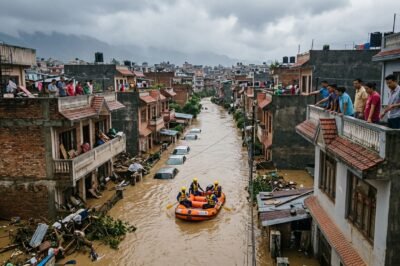
The roar of the Bagmati River has become a haunting soundtrack for the residents of Kathmandu and surrounding districts as Nepal grapples with one of the most catastrophic monsoon-induced disasters in its modern history. What began as a seasonal downpour has escalated into a full-blown humanitarian crisis, leaving a trail of destruction that has severed vital transportation links, leveled homes, and claimed hundreds of lives. The latest reports from the ground indicate that the situation remains extremely volatile, with the Department of Hydrology and Meteorology issuing fresh flood alerts as water levels in major river basins continue to surge past the danger mark. This is not merely a story of bad weather; it is a grim testament to the increasing vulnerability of the Himalayan region to extreme climatic events. For days, the relentless rain has transformed narrow streets into rushing torrents and peaceful hillsides into deadly mudslides. As the nation enters a critical phase of rescue and recovery, the international community watches with bated breath, recognizing that the scale of this disaster may redefine disaster management protocols for the entire South Asian subcontinent. This deep-dive analysis explores the immediate aftermath, the geographical extent of the damage, and the long-term implications for a nation caught in the crosshairs of a changing climate. The current monsoon season has defied traditional patterns, delivering an intensity of rainfall that has overwhelmed even the most robust drainage systems in the capital. The sheer volume of water cascading from the mountains has turned the Terai plains into an inland sea, while the middle hills face the constant threat of landslips that isolate entire villages from the outside world. In the following sections, we break down the statistical reality of the floods, the government response, and the science that explains why this particular event has been so uniquely devastating. H2: The Unprecedented Scale of the 2024 Monsoon Fury. The statistical magnitude of the recent rainfall is nothing short of staggering. In several districts, including Kavrepalanchowk, Lalitpur, and Makwanpur, meteorological stations recorded over 300mm of rain within a 24-hour window—a volume that typically accounts for a significant portion of the entire monthly average. This concentrated burst of precipitation triggered immediate flash floods, leaving little time for evacuation. The Bagmati River, which flows through the heart of the Kathmandu Valley, reached its highest level in decades, breaching embankments and inundating heritage sites, residential colonies, and commercial hubs. The rapid rise in water levels was exacerbated by the topography of the valley, which acts as a natural basin. Beyond the capital, the Koshi River—often referred to as the ‘Sorrow of Bihar’ for its impact on downstream India—showed dangerously high discharge rates, forcing authorities to open all 56 gates of the Koshi Barrage for the first time in years. This maneuver, while necessary to prevent the dam’s failure, has created a secondary crisis in the plains, highlighting the transboundary nature of Himalayan water management. H2: District-Wise Breakdown and the Infrastructure Collapse. The impact of the floods has not been uniform, with some districts bearing a disproportionate share of the tragedy. In Kavrepalanchowk, landslides have buried entire clusters of houses, making it the hardest-hit region in terms of casualties. Meanwhile, the Kathmandu Valley saw unprecedented urban flooding that submerged luxury hotels and low-income settlements alike, proving that water is a great equalizer in its path of destruction. Transportation infrastructure has suffered a near-total collapse in the affected zones. The Prithvi Highway, the primary artery connecting Kathmandu to the rest of the country, was blocked at multiple points by massive debris flows, trapping thousands of travelers in their vehicles. Bridges, some built decades ago and others more recent, have been swept away like toothpicks, effectively severing the supply chain for essential goods, including food, clean water, and medical supplies. The telecommunications network has also taken a hit, with fiber optic cables severed and mobile towers losing power, leaving many survivors unable to call for help or inform their families of their safety. H2: Human Toll and the Socio-Economic Impact. As the water begins to recede in some areas, the true cost of the disaster is coming into focus. The death toll has surpassed 200, with dozens more still reported missing. Behind these numbers are families who have lost everything—from their loved ones to their life savings stored in the form of livestock and grain. The economic impact is estimated to be in the billions of Nepalese Rupees. Agriculture, the backbone of the Nepalese economy, has been devastated. Thousands of hectares of paddy fields, ready for harvest, now lie under layers of silt and sand, jeopardizing food security for the coming year. Small businesses in urban centers have seen their inventory destroyed by muddy water, and the tourism sector, vital for Nepal’s foreign exchange, faces a wave of cancellations as travelers perceive the region as unsafe. The psychological trauma on the survivors, particularly children who witnessed the power of the floods, is an invisible but heavy burden that will require years of social intervention to heal. H2: Government Response and the Challenges of Rescue. The Government of Nepal has mobilized all available resources, including the Nepal Army, the Armed Police Force, and the Nepal Police, for search and rescue operations. Using rubber boats and helicopters, personnel have rescued thousands of stranded individuals from rooftops and isolated ridges. However, the scale of the disaster has stretched these resources to their limit. High winds and poor visibility have frequently grounded aerial rescue efforts, while flooded roads have prevented heavy machinery from reaching landslide sites where survivors might still be trapped under debris. Criticisms have emerged regarding the adequacy of early warning systems and the lack of urban planning that allows construction on floodplains. While the government did issue alerts, many residents argue that the gravity of the situation was not sufficiently communicated, or that they had no safe place to go once the waters began to rise. The coordination between local, provincial, and federal authorities remains a work in progress, highlighting the need for a more decentralized and better-equipped disaster response framework. H2: The Transboundary Connection: Implications for India. The floods in Nepal are not a localized event; they have significant ramifications for neighboring India, specifically the state of Bihar. As Nepal opens the gates of its barrages to manage the inland pressure, the volume of water moving southward increases the risk of flooding in the Ganga basin. The Gandak and Koshi rivers carry the runoff from the Himalayas directly into the Indian plains, creating a shared vulnerability. This year, the synchronization of heavy rains in both the hills of Nepal and the plains of Bihar has created a ‘perfect storm’ scenario. Indian authorities have been on high alert, evacuating villages along the border and reinforcing embankments. This recurring cycle of flooding underscores the urgent need for a more robust bilateral agreement on water management and real-time data sharing. Joint projects aimed at dam construction and river training have been discussed for decades, but political and environmental hurdles have slowed progress. The current crisis serves as a reminder that the river systems of the Himalayas do not recognize political borders, and a regional approach is the only viable long-term solution. H2: The Science of the Surge: Climate Change in the Himalayas. Scientists point to the warming of the Tibetan Plateau and the intensification of the South Asian monsoon as primary drivers for the increased frequency of such extreme events. The ‘Atmospheric River’ phenomenon, where narrow bands of concentrated moisture travel through the atmosphere, is increasingly depositing massive amounts of rain over the steep Himalayan terrain. Furthermore, the melting of glaciers creates precarious glacial lakes that can burst (GLOFs), adding to the volume of flash floods. Urbanization has exacerbated the problem; as Kathmandu grew, many of the natural wetlands and drainage channels that once soaked up excess rain were paved over, leaving the water with nowhere to go but into the streets. The 2024 floods are a clear signal that the ‘New Normal’ for the Himalayas involves higher peaks of intensity and lower levels of predictability. H2: Conclusion and the Path to Resilience. As Nepal enters the recovery phase, the focus must shift from emergency response to long-term resilience. Rebuilding infrastructure is not enough; it must be rebuilt to withstand the climate realities of the 21st century. This means enforcing stricter zoning laws to prevent construction in flood-prone areas, investing in sophisticated weather forecasting technology, and restoring natural ecosystems that act as buffers. The international community has a role to play, not just in providing immediate aid, but in supporting climate adaptation funds for vulnerable mountain nations. Nepal’s struggle is a harbinger for other mountainous regions around the world. The lessons learned from the 2024 flash floods—the importance of community-led disaster training, the necessity of transboundary cooperation, and the urgent need to address the root causes of climate change—will determine whether the next monsoon brings life-giving rain or another wave of destruction. For now, the people of Nepal remain resilient, digging through the mud to reclaim their lives, even as they keep a wary eye on the rising rivers.
Nepal Flash Floods Aftermath: Rising Waters and Renewed Alerts Deepen Himalayan Crisis
Posted by
Stories





-

Hunkkaar Teaser Analysis: Aneet Padda’s Gritty Transformation and the Evolving Landscape of Indian Thrillers
-

Mithila Palkar: The Relatable Queen of Indian Web Series and Her Meteoric Rise
-

Wamiqa Gabbi: The Meteoric Rise of Indian Web Series’ Most Versatile Leading Lady
-

Triptii Dimri Biography: The Evolution of India’s Newest Cinematic Sensation and Web Series Star
-

Wamiqa Gabbi: The Rise of India’s New Digital Icon and the Future of OTT Stardom
-

Mithila Palkar: The Unstoppable Evolution of India’s Digital Darling and Her Journey to the Silver Screen
-

Mithila Palkar: The Comprehensive Journey of India’s Web Series Sensation and Digital Pioneer
-

Mithila Palkar: The Relatable Queen of Indian Web Series and Her Inspiring Journey to Stardom
-

Sobhita Dhulipala Biography: The Meteoric Rise of India’s Most Versatile Web Series Star
-

Mithila Palkar: The Unstoppable Journey of India’s Digital Darling and Web Series Queen
-

Triptii Dimri: The Complete Biography of India’s Newest Cinematic Sensation and Web Series Icon
-

Wamiqa Gabbi: The Ethereal Rise of India’s Most Versatile Web Series Star
-

Sobhita Dhulipala: The Unstoppable Rise of India’s Most Versatile Web Series Icon
-

Wamiqa Gabbi: The Meteoric Rise of the New Queen of Indian Web Series and Her Unstoppable Journey to Stardom
-

Triptii Dimri: The Meteoric Rise of India’s New Cinema Sweetheart and Web Series Icon
-

Wamiqa Gabbi: The Versatile Queen of Indian OTT and Her Phenomenal Rise to Stardom
-

Tripti Dimri Biography: The Rise of India’s New National Crush and Her Journey from Laila Majnu to OTT Stardom
-

Wamiqa Gabbi Biography: The Meteoric Rise of India’s Newest OTT Sensation and Versatile Powerhouse
-

Wamiqa Gabbi Biography: The Meteoric Rise of the Digital Queen of Indian Web Series
-

The Rise of Wamiqa Gabbi: A Deep Dive into the Journey of India’s Most Versatile OTT Sensation
-

The Meteoric Rise of Triptii Dimri: Biography, Acting Prowess, and the Journey of India’s Newest Cinema Sensation

Launching Soon: The Future of News with Our E-Newspaper
In the ever-evolving landscape of media and technology, we are thrilled to announce the upcoming launch of our innovative e-newspaper, set to redefine the way news is consumed in the digital age. Embracing the convenience and accessibility that the digital world offers, our e-newspaper aims to deliver real-time news updates, insightful articles, and interactive features directly to your devices. With a commitment to journalistic integrity and a passion for storytelling, we are dedicated to keeping you informed, engaged, and connected, no matter where you are. Stay tuned for the launch of our e-newspaper, where the future of news awaits at your fingertips.
Recent News
- Netanyahu Orders West Bank Closure Following Attack on Israelis Ahead of Elections

- Jio Platforms and OYO Parent Company IPOs Move Forward Amid Market Interest

- Financial Stability Key to Achieving Price Stability, Says RBI Governor Shaktikanta Das

- First Batch of 60 Indians Rescued from Cambodia Cybercrime Centers Return Home: A Deep Dive into the Human Trafficking Crisis

- Pune Porsche Crash: Juvenile Justice Board Remands Minor to Observation Home Until June 5

- US stocks jump after biggest wipeout for Dow Jones in over a year

Politics
- Netanyahu Orders West Bank Closure Following Attack on Israelis Ahead of Elections
- Court Convicts Medha Patkar in Defamation Case: A Deep Dive into the Legal Battle with Delhi LG V K Saxena

- In Abhijeet Dipke’s Message To “Cockroaches”, Pause In Protests And A “Real Leaders” Reveal – NDTV

- The Ethics and Optics of Military Justice: Analyzing Trump’s Decision to Bar Livestreaming the Fort Hood Gunman Execution

- Delhi’s Political Pressure Cooker: Analyzing the Anti-CEC Protests and Security Gridlock

- Anti-CEC protests LIVE: CJP leaders Das, Ranka booked for unauthorised entry at Jantar Mantar – The Hindu

Categories
- Art & Culture 106
- Auto 85
- Beauty 15
- Blog 307
- Books 7
- Business 370
- Celebrities 217
- Crime Files 139
- Democracy 308
- Education 84
- Entertainment 154
- Environment 133
- epaper 1
- Fashion 37
- Food 59
- Gadgets 89
- Guide 150
- Handicrafts 14
- Health 281
- Healthy Living 108
- History 5
- incidents 169
- Lifestyle 41
- Music 7
- Photography 15
- Politics 460
- Science & Technology 160
- Sports 283
- Tech 142
- Television 4
- Travel 68
- Travel & Tourism 30
- Trends 57
- Weather 9
- Web Series 97
- Workout 4
- World 665
Leave a Reply