
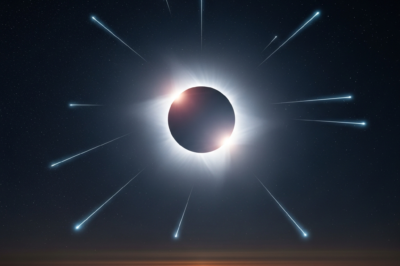
The astronomical community is currently buzzing with anticipation for one of the most spectacular celestial coincidences of the 21st century. On August 12, a date already famous among stargazers as the peak of the annual Perseid meteor shower, a total solar eclipse will sweep across parts of the globe. This rare alignment of two of nature’s most profound light shows has sparked a fundamental question among enthusiasts and professional astronomers alike: Will the Perseid shooting stars be visible during the daytime darkness of the total solar eclipse? To understand the magnitude of this event, one must first appreciate the distinct mechanics of both the Perseid meteor shower and a total solar eclipse. The Perseids are the result of Earth passing through the debris trail left by Comet 109P/Swift-Tuttle. As these tiny particles of ice and dust slam into our atmosphere at speeds of 37 miles per second, they incinerate, creating the brilliant streaks of light we call meteors. Conversely, a total solar eclipse occurs when the Moon passes directly between the Earth and the Sun, casting a narrow shadow of totality where the day momentarily turns into night. The convergence of these two events on August 12 offers a unique, albeit challenging, opportunity for observers to witness the ‘rain of fire’ during the ‘black sun.’
The Cosmic Mechanics of the Perseid Meteor Shower
The Perseid meteor shower is arguably the most beloved annual astronomical event for the general public, largely due to its reliability and the warm summer nights that accompany its peak. The source of the Perseids, Comet Swift-Tuttle, has an orbital period of approximately 133 years. Every year, from mid-July through late August, Earth intersects the ‘river of rubble’ left behind by this massive comet. The peak of this activity traditionally falls between August 11 and August 13. During a typical peak, an observer under a dark, rural sky might see between 60 and 100 meteors per hour. These meteors are known for being fast and bright, often leaving persistent ‘trains’ or ionization trails that linger in the sky for several seconds. The radiant point—the spot in the sky where the meteors appear to originate—is located in the constellation Perseus, which rises late in the evening for Northern Hemisphere observers. This timing is crucial when considering the solar eclipse, as the Sun’s position during the day is far removed from the Perseid radiant, yet the sheer volume of debris in the atmosphere remains constant regardless of the hour.
The Darkness of Totality: A Window into the Universe
A total solar eclipse is often described as the most awe-inspiring sight in nature. When the Moon completely covers the solar disk, the sky darkens significantly, though not entirely to the level of a moonless midnight. This period, known as totality, lasts only a few minutes. During these precious moments, the Sun’s outer atmosphere, the corona, becomes visible as a pearly white halo. The sky takes on a deep indigo hue, and the brightest stars and planets emerge from the glare of the day. For instance, Venus and Jupiter often become clearly visible to the naked eye. The level of darkness during totality is roughly equivalent to late civil twilight or the light of a full moon. This specific level of illumination is the critical factor in determining whether Perseid meteors will be visible. While the sky is dark enough to see the brightest stars, it is still significantly brighter than a true nighttime sky, which typically limits the visibility of fainter meteors.
Can Meteors Be Seen During the Eclipse? The Science of Magnitude
The visibility of a Perseid meteor during the total solar eclipse depends entirely on the meteor’s apparent magnitude, which is its perceived brightness. Most meteors seen during the peak of a shower are relatively faint, with magnitudes ranging from +3 to +5. For context, the human eye can see up to magnitude +6 under perfect dark conditions. During a total solar eclipse, the sky brightness is generally estimated to be around magnitude -4 to -5 in terms of integrated sky light, but the limiting magnitude for point sources (like stars and meteors) usually hovers around +1 or +2. This means that only the brightest Perseids—those categorized as ‘fireballs’—would be visible to the naked eye during totality. Fireballs are meteors that reach a magnitude of -3 or brighter. Fortunately, the Perseids are famous for producing a high percentage of fireballs. Statistically, if a major meteoroid hits the atmosphere during the 2 to 4 minutes of totality, and it is large enough to produce a brilliant flash, observers within the path of totality could indeed witness a shooting star alongside the eclipsed Sun.
Optimal Viewing Locations and the Path of Totality
For the upcoming August 12 event, specifically referencing the 2026 total solar eclipse which aligns with the Perseid peak, the path of totality will cross through the Arctic, Greenland, Iceland, and Northern Spain. Location is everything when trying to catch this dual phenomenon. In Northern Spain, the eclipse will occur late in the evening, shortly before sunset. This is particularly advantageous because as the Sun nears the horizon, the path of the Moon’s shadow lengthens, and the sky can appear even darker. Furthermore, the Perseid radiant will be higher in the sky compared to locations further west, increasing the mathematical probability of a meteor entering the field of view. Coastal regions in Galicia and the mountains of Asturias offer some of the most promising vantage points. However, weather remains the ultimate arbiter; a single cloud could obscure both the corona and any potential meteors, making the selection of a high-altitude or clear-weather climate essential for serious observers.
Technological Challenges for Astrophotographers
Capturing a Perseid meteor during a solar eclipse is considered the ‘Holy Grail’ of astrophotography. The technical difficulties are immense. To photograph the solar corona, photographers typically use specialized filters or very short exposure times to prevent overexposure of the Sun’s delicate features. However, to capture a meteor, one typically needs longer exposures and a wider field of view. Achieving a balance where the corona is perfectly detailed while a faint streak of light is recorded against the darkened sky requires advanced equipment and precise planning. Most experts recommend a dual-camera setup: one with a long telephoto lens focused on the Sun to capture the details of totality, and another with a wide-angle lens set to a high ISO to capture the broader sky. Given that totality lasts only minutes, there is zero room for error. The use of intervalometers to trigger continuous frames increases the statistical chance of catching a meteor mid-flight during the brief window of darkness.
Historical Context and Future Outlook
History rarely records the simultaneous occurrence of a major meteor shower peak and a total solar eclipse, making the August 12 event a landmark in modern astronomy. While records from ancient civilizations occasionally mention ‘falling stars’ during ‘disappearing suns,’ scientific verification of such events is scarce. This upcoming event provides a rare data point for scientists studying meteoroid density in Earth’s path. By observing the frequency of fireballs during the eclipse, researchers can gain insights into the distribution of larger particles within the Swift-Tuttle debris stream. Looking forward, the intersection of these two events serves as a reminder of the clockwork precision of our solar system. Even if no meteors are seen by the average observer, the mere possibility adds a layer of excitement to the eclipse experience. As we move closer to the date, public interest is expected to reach a fever pitch, driving a surge in ‘astro-tourism’ to Spain and Iceland. The convergence of the Perseids and the total solar eclipse is a testament to the dynamic and ever-changing nature of our night sky, promising a memory that will last a lifetime for those lucky enough to be under the shadow.





































Leave a Reply