
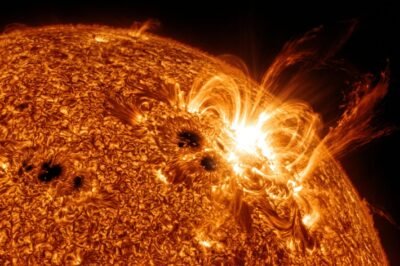
The Sun, an ancient and volatile nuclear furnace at the heart of our solar system, has recently yielded a secret that could protect our modern civilization from the ravages of space weather. For decades, scientists have struggled to predict exactly when a solar flare—a sudden, intense blast of radiation—will erupt from the solar surface. However, a groundbreaking new study, as reported by The Hindu and published in the Astrophysical Journal, suggests that we are now closer than ever to identifying the early warning signs of these celestial events. This discovery is not merely an academic triumph; it is a critical step in safeguarding the satellites, power grids, and communication systems that underpin the global economy. Solar flares are caused by the sudden release of magnetic energy stored in the Sun’s atmosphere. These eruptions can release energy equivalent to millions of hydrogen bombs exploding at once. While the light from a flare reaches Earth in about eight minutes, the associated Coronal Mass Ejections (CMEs)—massive clouds of charged particles—can take days to arrive. If a major CME hits Earth, it can induce geomagnetic storms that fry transformers and disrupt GPS signals. The new research focuses on identifying subtle changes in the Sun’s upper atmosphere, or corona, that occur before a flare begins. By analyzing data from NASA’s Solar Dynamics Observatory (SDO), researchers identified pre-flare flashes—small brightenings in the corona that serve as precursors to the main event. This provides a smoking gun for solar physicists, allowing for a more proactive approach to space weather monitoring and deep space exploration safety protocols. H2: Understanding the Solar Beast: The Nature of Flares and Magnetic Reconnection. Solar flares are perhaps the most violent events in our solar system. They are driven by a process known as magnetic reconnection. The Sun is composed of plasma, a state of matter consisting of charged particles that carry magnetic fields. As the Sun rotates at different speeds at its poles versus its equator, these magnetic field lines become twisted, knotted, and stressed. When these lines eventually snap and reconnect into a more stable configuration, a massive amount of energy is released. This energy heats the surrounding plasma to tens of millions of degrees and accelerates particles to near-light speeds. The resulting radiation spans the entire electromagnetic spectrum, from radio waves to X-rays and gamma rays. For over a century, the primary method of predicting these flares was observing sunspots—darker, cooler regions on the Sun where magnetic activity is high. However, not every sunspot produces a flare, and not every flare is preceded by a visible change in sunspot geometry. This unpredictability has left humanity vulnerable. A solar storm of the magnitude of the 1859 Carrington Event would, in the modern day, cause trillions of dollars in damage and potentially knock out the internet for months. Thus, identifying the precise triggers in the solar atmosphere is a high-stakes endeavor for modern science. H2: The Breakthrough: Identifying the Corona’s Pre-Flare Flashes. The recent study, led by researchers at NorthWest Research Associates (NWRA), utilized a vast archive of data from NASA’s Solar Dynamics Observatory. The team focused on the solar corona, the outermost layer of the Sun’s atmosphere, which is counterintuitively much hotter than the surface below. By looking at active regions—the areas above sunspot groups—the researchers identified small, transient flashes of light that occurred before the large-scale eruptive flares. These flashes act as a sort of telegraph, signaling that the magnetic environment is becoming unstable enough to trigger a major eruption. Historically, scientists focused on the photosphere, the visible surface of the Sun, to find predictors. But the NWRA team discovered that the corona holds more reliable clues. By using statistical analysis and machine learning techniques to sift through a decade of SDO data, they found that these small brightenings were consistently present in the lead-up to solar flares. These flashes are essentially localized magnetic reconnections—smaller snaps that precede the big break. This distinction is vital because it allows for a more granular understanding of the Sun’s internal clock and the physical triggers of space weather. H2: Technological Impacts: Why Early Detection is Vital for Modern Society. Our modern world is inextricably linked to the behavior of the Sun. In 1989, a solar storm caused a massive blackout in Quebec, Canada, leaving millions without power for nine hours. Today, our reliance on electronic infrastructure is orders of magnitude higher. GPS satellites, which are essential for everything from aviation and maritime navigation to the synchronization of global banking transactions, are particularly vulnerable to the radiation bursts from solar flares. Furthermore, the high-energy particles released can pose a lethal threat to astronauts aboard the International Space Station or those involved in future lunar and Martian missions. By capturing the Sun’s early warning signs, we gain precious time. Even a few hours of advanced warning would allow satellite operators to put their spacecraft into safe mode, airlines to reroute flights away from polar regions where radiation is highest, and power grid managers to balance loads to prevent transformer meltdowns. The ability to predict these events with high confidence would transition space weather forecasting from a reactive science to a proactive defensive strategy, much like how terrestrial meteorology allows us to prepare for hurricanes days in advance. H2: The Methodology: Leveraging the Solar Dynamics Observatory and Big Data. The Solar Dynamics Observatory has been staring at the Sun since 2010, capturing images in multiple wavelengths of light every few seconds. This has resulted in a massive dataset that was previously too large to analyze manually. The NWRA researchers used a database of images from the Atmospheric Imaging Assembly (AIA) and the Helioseismic and Magnetic Imager (HMI). Their methodology involved comparing the magnetic and radiant characteristics of regions that flared versus those that remained dormant. What set this study apart was its focus on the dynamic properties of the corona rather than the static properties of the photosphere. They looked at things like the magnetic flux, the helicity (the degree of twisting in the magnetic fields), and the intensity of the light in extreme ultraviolet wavelengths. They found that while the surface of the Sun might look relatively quiet, the corona above it begins to sizzle with small-scale energy releases long before the flare actually happens. This suggests that the trigger for a solar flare is an atmospheric phenomenon that propagates downward or is a result of cumulative instability in the upper layers. This shift in focus could redefine the next generation of solar monitoring instruments. H2: Predictive Modeling and the Future of Space Weather Forecasting. The discovery of these pre-flare flashes is just the beginning. The goal for NASA, the ESA, and other space agencies is to integrate these findings into real-time predictive models. Currently, the National Oceanic and Atmospheric Administration (NOAA) provides space weather alerts, but these are often based on observations of flares that have already occurred. Integrating coronal pre-cursors could extend the warning window significantly. This research also has implications for our understanding of other stars. Solar-type stars across the galaxy exhibit similar flaring behavior, and understanding the Sun’s early warning signs can help astronomers characterize the habitability of planets orbiting other stars. If a star flares too frequently or violently, it could strip the atmosphere off an otherwise habitable exoplanet. Furthermore, as we enter Solar Cycle 25, which is proving to be more active than originally predicted, the timing of this study is perfect. We are currently approaching the solar maximum, a period of peak activity where flares and CMEs are most frequent. Having better tools to predict these events will be crucial for the next several years of global communication stability. H2: Conclusion: A New Era of Solar Stewardship and Global Security. The capture of the Sun’s early warning signs represents a monumental shift in solar physics. We are moving away from a period of observation and into an era of true prediction. This study from The Hindu highlights the global importance of space weather research and the need for international cooperation. As India launches its own solar mission, Aditya-L1, the data gathered will complement findings like those from the NWRA, creating a comprehensive global net for solar monitoring. The Sun is the life-giver of our planet, but it is also a source of immense destructive power. By learning to read the subtle signals it sends before it lashes out, we are ensuring the resilience of our technological civilization. The future of space exploration and the security of our digital world depend on our ability to understand the magnetic dance of our home star. This study provides the Rosetta Stone needed to decode the Sun’s most dangerous moods, turning a cosmic threat into a manageable risk. As we look toward the stars, we do so with a newfound clarity, empowered by the data and the dedication of the scientific community to protect our planet from the elements of the deep solar system.
Stories





-

Hunkkaar Teaser Analysis: Aneet Padda’s Gritty Transformation and the Evolving Landscape of Indian Thrillers
-

Mithila Palkar: The Relatable Queen of Indian Web Series and Her Meteoric Rise
-

Wamiqa Gabbi: The Meteoric Rise of Indian Web Series’ Most Versatile Leading Lady
-

Triptii Dimri Biography: The Evolution of India’s Newest Cinematic Sensation and Web Series Star
-

Wamiqa Gabbi: The Rise of India’s New Digital Icon and the Future of OTT Stardom
-

Mithila Palkar: The Unstoppable Evolution of India’s Digital Darling and Her Journey to the Silver Screen
-

Mithila Palkar: The Comprehensive Journey of India’s Web Series Sensation and Digital Pioneer
-

Mithila Palkar: The Relatable Queen of Indian Web Series and Her Inspiring Journey to Stardom
-

Sobhita Dhulipala Biography: The Meteoric Rise of India’s Most Versatile Web Series Star
-

Mithila Palkar: The Unstoppable Journey of India’s Digital Darling and Web Series Queen
-

Triptii Dimri: The Complete Biography of India’s Newest Cinematic Sensation and Web Series Icon
-

Wamiqa Gabbi: The Ethereal Rise of India’s Most Versatile Web Series Star
-

Sobhita Dhulipala: The Unstoppable Rise of India’s Most Versatile Web Series Icon
-

Wamiqa Gabbi: The Meteoric Rise of the New Queen of Indian Web Series and Her Unstoppable Journey to Stardom
-

Triptii Dimri: The Meteoric Rise of India’s New Cinema Sweetheart and Web Series Icon
-

Wamiqa Gabbi: The Versatile Queen of Indian OTT and Her Phenomenal Rise to Stardom
-

Tripti Dimri Biography: The Rise of India’s New National Crush and Her Journey from Laila Majnu to OTT Stardom
-

Wamiqa Gabbi Biography: The Meteoric Rise of India’s Newest OTT Sensation and Versatile Powerhouse
-

Wamiqa Gabbi Biography: The Meteoric Rise of the Digital Queen of Indian Web Series
-

The Rise of Wamiqa Gabbi: A Deep Dive into the Journey of India’s Most Versatile OTT Sensation
-

The Meteoric Rise of Triptii Dimri: Biography, Acting Prowess, and the Journey of India’s Newest Cinema Sensation

Launching Soon: The Future of News with Our E-Newspaper
In the ever-evolving landscape of media and technology, we are thrilled to announce the upcoming launch of our innovative e-newspaper, set to redefine the way news is consumed in the digital age. Embracing the convenience and accessibility that the digital world offers, our e-newspaper aims to deliver real-time news updates, insightful articles, and interactive features directly to your devices. With a commitment to journalistic integrity and a passion for storytelling, we are dedicated to keeping you informed, engaged, and connected, no matter where you are. Stay tuned for the launch of our e-newspaper, where the future of news awaits at your fingertips.
Recent News
- India vs Malaysia LIVE score, Asian Games 2026 men’s hockey final: Harmanpreet Singh’s Early Lead and Tactical Masterclass

- Comprehensive Analysis: Asian Games 2026 Wrestling – India’s Schedule, Medal Prospects, and Global Standings

- Jr. NTR Takes Stand Against AI Misuse: A Comprehensive Analysis of the ‘Chuttamalle’ Deepfake Controversy

- Stroke Care Delays Increased Globally During COVID-19 Pandemic – European Medical Journal Analysis

- Deep Analysis: Nayara Energy Hikes Petrol and Diesel Prices Amid 2026 Global Energy Shifts

- Asian Games 2026 Wrestling Day 3 Live: Susaki, Sujeet, Zare in Action – United World Wrestling

Politics
- Deep Analysis: Nayara Energy Hikes Petrol and Diesel Prices Amid 2026 Global Energy Shifts
- Mamata Banerjee Allegations: A Deep Dive into the ‘Hijacking’ of the Electoral Process

- Trump to Host Zuckerberg and AI Titans: A Seismic Shift in Tech Governance and Global Strategy

- 9 Pak Soldiers Killed After First Woman Unit Of Baloch Rebels Attack Convoy: A Deep Dive Analysis

- Donald Trump At UN General Assembly: Make Deal Or Drive Iran Into Hell? – A Comprehensive Geopolitical Analysis

- Supreme Court Critiques ‘Machine-Generated’ Delhi SIR Notices: A Deep Dive into Judicial Concerns over Automated Governance

Categories
- Art & Culture 103
- Auto 85
- Beauty 15
- Blog 292
- Books 7
- Business 359
- Celebrities 217
- Crime Files 139
- Democracy 308
- Education 84
- Entertainment 154
- Environment 133
- epaper 1
- Fashion 37
- Food 59
- Gadgets 87
- Guide 150
- Handicrafts 11
- Health 278
- Healthy Living 107
- History 5
- incidents 163
- Lifestyle 41
- Music 7
- Photography 15
- Politics 441
- Science & Technology 160
- Sports 264
- Tech 133
- Television 2
- Travel 68
- Travel & Tourism 30
- Trends 50
- Weather 8
- Web Series 97
- Workout 4
- World 661
Leave a Reply