
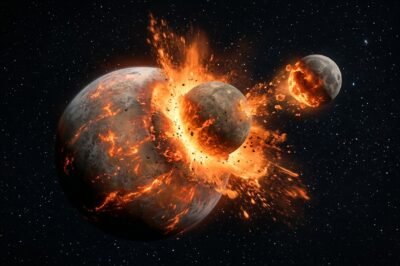
For decades, the story of our Moon’s birth has been told as a slow, agonizing process of cosmic accumulation. Most of us grew up learning the standard Giant Impact Hypothesis, which suggested that a Mars-sized planet named Theia collided with the early Earth, creating a massive disk of debris that gradually coalesced into the Moon over thousands or even millions of years. However, a groundbreaking study published by researchers using state-of-the-art supercomputer simulations has completely upended this timeline. Instead of a slow-motion dance of gravity and dust, new evidence suggests that the Moon may have formed in as little as five hours following a catastrophic impact. This revelation does not just shave time off the clock; it fundamentally changes our understanding of planetary physics, the chemical composition of our nearest celestial neighbor, and the violent history of the inner solar system. By utilizing unprecedented computational power to model the collision with hundreds of millions of particles, scientists have revealed a scenario where a massive chunk of Earth and Theia was launched directly into orbit, bypassing the need for a long-lived debris disk and solving one of the most persistent mysteries in lunar science.
The Traditional Giant Impact Hypothesis and Its Limitations
Before we can appreciate the speed of the five-hour model, we must understand the traditional framework that it challenges. The Giant Impact Hypothesis has long been the leading explanation for the Moon’s existence. According to this theory, roughly 4.5 billion years ago, the proto-Earth was struck by Theia. The energy of this impact was so great that it supposedly vaporized large portions of both bodies, creating a ring of molten rock and gas—a synestia—that surrounded the Earth. Over centuries, this material was thought to have cooled and clumped together to form the Moon. While this model explained the Moon’s size and its lack of a large iron core, it suffered from a major flaw known as the Isotopic Crisis.
The Isotopic Crisis refers to the fact that when scientists analyze lunar rocks brought back by the Apollo missions, they find that the oxygen and tungsten isotopes are nearly identical to those found on Earth. If the Moon were formed primarily from the debris of a separate planet like Theia, as traditional simulations suggested, the Moon should have a chemical signature more similar to Theia than to Earth. Standard low-resolution simulations consistently produced a Moon composed of about 80% Theia material. The discrepancy between these models and the physical evidence has haunted planetary scientists for years, leading to complex theories about mixing and equilibration that never quite felt complete. The new high-resolution simulations provide a much cleaner solution to this isotopic puzzle.
Supercomputing the Cosmos: The SWIFT Revolution
The breakthrough in this research was made possible by the Institute for Computational Cosmology at Durham University, using a specialized open-source simulation code called SWIFT. Unlike previous models that relied on thousands or a few million particles to represent the colliding planets, the new study utilized up to 100 million particles. This increase in resolution is not just a cosmetic improvement; it allows for the simulation of complex fluid dynamics and gravitational interactions that are invisible at lower resolutions. When the resolution is too low, the simulation can miss the fine-grained behavior of the ejected material, leading to inaccurate results regarding the mass and orbit of the resulting body.
By running these massive simulations on the DiRAC Memory Intensive service, researchers were able to witness the immediate aftermath of the collision in high definition. They discovered that at this level of detail, the behavior of the ejected material changed significantly. Instead of forming a messy, distributed disk, a large portion of the material remained cohesive. The simulation showed two distinct clumps of material being ejected from the impact site. While the smaller clump was eventually re-absorbed by the Earth, the larger clump—composed significantly of Earth’s outer mantle material—was flung into a stable orbit. This process occurred with startling speed, effectively creating a fully formed satellite in less time than it takes to fly from New York to London.
The Five-Hour Formation: A Direct-to-Orbit Scenario
The most shocking aspect of the new simulation is the immediacy of the Moon’s creation. In the “immediate-satellite” scenario, the collision between Earth and Theia happens at a specific angle and velocity that allows for a massive plume of debris to be ejected. As this plume expands, gravity begins to pull it into a centralized mass almost instantly. Within a few hours, the gravity of the Earth and the internal gravity of the plume interact to prune away the trailing debris, leaving a single, large body in orbit. This model bypasses the long-term accretion phase entirely, suggesting that the Moon was essentially “born” as a solid or near-solid body rather than being slowly built from dust.
This direct-to-orbit mechanism is revolutionary because it explains why the Moon is so large relative to the Earth. In traditional disk-based models, much of the material is lost or falls back to the planet before it can coalesce. By forming the Moon all at once, the system preserves more of the angular momentum and mass from the initial impact. Furthermore, this rapid formation explains the Moon’s orbital tilt and its current distance from Earth. The simulation data matches the observed physical properties of the Moon with a level of precision that previous, slower models simply could not achieve. It paints a picture of a solar system that was far more dynamic and capable of producing instant transformations than we ever dared to imagine.
Solving the Chemical Mystery of the Moon’s Mantle
One of the primary reasons this new theory is gaining traction is its ability to solve the isotopic identity of the Moon. Because the Moon was formed instantly from material ripped directly from the outer layers of the Earth and the impacting body, the simulations show that the Moon’s outer layers would be dominated by terrestrial material. In the immediate-satellite model, the Moon is not a well-mixed soup of Theia and Earth; rather, it is a body whose surface reflects the composition of the proto-Earth’s mantle. This perfectly aligns with the Apollo rock samples that have puzzled scientists for fifty years.
This finding has deep implications for our understanding of the early Earth as well. If the Moon is indeed a piece of the early Earth’s mantle, then studying lunar geology is the most direct way to understand the conditions of our own planet shortly after its formation. The heat of the impact would have melted the Moon, creating a lunar magma ocean. Because the Moon formed so quickly, it would have retained a specific chemical fingerprint that has been preserved in its crust, which has not been subject to the plate tectonics and erosion that have erased Earth’s earliest history. This makes the Moon a “time capsule” of the five-hour event that defined our planet’s future.
Implications for Planetary Formation and Exoplanets
The success of these high-resolution simulations suggests that we may need to rethink how other moons and even planets form throughout the galaxy. If a five-hour formation is possible for Earth’s Moon, it may be a common occurrence in the chaotic environment of young star systems. Astronomers observing distant exoplanetary systems might now look for evidence of rapid satellite formation. This shift in perspective allows for a more diverse range of planetary architectures, where large moons can be created in single, violent events rather than requiring the perfect conditions for a long-lived accretion disk.
Furthermore, this research highlights the critical importance of computational resolution in science. It serves as a reminder that our understanding of the universe is often limited by the tools we use to model it. As supercomputers become even more powerful, we may find that other “slow” processes in the universe—such as the formation of rings around gas giants or the birth of stars—might happen much faster than previously thought. The five-hour Moon theory is a testament to the fact that in the realm of physics, a change in scale can lead to a fundamental change in our understanding of reality.
Conclusion: A New Chapter in Lunar Science
The revelation that the Moon may have formed in just five hours marks a paradigm shift in planetary science. By moving away from the slow-growth models of the past and embracing the high-energy, rapid-formation scenarios provided by modern supercomputing, we are closer than ever to understanding the true origin of our celestial companion. This new model not only resolves the long-standing isotopic crisis but also provides a more robust explanation for the Moon’s physical characteristics. As we prepare for future missions like NASA’s Artemis, which aims to return humans to the lunar surface, this knowledge will be vital. We are no longer looking at a distant, alien rock; we are looking at a piece of our own planet, forged in a few hours of cosmic fire. The Moon is a witness to the violent, instantaneous birth of the Earth-Moon system, and its story is far more dramatic than we ever imagined. Future research will likely focus on refining these simulations and searching for specific geological markers on the Moon that could definitively prove this rapid-formation theory, forever changing the textbooks of the future.






































Leave a Reply