
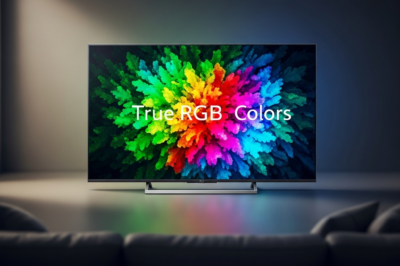
The landscape of home entertainment has just undergone a seismic shift as Sony Electronics officially announced its latest flagship Bravia TV lineup, centered around the revolutionary ‘True RGB’ technology. For decades, home enthusiasts and professional colorists have chased the elusive goal of perfect color reproduction, often finding themselves at the mercy of panel limitations that prioritize brightness over chromatic purity. Sony’s latest announcement, first reported by tech giant Engadget, promises to bridge this gap by introducing a display architecture that eliminates the compromises of traditional sub-pixel arrangements. This isn’t just a minor incremental update; it represents a fundamental rethinking of how light and color are processed at the microscopic level. By moving away from white-assisted sub-pixel structures (often found in WOLED panels) and focusing on a pure Red-Green-Blue (RGB) emission system, Sony aims to reclaim its throne as the undisputed king of premium display technology. This development comes at a time when consumer demand for high-bitrate streaming and 4K physical media is at an all-time high, necessitating hardware that can actually display the nuanced data being delivered to the screen.
The Evolution of Bravia: From Trinitron to True RGB
Sony’s journey in the display industry has always been defined by a relentless pursuit of the ‘Kando’ philosophy—the power to move people through technology. This journey began in the analog era with the legendary Trinitron tubes, which set the standard for professional monitoring and home viewing for over thirty years. As the industry transitioned to flat panels, Sony continued to innovate with the introduction of the Bravia brand, pioneering technologies like the X-Reality Pro engine and more recently, the Cognitive Processor XR. However, the market has recently been dominated by a debate between OLED’s deep blacks and LCD’s high brightness. While White-OLED (WOLED) helped bring self-emissive technology to the masses, it did so by adding a white sub-pixel to boost luminance, which can sometimes dilute color saturation at peak brightness levels. The new True RGB Bravia lineup seeks to eliminate this trade-off. By utilizing a pure RGB structure, every pixel is capable of producing the full spectrum of color without the need for a white boost, ensuring that ‘crimson’ looks like crimson even at 2,000 nits of brightness. This historical context is vital to understanding why the True RGB announcement is being hailed as the most significant milestone since the launch of the first OLED TVs.
The Science Behind True RGB: Why Sub-Pixel Architecture Matters
To understand the magnitude of Sony’s breakthrough, one must look at the physics of light filtration. In most modern televisions, brightness is often achieved by compromising color volume. For instance, in many high-end displays, as the screen gets brighter, the colors appear more ‘washed out’ because the white sub-pixel is doing the heavy lifting to reach high peak nit levels. Sony’s True RGB technology utilizes a new generation of self-emissive materials—likely leveraging advancements in either QD-OLED or a refined micro-LED approach—that allows each R, G, and B sub-pixel to hit higher luminance targets independently. This results in 100% color volume within the DCI-P3 color space and significantly higher coverage of the Rec.2020 gamut, which is the current gold standard for 4K HDR mastering. Furthermore, the absence of a white sub-pixel means that there is no ‘blooming’ or ‘color shift’ when viewing the screen from an angle. The engineering precision required to manufacture these panels at scale is immense, involving vacuum evaporation techniques and specialized backplane technologies that ensure each sub-pixel remains thermally stable even under high-load HDR scenes.
Cognitive Processor XR: The Brains Behind the Beauty
Hardware alone does not make a world-class television; the processing engine is equally critical. Sony’s updated Cognitive Processor XR is the heart of the new True RGB lineup. Unlike traditional AI that analyzes image elements like color, contrast, and detail individually, the Cognitive Processor XR cross-analyzes every element at once, just as the human brain does. In the context of True RGB, the processor has an even more complex task. It must manage the massive color data bandwidth provided by the new panels to ensure skin tones look natural, textures are palpable, and motion is fluid. One of the standout features of this new engine is ‘XR Clear Image,’ which uses zonal analysis to reduce noise and blur in lower-resolution content, effectively upscaling legacy 1080p content to look almost native 4K on the True RGB panel. The synergy between the pure RGB light source and the XR processor allows for a level of depth and three-dimensionality that was previously only available in professional mastering monitors costing upwards of $30,000.
Impact on the High-End Market: Sony vs. The Competition
The announcement of the True RGB lineup puts Sony in a direct collision course with other industry titans like Samsung and LG. For the last few years, Samsung’s QD-OLED and LG’s MLA-OLED (Micro Lens Array) have been the benchmarks for premium viewing. Sony’s move into True RGB suggests a pivot toward ‘creative intent’—the idea that the TV should show exactly what the director saw on the set. While Samsung focuses on extreme brightness and LG on accessibility and manufacturing efficiency, Sony is positioning the True RGB Bravia as the ‘Director’s Choice.’ Industry analysts suggest that this move could force competitors to accelerate their own RGB-native research and development. From a market perspective, this places Sony at the absolute top tier of the ‘prosumer’ segment, appealing to cinephiles, professional photographers, and gamers who demand uncompromising visual fidelity. The economic implications are also noteworthy, as Sony’s investment in this tech indicates a belief that consumers are willing to pay a premium for superior color accuracy over sheer screen size.
A Powerhouse for Gaming and Professional Content Creation
Beyond movies, the True RGB Bravia lineup is designed to be the ultimate display for the PlayStation 5 and high-end PC gaming. With full support for HDMI 2.1 features, including 4K/120fps, Variable Refresh Rate (VRR), and Auto Low Latency Mode (ALLM), the gaming experience is elevated by the panel’s nearly instantaneous response time. However, the real advantage for gamers lies in ‘Auto HDR Tone Mapping.’ Because the True RGB panel can maintain color saturation at high brightness, the vibrant worlds of modern AAA titles appear more vivid and immersive. For professional creators, the True RGB Bravia serves as a reliable secondary monitor for color grading and video editing. The TV includes a ‘Calman Ready’ feature, allowing professional-grade calibration tools to interface directly with the hardware to ensure the screen meets industry-standard delta-E values. This dual-purpose nature makes the new Bravia lineup a versatile tool for the modern digital lifestyle, blurring the lines between consumer electronics and professional gear.
Sustainability and the Future of the Bravia Brand
In addition to technical prowess, Sony has integrated its environmental vision into the True RGB lineup. The new models utilize SORPLAS, a Sony-developed recycled plastic that maintains high durability while reducing the carbon footprint of manufacturing. The packaging has also been redesigned to use less plastic and more sustainable paper-based materials. Looking forward, the introduction of True RGB sets a new baseline for the industry. We can expect this technology to eventually trickle down to more affordable models over the next five years, but for now, it remains the crown jewel of Sony’s engineering. As we move toward an era of 8K content and increasingly sophisticated AI-generated media, the need for a display that can accurately represent every single photon of light is paramount. Sony’s True RGB Bravia is not just a television; it is a window into the future of visual storytelling, ensuring that the art of cinema is preserved and presented in its purest form.
Conclusion: The Dawn of a New Visual Era
Sony’s announcement of the True RGB Bravia lineup marks a definitive turning point in the history of display technology. By solving the age-old conflict between brightness and color purity, Sony has provided a solution that satisfies both the technical requirements of professionals and the emotional desires of casual viewers. While the price point is expected to reflect its premium status, the value proposition for those who value visual integrity is undeniable. As the lines between the theater and the living room continue to blur, Sony has once again proven that it is the leader in defining how we perceive digital reality. The True RGB Bravia is more than a product; it is a statement of intent—a promise that the future of television is brighter, more colorful, and more accurate than ever before.




































Leave a Reply