
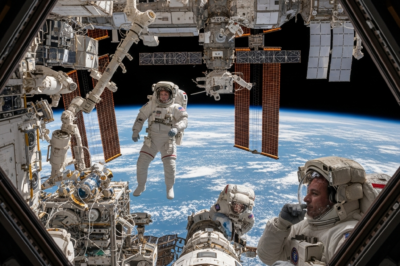
On Space Exploration Day, we pause to celebrate one of humanity’s most ambitious and enduring achievements: the International Space Station (ISS). For over two decades, this modular laboratory has orbited our planet at a staggering speed of 17,500 miles per hour, serving as a beacon of international cooperation and scientific curiosity. While the headline from The Hindu highlights the general observance of this day, the story of the ISS is one of profound complexity, human resilience, and the relentless pursuit of knowledge. This orbiting outpost is not just a collection of metal tubes; it is a pressurized environment where international borders vanish, replaced by the common language of science and the shared goal of extending humanity’s reach into the cosmos. As we reflect on Space Exploration Day, we must look beyond the gleaming solar arrays and delve into the intricate daily lives of those who call the vacuum of space their home, and the groundbreaking research that is currently shaping the future of medicine, materials science, and interplanetary travel.
The Historical Genesis: From Cold War Rivalry to Orbital Unity
The origins of the International Space Station are rooted in a transition from the competitive spirit of the Space Race to an era of unprecedented global collaboration. Following the end of the Cold War, the realization dawned that the massive costs and technical challenges of sustained human presence in space were too great for any single nation to bear alone. In 1993, the United States, Russia, Japan, Europe, and Canada came together to merge their respective space station projects into what would become the ISS. The first module, Zarya, was launched by Russia in 1998, followed shortly by the American Unity node. Since then, the station has grown into a sprawling complex roughly the size of a football field. This historical context is vital because it underscores the station’s role as a diplomatic masterstroke. Even during periods of geopolitical tension on Earth, the ISS has remained a sanctuary of peace, where astronauts and cosmonauts rely on one another for survival, proving that the vacuum of space requires a level of trust that transcends terrestrial politics.
The Physiology of Microgravity: Surviving the Orbital Environment
Life at the International Space Station is an ongoing experiment in human biology. Without the constant pull of Earth’s gravity, the human body undergoes dramatic and often detrimental changes. Astronauts experience fluid shifts, where blood and other fluids move toward the upper body, causing the characteristic puffy faces and thin legs often seen in orbital footage. More significantly, the lack of weight-bearing activity leads to rapid bone density loss and muscle atrophy. To combat these effects, residents of the ISS must adhere to a grueling two-hour daily exercise regimen using specialized equipment like the Advanced Resistive Exercise Device (ARED), which uses vacuum cylinders to simulate weights. Beyond the physical toll, the ISS serves as a laboratory for studying the long-term effects of cosmic radiation. Outside the protection of Earth’s atmosphere, astronauts are exposed to higher levels of ionizing radiation, which increases the risk of cancer and cardiovascular issues. Every day spent on the station provides critical data that will one day enable humans to survive the long journey to Mars.
The Choreography of Daily Life: Work, Sleep, and Sustenance
The daily schedule aboard the ISS is managed with millisecond precision. From the moment the crew wakes up in their phone-booth-sized sleeping quarters to the final synchronization of their logs at night, every minute is accounted for. Nutrition is a major logistical challenge; food must be shelf-stable, easy to prepare, and crumb-free to avoid clogging air filters or being inhaled in microgravity. Most meals are dehydrated or thermo-stabilized, requiring the addition of water or a quick warm-up in a specialized oven. Water itself is a precious resource, managed through one of the most advanced recycling systems ever devised. On the ISS, every drop of moisture—including sweat and urine—is filtered and purified back into drinking water. As the famous astronaut saying goes, ‘Today’s coffee is tomorrow’s coffee.’ Maintaining hygiene is equally complex; there are no showers. Instead, astronauts use no-rinse soap and shampoo with limited water to stay clean. Despite these challenges, the crew finds time for psychological well-being, often gathering in the Cupola—a seven-windowed observation module—to gaze at the Earth below, a view that many describe as the ‘Overview Effect,’ a profound shift in perspective regarding our planet’s fragility.
Pioneering Research: The Scientific Legacy of the ISS
The primary mission of the International Space Station is research that cannot be conducted anywhere else. In the microgravity environment, physical processes behave differently. For instance, protein crystals grow larger and more perfectly than they do on Earth, allowing scientists to study the structures of diseases like Alzheimer’s and cancer with unprecedented clarity. The ISS has also been the site of breakthroughs in 3D bioprinting, where researchers are learning how to print human tissues and even organ-like structures without the collapsing force of gravity. In material science, experiments with colloids and metal alloys are leading to the development of stronger, lighter materials for use in everything from jet engines to medical implants. Furthermore, the Alpha Magnetic Spectrometer (AMS-02) mounted on the exterior of the station is searching for evidence of dark matter and antimatter, helping to answer fundamental questions about the origin of the universe. The station is not just a home; it is a multi-disciplinary laboratory that has hosted over 3,000 experiments from researchers in over 100 countries.
The Engineering Marvel: Maintaining a Complex in the Vacuum
Maintaining a habitable environment in the harsh vacuum of space is a constant battle against physics. The ISS must maintain a consistent pressure and oxygen level while scrubbing out the carbon dioxide exhaled by the crew. This is achieved through the Environmental Control and Life Support System (ECLSS). Outside the station, the temperature can fluctuate from 250 degrees Fahrenheit in direct sunlight to minus 250 degrees in the shade. To manage this, a complex system of radiators and ammonia loops sheds excess heat into space. Occasionally, the station must perform ‘debris avoidance maneuvers’ to steer clear of space junk, a growing threat in Low Earth Orbit. When repairs are needed on the exterior, astronauts perform Extravehicular Activities (EVAs), or spacewalks. These are high-stakes operations that require months of training in underwater buoyancy labs. Every spacewalk is a testament to human engineering and the bravery of those who step out of the airlock into the infinite void to ensure the station remains operational.
The Transition: The Future of the ISS and Commercial Space
As we celebrate Space Exploration Day, we must also look toward the eventual decommissioning of the ISS, currently slated for around 2030. After decades of service, the structural integrity of the oldest modules is beginning to show signs of age. NASA and its partners are already preparing for a transition to commercial space stations. Companies like Axiom Space are planning to attach private modules to the ISS, which will eventually detach to form their own independent stations. This shift is part of a broader strategy to foster a ‘low-Earth orbit economy,’ where NASA becomes one of many customers rather than the sole operator. Meanwhile, the focus of international space agencies is shifting toward the Lunar Gateway—a smaller station that will orbit the Moon and serve as a jumping-off point for missions to the lunar surface and eventually Mars. The legacy of the ISS will live on in these new endeavors, having provided the blueprint for how humans can live, work, and thrive together in the final frontier.
Conclusion: The Enduring Spirit of Exploration
The International Space Station stands as the most complex engineering project in human history, but its true value lies in its demonstration of what is possible when humanity works together. On Space Exploration Day, as we reflect on the life of the astronauts orbiting above, we are reminded that exploration is a fundamental part of the human spirit. The ISS has taught us how to survive in the most hostile environment imaginable, how to conduct world-class science in freefall, and how to build bridges across cultures and continents. As the station enters its final decade of operation, the lessons learned there will be the foundation upon which the next generation of explorers builds their dreams. Whether it is returning to the Moon or setting foot on Mars, the journey begins with the knowledge gained 250 miles above our heads. The ISS is not just a station in space; it is a testament to our collective potential and a promise that the stars are within our reach.





































Leave a Reply