
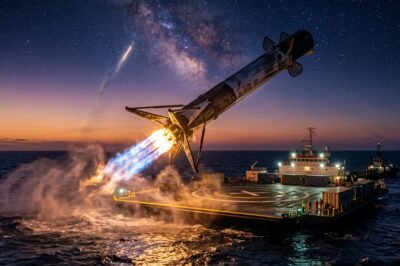
The early morning sky of September 8, 2026, was not merely a canvas for light but a testament to human ingenuity as SpaceX’s Falcon 9 rocket, often referred to as the premier ‘rocket taxi’ of the orbital age, ascended from the Florida coast. This launch was no ordinary satellite deployment; it carried the Nancy Grace Roman Space Telescope, a mission poised to redefine our understanding of the universe. As the rocket pierced the stratosphere, onlookers were treated to a spectacle of fire and physics. However, the true marvel occurred minutes later when the first-stage booster began its rhythmic descent back to Earth, aiming for a precision landing on a droneship stationed in the Atlantic. This seamless return of the hardware, captured in the ‘Space Photo of the Day,’ underscores a pivotal shift in space exploration where the extraordinary has become routine. In this detailed analysis, we explore the intricacies of the Roman Telescope’s mission, the technical mastery of SpaceX’s reusable architecture, and what this specific launch means for the future of astronomical discovery. The synergy between private enterprise and federal scientific goals has never been more visible than in the fiery arc of a returning booster. The Nancy Grace Roman Space Telescope, named after NASA’s first chief astronomer who is often called the ‘Mother of Hubble,’ represents the next generation of wide-field infrared surveying. Unlike its predecessors, Roman is designed to see a patch of sky 100 times larger than Hubble, while maintaining the same crisp resolution. H2: The Nancy Grace Roman Space Telescope: A New Eye on the Cosmos. The telescope’s primary instrument is a 2.4-meter mirror, identical in size to Hubble’s, but equipped with a 300-megapixel camera that allows for unprecedented surveying speeds. This capability is essential for its primary mission: investigating the mysteries of dark energy and dark matter. By observing billions of galaxies and thousands of supernovae over its five-year primary mission, Roman will help scientists understand how the expansion of the universe has changed over time. Furthermore, the telescope features a state-of-the-art coronagraph, a technology demonstration that will allow it to block the glare of stars and directly image exoplanets. This is a crucial step toward finding Earth-like worlds around other suns. The successful delivery of this multi-billion dollar instrument by SpaceX is a vote of confidence in commercial launch providers for high-stakes scientific endeavors. H2: The SpaceX Rocket Taxi: Mastery of Propulsive Landing. The term ‘rocket taxi’ has become shorthand for the Falcon 9’s role as a reliable, reusable transport system for orbital payloads. For the September 8, 2026 mission, SpaceX utilized a flight-proven booster that had already seen multiple trips to the edge of space. The logistics of the return are as complex as the launch itself. After stage separation, the booster performed a flip maneuver using nitrogen gas thrusters, followed by an entry burn to shield itself from the intense heat of atmospheric reentry. The iconic ‘Space Photo of the Day’ captures the final seconds of this descent, where the four grid fins steer the skyscraper-sized cylinder toward the droneship ‘A Shortfall of Gravitas.’ The precision required to land on a moving platform in the middle of the ocean cannot be overstated. By successfully recovering the booster yet again, SpaceX continues to drive down the cost of access to space, making missions like the Roman Telescope economically viable for NASA’s budget. H2: Key Technical Specifications and Launch Dynamics. The launch occurred at precisely 4:32 AM ET, a timing dictated by the specific orbital mechanics required to place the Roman Telescope into its halo orbit around the second Sun-Earth Lagrange point (L2). This location, roughly 1.5 million kilometers from Earth, provides a stable environment for infrared observations away from the heat and light interference of our planet. The Falcon 9 utilized its nine Merlin 1D engines, generating over 1.7 million pounds of thrust at sea level. The propellant mixture of sub-cooled liquid oxygen and rocket-grade kerosene (RP-1) allowed for the high-energy density needed to lift the heavy observatory. During the first two minutes of flight, the vehicle reached Max-Q, the point of maximum aerodynamic pressure, proving the structural integrity of the fairings protecting the delicate telescope. The successful separation of these fairings, which were also recovered for reuse, marks another victory for SpaceX’s sustainability model. H2: Comparing Roman to the Webb and Hubble Legacies. While the James Webb Space Telescope (JWST) focuses on deep, narrow views of the early universe in mid-infrared, the Roman Telescope provides the ‘big picture.’ If Hubble is like a high-powered zoom lens and Webb is a magnifying glass, Roman is a wide-angle lens. This allows Roman to find the ‘needles in the haystack’ that Webb can then examine in greater detail. For instance, Roman will use gravitational microlensing—the way light from a distant star bends around a closer planet—to find thousands of exoplanets in the heart of the Milky Way. This statistical survey will complement the Kepler mission’s data, providing a more complete census of planetary systems in our galaxy. The synergy between these three great observatories—Hubble, Webb, and Roman—represents a golden age of astronomy that was once thought impossible due to the high costs of space launches. H2: The Socio-Economic Impact of Reusable Spaceflight. The return of the Falcon 9 booster is not just a technical win; it is an economic revolution. Historically, a launch vehicle was a multi-million dollar asset discarded after a single use. SpaceX’s ability to reuse boosters up to 20 times has slashed the price of a launch from $200 million to approximately $50 million or less for commercial customers. This cost-saving allows NASA to allocate more funding toward the scientific instruments themselves rather than the ‘taxi’ ride to get them there. Furthermore, the rapid turnaround of boosters means that the cadence of discovery is accelerating. In 2026 alone, SpaceX is on track to exceed 150 launches, a frequency that was unheard of in the era of the Space Shuttle. This democratization of space also opens the door for smaller nations and private research institutions to send their own experiments into orbit, fostering a global ecosystem of innovation. H2: Astrophotography and the Space Photo of the Day Phenomenon. The specific image released on September 8, 2026, which prompted this analysis, showcases the ‘entry burn’ of the booster. This occurs when the rocket reignites three of its engines to slow down as it hits the thicker parts of the atmosphere. The photo reveals a spectacular ‘nebula’ of exhaust gases illuminated by the rising sun, a phenomenon often called a ‘space jellyfish.’ This type of astrophotography has become a vital tool for public engagement. By documenting the beauty and the raw power of these missions, NASA and SpaceX are inspiring a new generation of scientists, engineers, and dreamers. The image serves as a bridge between the cold, hard numbers of orbital mechanics and the human emotional response to exploration. It captures the moment where science becomes art, and where the heavy lifting of exploration is seen as a graceful, controlled ballet of machines. In conclusion, the successful launch of the Nancy Grace Roman Space Telescope and the subsequent return of its SpaceX taxi represent a perfect harmony of mission and machine. As Roman settles into its orbit at L2, it will begin its journey of peeling back the layers of the dark universe, searching for the invisible forces that shape our reality. Meanwhile, the Falcon 9 booster, now safely back on Earth, will be inspected, refurbished, and prepared for its next mission. This cycle of departure and return is the new heartbeat of the space age. The future implications are clear: we are no longer visitors to the stars, but frequent commuters. As we look toward the 2030s, the lessons learned from this mission will inform our attempts to reach Mars and beyond, ensuring that the ‘rocket taxi’ service remains the backbone of our journey into the great unknown.
SpaceX Rocket Taxi Returns: A Masterclass in Reusability After the Roman Space Telescope Deployment
Posted by
Stories





-

Hunkkaar Teaser Analysis: Aneet Padda’s Gritty Transformation and the Evolving Landscape of Indian Thrillers
-

Mithila Palkar: The Relatable Queen of Indian Web Series and Her Meteoric Rise
-

Wamiqa Gabbi: The Meteoric Rise of Indian Web Series’ Most Versatile Leading Lady
-

Triptii Dimri Biography: The Evolution of India’s Newest Cinematic Sensation and Web Series Star
-

Wamiqa Gabbi: The Rise of India’s New Digital Icon and the Future of OTT Stardom
-

Mithila Palkar: The Unstoppable Evolution of India’s Digital Darling and Her Journey to the Silver Screen
-

Mithila Palkar: The Comprehensive Journey of India’s Web Series Sensation and Digital Pioneer
-

Mithila Palkar: The Relatable Queen of Indian Web Series and Her Inspiring Journey to Stardom
-

Sobhita Dhulipala Biography: The Meteoric Rise of India’s Most Versatile Web Series Star
-

Mithila Palkar: The Unstoppable Journey of India’s Digital Darling and Web Series Queen
-

Triptii Dimri: The Complete Biography of India’s Newest Cinematic Sensation and Web Series Icon
-

Wamiqa Gabbi: The Ethereal Rise of India’s Most Versatile Web Series Star
-

Sobhita Dhulipala: The Unstoppable Rise of India’s Most Versatile Web Series Icon
-

Wamiqa Gabbi: The Meteoric Rise of the New Queen of Indian Web Series and Her Unstoppable Journey to Stardom
-

Triptii Dimri: The Meteoric Rise of India’s New Cinema Sweetheart and Web Series Icon
-

Wamiqa Gabbi: The Versatile Queen of Indian OTT and Her Phenomenal Rise to Stardom
-

Tripti Dimri Biography: The Rise of India’s New National Crush and Her Journey from Laila Majnu to OTT Stardom
-

Wamiqa Gabbi Biography: The Meteoric Rise of India’s Newest OTT Sensation and Versatile Powerhouse
-

Wamiqa Gabbi Biography: The Meteoric Rise of the Digital Queen of Indian Web Series
-

The Rise of Wamiqa Gabbi: A Deep Dive into the Journey of India’s Most Versatile OTT Sensation
-

The Meteoric Rise of Triptii Dimri: Biography, Acting Prowess, and the Journey of India’s Newest Cinema Sensation

Launching Soon: The Future of News with Our E-Newspaper
In the ever-evolving landscape of media and technology, we are thrilled to announce the upcoming launch of our innovative e-newspaper, set to redefine the way news is consumed in the digital age. Embracing the convenience and accessibility that the digital world offers, our e-newspaper aims to deliver real-time news updates, insightful articles, and interactive features directly to your devices. With a commitment to journalistic integrity and a passion for storytelling, we are dedicated to keeping you informed, engaged, and connected, no matter where you are. Stay tuned for the launch of our e-newspaper, where the future of news awaits at your fingertips.
Recent News
- India vs Malaysia LIVE score, Asian Games 2026 men’s hockey final: Harmanpreet Singh’s Early Lead and Tactical Masterclass

- Comprehensive Analysis: Asian Games 2026 Wrestling – India’s Schedule, Medal Prospects, and Global Standings

- Jr. NTR Takes Stand Against AI Misuse: A Comprehensive Analysis of the ‘Chuttamalle’ Deepfake Controversy

- Stroke Care Delays Increased Globally During COVID-19 Pandemic – European Medical Journal Analysis

- Deep Analysis: Nayara Energy Hikes Petrol and Diesel Prices Amid 2026 Global Energy Shifts

- Asian Games 2026 Wrestling Day 3 Live: Susaki, Sujeet, Zare in Action – United World Wrestling

Politics
- Deep Analysis: Nayara Energy Hikes Petrol and Diesel Prices Amid 2026 Global Energy Shifts
- Mamata Banerjee Allegations: A Deep Dive into the ‘Hijacking’ of the Electoral Process

- Trump to Host Zuckerberg and AI Titans: A Seismic Shift in Tech Governance and Global Strategy

- 9 Pak Soldiers Killed After First Woman Unit Of Baloch Rebels Attack Convoy: A Deep Dive Analysis

- Donald Trump At UN General Assembly: Make Deal Or Drive Iran Into Hell? – A Comprehensive Geopolitical Analysis
- Supreme Court Critiques ‘Machine-Generated’ Delhi SIR Notices: A Deep Dive into Judicial Concerns over Automated Governance

Categories
- Art & Culture 103
- Auto 85
- Beauty 15
- Blog 292
- Books 7
- Business 359
- Celebrities 217
- Crime Files 139
- Democracy 308
- Education 84
- Entertainment 154
- Environment 133
- epaper 1
- Fashion 37
- Food 59
- Gadgets 87
- Guide 150
- Handicrafts 11
- Health 278
- Healthy Living 107
- History 5
- incidents 163
- Lifestyle 41
- Music 7
- Photography 15
- Politics 441
- Science & Technology 160
- Sports 264
- Tech 133
- Television 2
- Travel 68
- Travel & Tourism 30
- Trends 50
- Weather 8
- Web Series 97
- Workout 4
- World 661
Leave a Reply