
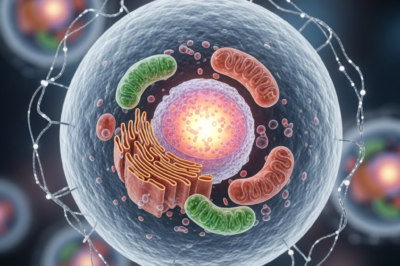
The human body is an architectural marvel of staggering complexity, composed of approximately 37 trillion cells that must work in perfect synchrony every second of every day. To the outside observer, life seems effortless, but beneath the surface of our skin lies a chaotic world of chemical reactions, kinetic movements, and structural stresses that would dismantle any man-made machine within minutes. Yet, human cells almost never fail. Recent research highlighted by Technology Org delves into the profound question of biological robustness: how do these microscopic units maintain such incredible stability despite the constant threat of mutation, environmental toxins, and thermodynamic decay? The answer lies in a series of multi-layered, redundant error-correction systems that have been refined over billions of years of evolution. Understanding these mechanisms is not just a matter of biological curiosity; it is the frontier of modern medicine, longevity research, and the future of synthetic biology. In this deep dive, we explore the intricate machinery that allows our cells to persist against the odds, providing a blueprint for resilience that defies even our most advanced technological constructs.
The High-Fidelity Machinery of DNA Replication and Proofreading
At the heart of cellular stability is the preservation of the genetic code. Every time a cell divides, it must copy its entire genome—roughly 3 billion base pairs—with near-perfect accuracy. If this process were left to chance, the resulting mutations would quickly lead to systemic collapse or cancer. However, the cell employs a sophisticated suite of enzymes, primarily DNA polymerases, which possess an inherent proofreading ability. As the DNA strand is synthesized, these enzymes act like a high-speed editor, identifying and removing mispaired nucleotides before moving forward. This initial step reduces the error rate to about one in every hundred thousand bases. But the cell doesn’t stop there. Post-replication mismatch repair (MMR) systems scan the newly formed DNA for any lingering errors that the polymerase missed, further reducing the error rate to an astonishing one in ten billion. To put this in perspective, if a human typist were this accurate, they could type the entire Encyclopedia Britannica thousands of times without making a single typo. This level of fidelity ensures that the ‘operating system’ of our cells remains intact through thousands of generations of cell division, providing the foundational stability required for multicellular life.
Protein Folding and the Role of Molecular Chaperones
While DNA provides the blueprint, proteins are the workhorses of the cell, performing everything from structural support to enzymatic catalysis. For a protein to function correctly, it must fold into a very specific three-dimensional shape. However, the cellular environment is crowded and turbulent, making improper folding a frequent risk. Misfolded proteins are not just useless; they can become toxic, clumping together to form plaques associated with diseases like Alzheimer’s and Parkinson’s. To prevent this, cells utilize ‘molecular chaperones,’ specialized proteins that assist others in reaching their correct conformation. These chaperones, such as Heat Shock Proteins (HSPs), act like biological quality-control officers. They stabilize unfolded chains, provide isolated environments for folding to occur safely, and even attempt to refold proteins that have become denatured due to heat or stress. By managing the proteome with such precision, the cell ensures that its internal machinery continues to run smoothly, preventing the ‘cogs’ of the biological engine from jamming and causing systemic failure.
Autophagy: The Art of Cellular Housekeeping and Recycling
Even with perfect replication and folding, components within a cell eventually wear out. Mitochondria, the cell’s power plants, can become damaged and start leaking harmful reactive oxygen species. To combat this internal decay, cells have evolved a process called autophagy, literally meaning ‘self-eating.’ This is a highly regulated recycling program where the cell identifies damaged organelles or long-lived proteins, sequesters them in double-membraned vesicles called autophagosomes, and delivers them to the lysosome for degradation. The lysosome, filled with acidic enzymes, breaks these components down into their basic building blocks—amino acids and lipids—which are then released back into the cytoplasm to be used in the construction of new cellular parts. This constant ‘spring cleaning’ prevents the accumulation of cellular garbage that would otherwise lead to inflammation and dysfunction. Autophagy is so critical to cellular health that its discovery led to a Nobel Prize, and it remains a primary focus for researchers looking to slow the aging process and enhance cellular longevity.
The Checkpoint Guards: Cell Cycle Control and Surveillance
Cellular life is governed by a strict timeline known as the cell cycle. For a cell to transition from growth to DNA synthesis and finally to division (mitosis), it must pass through several ‘checkpoints.’ These checkpoints act as biological gates that only open if specific conditions are met. For instance, the G1 checkpoint ensures the DNA is undamaged before replication begins, while the spindle assembly checkpoint ensures that chromosomes are properly aligned before they are pulled apart. These gates are guarded by proteins like p53, often called the ‘guardian of the genome.’ If p53 detects DNA damage, it halts the cell cycle and recruits repair enzymes. If the damage is too extensive to fix, p53 can trigger a process called senescence, where the cell stops dividing permanently, or apoptosis, which is programmed cell death. By preventing damaged cells from proliferating, these checkpoints act as a vital fail-safe against the development of tumors and the spread of genetic instability throughout the tissue.
Programmed Cell Death: Saving the Whole through Sacrifice
Perhaps the most counterintuitive reason our cells ‘never fail’ is that they are programmed to die when they become a liability. Apoptosis is a highly orchestrated form of cellular suicide that allows an organism to remove redundant, damaged, or potentially dangerous cells without causing inflammation. Unlike necrosis, where a cell bursts and spills its toxic contents, an apoptotic cell shrinks, its DNA is fragmented, and its membrane is ‘tagged’ for removal by immune cells. This process is essential during embryonic development—forming our fingers and toes by removing the webbing between them—and throughout our lives to eliminate cells that have reached the end of their functional utility. By sacrificing the individual cell for the good of the organism, the body maintains its overall integrity. This ‘altruistic’ behavior of cells ensures that the system as a whole remains robust, even when individual components are compromised.
Network Robustness and Evolutionary Redundancy
On a macro level, the reason cells are so resilient is due to the ‘redundancy’ built into biological networks. Biological systems do not rely on a single pathway for critical functions; instead, they utilize complex, interlocking networks with multiple backups. If one metabolic pathway is inhibited by a toxin or a lack of nutrients, the cell can often bypass that route using an alternative chemical sequence. This is known as network robustness. Much like the internet is designed to reroute traffic if a server goes down, the cell’s regulatory networks are ‘scale-free,’ meaning they are governed by a few highly connected ‘hubs’ and many ‘nodes.’ This structure makes the cell incredibly resistant to random errors. Evolution has favored these redundant systems because they allow life to persist in fluctuating environments. Whether facing extreme temperatures, lack of food, or chemical stressors, the cell’s ability to pivot and adapt through these backup systems is what ultimately prevents total failure.
Conclusion: The Future of Biologically Inspired Engineering
The realization that our cells possess such sophisticated fail-safes has profound implications for the future of technology and medicine. As we move into an era of synthetic biology, scientists are looking to mimic these cellular error-correction mechanisms to create ‘self-healing’ materials and more robust computer architectures. Furthermore, by understanding why these systems occasionally do falter—leading to aging and chronic disease—we can develop targeted therapies that reinforce these natural defenses. The research from Technology Org reminds us that we are walking miracles of bio-engineering. Our cells don’t just ‘survive’; they actively maintain their existence through a tireless, microscopic effort of monitoring, repairing, and recycling. As we continue to unlock the secrets of cellular resilience, we come closer to a future where we can not only prevent failure but also extend the peak performance of the human body well beyond its current biological limits. The story of the cell is one of persistent defiance against the second law of thermodynamics, a testament to the power of evolutionary refinement.






































Leave a Reply