
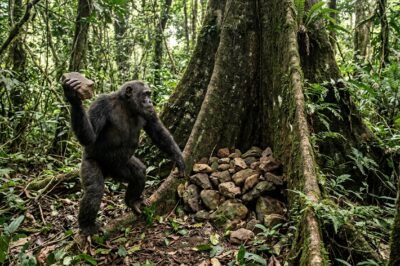
Deep in the humid, vine-draped forests of West Africa, a mystery has been unfolding for over a decade that challenges our fundamental understanding of primate intelligence and the origins of culture. For over ten years, researchers have been documenting a behavior that sounds more like a myth than a biological reality: groups of chimpanzees are systematically picking up heavy rocks and hurling them with deliberate force against the trunks of specific trees. This behavior, known as Accumulative Stone Throwing (AST), results in significant piles of stones at the base of these trees, resembling the cairns built by early human ancestors. While chimpanzees are well-known for their tool-use, such as using sticks to fish for termites or stones to crack open nuts, AST is uniquely baffling because it appears to serve no immediate survival purpose. There is no caloric reward, no predatory defense, and no direct environmental gain. This has led scientists from the Max Planck Institute for Evolutionary Anthropology to delve into the evolutionary roots of ritual, communication, and symbolic behavior. The sound of a heavy rock striking a hollow trunk echoes through the canopy, a percussive thud that signals something profound about the cognitive landscape of our closest living relatives. This analysis explores the decade-long study published recently, exploring why these primates are drawn to these specific arboreal targets and what it reveals about the evolution of culture and perhaps even early religious impulses in the Great Apes. ## The Discovery of Accumulative Stone Throwing. The initial discovery of these stone piles, or cairns, came as a surprise to field researchers who were setting up remote camera traps as part of the Pan African Programme: The Cultured Chimpanzee (PanAf). Unlike the well-documented use of stones to crack oil palm nuts, which involves a precise and functional strike on a flat stone anvil, AST involves a high-energy toss or a forceful slam. The camera footage revealed adult males, and occasionally females and juveniles, approaching a specific stone tree, emitting a loud vocalization known as a pant-hoot, and then forcefully throwing a rock at the tree before moving on. The repetition of this act over a decade has resulted in significant accumulations of stones tucked between the buttress roots of these trees. Researchers have noted that these trees are often hollow or have particular resonant properties, suggesting that the sound produced by the impact is as important as the act itself. This behavior was not observed in all chimpanzee populations across Africa, but rather concentrated in four specific West African countries: Guinea-Bissau, Guinea, Liberia, and Côte d’Ivoire. This marks AST as a distinct cultural trait rather than a universal species-wide instinct. The localized nature of this tradition suggests that the knowledge of which trees to hit and where the shrines are located is passed down through social learning within specific communities. This discovery adds a new layer to our understanding of primate societies, suggesting they possess historical traditions that are maintained over long periods. ## Deciphering the Pattern of Ritualistic Behavior. What makes AST particularly fascinating to the scientific community is its seemingly non-utilitarian nature. In most cases of animal tool use, there is a clear caloric or survival-based reward. A crow uses a twig to extract a grub; a chimpanzee uses a stick to extract honey. However, throwing a rock at a tree provides no immediate food or mating advantage. This has led researchers to categorize the behavior as ritualized. Analysis of the decade-long data set shows that the behavior is often performed in a high-arousal state. The chimpanzee approaches the tree, displays a level of excitement, and then performs the throw. The fact that the stones are left at the site is a crucial observation. In human archaeology, the accumulation of objects in a specific location often points to the creation of a sacred or significant space. By studying the patterns of these throws, scientists have found that certain trees are hit hundreds of times, while others nearby are ignored. The selection process for these trees involves both the visual presence of the existing pile and the acoustic feedback of the trunk. This suggests a feedback loop where the ritual creates a landmark, and the landmark reinforces the ritual, creating a sense of place within the forest that persists for years. ## The Role of Acoustic Communication and Drumming. A leading hypothesis regarding the why of this behavior centers on the acoustic properties of the chosen trees. Chimpanzees are highly vocal animals, and sound is their primary method of maintaining contact over long distances in dense forest environments. The pant-hoot is a signature call, but buttress drumming—where chimps kick or hit the large, wall-like roots of trees with their hands or feet—is also common. Researchers argue that AST might be an extension of this drumming behavior. By using a stone, the chimpanzee can produce a louder, sharper, and more unique sound than by using their limbs alone. The hollow nature of many stone trees acts as a resonator, projecting the sound further into the forest canopy. This could serve as a long-distance signal to rival groups or as a way to reinforce the presence and dominance of a male within his territory. The auditory signature of a rock hitting a resonant tree is distinct, and over a decade, these drumming posts become established fixtures in the chimpanzees’ mental map of their environment. This indicates a sophisticated understanding of acoustics and the strategic use of external objects to amplify biological signals. The energy spent in carrying heavy rocks to these sites suggests that the acoustic payoff is significant enough to justify the physical effort. ## Cultural Traditions Across Chimp Communities. One of the most significant findings of the PanAf study is that AST is a regional culture. This discovery adds to the growing body of evidence that chimpanzee societies possess diverse cultures, much like human ethnic groups. In some regions, chimps specialize in honey-dipping; in others, they are expert spear-fishers for galagos. The presence of stone-throwing sites in West Africa and their absence in East Africa tells us that this is a learned tradition. This has profound implications for how we view primate intelligence and social structure. It suggests that a group of chimpanzees at some point in the past invented this ritual, and it caught on, being transmitted through observation and imitation. The persistence of these sites over ten years shows a high level of social stability and tradition-keeping. It also raises urgent questions about the extinction of cultures; as chimpanzee habitats are destroyed by logging and mining, we are not just losing a species, we are losing unique, ancient traditions that represent the non-human equivalent of history. These stone piles are physical manifestations of a collective memory that could be centuries old, representing a legacy that is wiped out when a community is displaced. ## Challenging the Boundary Between Primate and Human. The sight of a pile of stones at the base of a tree is eerily similar to the cairns found throughout human history, which have served as trail markers, burial sites, or religious shrines. This similarity has prompted evolutionary biologists to reconsider the origins of human ritual. If our closest relatives are creating significant landmarks through repetitive, symbolic actions, it suggests that the cognitive foundations for human religion and symbolic thought may be much older than previously believed. The stone trees of the chimpanzees might be the evolutionary precursor to the megalithic structures of early humans. While it is a leap to call this religion in the human sense, the behavioral markers—symbolism, repetition, social learning, and the creation of a non-functional site—are all present. This research forces us to broaden our definition of culture to include our primate cousins. It challenges the anthropocentric view that humans are the only beings capable of imbuing the physical landscape with abstract meaning. The realization that chimpanzees are also landmark-builders suggests that the human mind did not develop these traits in a vacuum but as part of a long evolutionary continuum. ## Future Directions in Primatological Research. As the study continues into its second decade, scientists are moving from asking what is happening to why it persists and how it evolves. Future research will involve more sophisticated acoustic modeling to determine exactly how far the sound of a stone strike travels compared to a hand strike across different forest densities. There is also a push to use artificial intelligence and machine learning to analyze the thousands of hours of camera trap footage to see if there are specific dialects of throwing or if certain individuals act as the keepers of the ritual. Furthermore, the conservation status of these cultural sites is a growing concern for international wildlife organizations. If a forest is logged, even if the chimps survive elsewhere, they lose their monuments and their connection to their ancestral sites. Protecting the physical environment must now include protecting the cultural landscape of the chimpanzees. The decade of observation has only scratched the surface of this mystery. As we refine our tools and deepen our understanding, the stone trees of West Africa will likely remain a focal point for understanding the shared evolutionary journey of primates and humans. The persistence of these rock piles is a testament to a wild, sophisticated mind that we are just beginning to hear. ## Conclusion: The Legacy of the Stone Trees. The long-term study of chimpanzee stone throwing serves as a powerful reminder of how much there is still to learn about the natural world and the creatures within it. For over ten years, these primates have maintained a tradition that bridges the gap between simple tool use and complex symbolic behavior. The implications for our understanding of human evolution are vast, suggesting that the roots of our most complex social and ritualistic behaviors may lie deep in our shared ancestral past with the Great Apes. As researchers continue to monitor these sites, they are not just observing animals; they are witnessing the ongoing history of a non-human culture. The stone trees stand as monuments to primate intelligence, and the effort to decode their meaning is one of the most exciting frontiers in modern science. The legacy of the stone trees is a reminder that the world is full of intelligence and culture, often hidden in the most unexpected places. Protecting these primates and their traditions is a duty that goes beyond conservation; it is about respecting the diverse ways in which life on Earth expresses its complexity. The echoing sound of a stone striking a hollow tree is a call from our evolutionary past, and it is a call we must listen to with humility and wonder.
The Mystery of the Stone-Throwing Chimpanzees: A Decade of Ritualized Behavior Uncovered
Posted by
Stories





-

Hunkkaar Teaser Analysis: Aneet Padda’s Gritty Transformation and the Evolving Landscape of Indian Thrillers
-

Mithila Palkar: The Relatable Queen of Indian Web Series and Her Meteoric Rise
-

Wamiqa Gabbi: The Meteoric Rise of Indian Web Series’ Most Versatile Leading Lady
-

Triptii Dimri Biography: The Evolution of India’s Newest Cinematic Sensation and Web Series Star
-

Wamiqa Gabbi: The Rise of India’s New Digital Icon and the Future of OTT Stardom
-

Mithila Palkar: The Unstoppable Evolution of India’s Digital Darling and Her Journey to the Silver Screen
-

Mithila Palkar: The Comprehensive Journey of India’s Web Series Sensation and Digital Pioneer
-

Mithila Palkar: The Relatable Queen of Indian Web Series and Her Inspiring Journey to Stardom
-

Sobhita Dhulipala Biography: The Meteoric Rise of India’s Most Versatile Web Series Star
-

Mithila Palkar: The Unstoppable Journey of India’s Digital Darling and Web Series Queen
-

Triptii Dimri: The Complete Biography of India’s Newest Cinematic Sensation and Web Series Icon
-

Wamiqa Gabbi: The Ethereal Rise of India’s Most Versatile Web Series Star
-

Sobhita Dhulipala: The Unstoppable Rise of India’s Most Versatile Web Series Icon
-

Wamiqa Gabbi: The Meteoric Rise of the New Queen of Indian Web Series and Her Unstoppable Journey to Stardom
-

Triptii Dimri: The Meteoric Rise of India’s New Cinema Sweetheart and Web Series Icon
-

Wamiqa Gabbi: The Versatile Queen of Indian OTT and Her Phenomenal Rise to Stardom
-

Tripti Dimri Biography: The Rise of India’s New National Crush and Her Journey from Laila Majnu to OTT Stardom
-

Wamiqa Gabbi Biography: The Meteoric Rise of India’s Newest OTT Sensation and Versatile Powerhouse
-

Wamiqa Gabbi Biography: The Meteoric Rise of the Digital Queen of Indian Web Series
-

The Rise of Wamiqa Gabbi: A Deep Dive into the Journey of India’s Most Versatile OTT Sensation
-

The Meteoric Rise of Triptii Dimri: Biography, Acting Prowess, and the Journey of India’s Newest Cinema Sensation

Launching Soon: The Future of News with Our E-Newspaper
In the ever-evolving landscape of media and technology, we are thrilled to announce the upcoming launch of our innovative e-newspaper, set to redefine the way news is consumed in the digital age. Embracing the convenience and accessibility that the digital world offers, our e-newspaper aims to deliver real-time news updates, insightful articles, and interactive features directly to your devices. With a commitment to journalistic integrity and a passion for storytelling, we are dedicated to keeping you informed, engaged, and connected, no matter where you are. Stay tuned for the launch of our e-newspaper, where the future of news awaits at your fingertips.
Recent News
- India vs Malaysia LIVE score, Asian Games 2026 men’s hockey final: Harmanpreet Singh’s Early Lead and Tactical Masterclass

- Comprehensive Analysis: Asian Games 2026 Wrestling – India’s Schedule, Medal Prospects, and Global Standings

- Jr. NTR Takes Stand Against AI Misuse: A Comprehensive Analysis of the ‘Chuttamalle’ Deepfake Controversy

- Stroke Care Delays Increased Globally During COVID-19 Pandemic – European Medical Journal Analysis

- Deep Analysis: Nayara Energy Hikes Petrol and Diesel Prices Amid 2026 Global Energy Shifts

- Asian Games 2026 Wrestling Day 3 Live: Susaki, Sujeet, Zare in Action – United World Wrestling

Politics
- Deep Analysis: Nayara Energy Hikes Petrol and Diesel Prices Amid 2026 Global Energy Shifts
- Mamata Banerjee Allegations: A Deep Dive into the ‘Hijacking’ of the Electoral Process

- Trump to Host Zuckerberg and AI Titans: A Seismic Shift in Tech Governance and Global Strategy

- 9 Pak Soldiers Killed After First Woman Unit Of Baloch Rebels Attack Convoy: A Deep Dive Analysis

- Donald Trump At UN General Assembly: Make Deal Or Drive Iran Into Hell? – A Comprehensive Geopolitical Analysis

- Supreme Court Critiques ‘Machine-Generated’ Delhi SIR Notices: A Deep Dive into Judicial Concerns over Automated Governance

Categories
- Art & Culture 103
- Auto 85
- Beauty 15
- Blog 292
- Books 7
- Business 359
- Celebrities 217
- Crime Files 139
- Democracy 308
- Education 84
- Entertainment 154
- Environment 133
- epaper 1
- Fashion 37
- Food 59
- Gadgets 87
- Guide 150
- Handicrafts 11
- Health 278
- Healthy Living 107
- History 5
- incidents 163
- Lifestyle 41
- Music 7
- Photography 15
- Politics 441
- Science & Technology 160
- Sports 264
- Tech 133
- Television 2
- Travel 68
- Travel & Tourism 30
- Trends 50
- Weather 8
- Web Series 97
- Workout 4
- World 661
Leave a Reply