
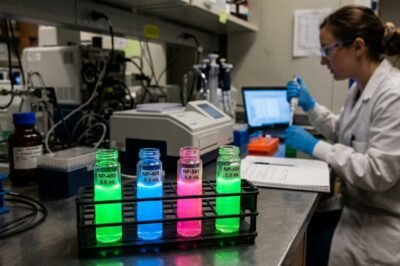
The intersection of aesthetic beauty and rigorous scientific inquiry has long been a hallmark of the Chemical & Engineering News (C&EN) “Chemistry in Pictures” series. However, the recent spotlight on the world’s tiniest glow sticks represents more than just a visual spectacle; it marks a significant milestone in the field of nanotechnology and molecular engineering. These microscopic beacons of light, often thousands of times smaller than a human hair, are the result of sophisticated chemical synthesis that mimics the chemiluminescent reaction found in traditional emergency glow sticks but at a scale that allows for integration into biological systems and advanced materials. This development is not merely a novelty for the lab; it is a profound leap forward in how we visualize invisible processes, from the cellular level to the macro-scale of industrial manufacturing. By shrinking the mechanism of light production to the nanoscale, researchers have opened a Pandora’s box of possibilities in medical diagnostics, precision sensing, and even high-tech consumer electronics. In this analysis, we delve deep into the mechanics, the market potential, and the future trajectory of these luminescent wonders, exploring how something so small can illuminate such a vast array of scientific challenges.
The Nano-Scale Brilliance: Understanding Chemiluminescence at the Molecular Level
At the heart of these tiny glow sticks lies the principle of chemiluminescence—the production of light through a chemical reaction rather than heat. Unlike fluorescence, which requires an external light source (like a UV lamp) to excite molecules, chemiluminescence is self-sustaining. In the context of the C&EN feature, these miniaturized systems typically involve a reaction between an organic oxalate ester and hydrogen peroxide in the presence of a fluorescent dye. When these components interact, they form a high-energy intermediate that decomposes, transferring its energy to the dye molecules, which then release that energy as vibrant, visible light. The engineering challenge has always been to contain this complex multi-step reaction within a stable nanoparticle or a lipid-based carrier without losing intensity or duration.
The significance of achieving this at the nanoscale cannot be overstated. Standard glow sticks rely on macroscopic glass ampoules to keep reagents separate until they are needed. In the nano-regime, researchers utilize clever encapsulation techniques, such as polymer-based shells or micellar structures, to shield the reactive core from the surrounding environment. This level of control allows scientists to “tune” the light output by altering the concentration of dyes or the thickness of the shell, effectively creating a customizable light source that can be triggered by specific external stimuli, such as a change in pH, the presence of a particular enzyme, or even a targeted temperature shift.
Technological Foundations and the Path to Miniaturization
The transition from a 6-inch plastic tube to a 50-nanometer particle required a paradigm shift in materials science. One of the primary hurdles was the quenching effect, where high concentrations of fluorescent dyes often lose their brightness due to intermolecular interactions. To solve this, chemists have developed “aggregation-induced emission” (AIE) molecules and other advanced fluorophores that thrive in the packed environment of a nanoparticle. These materials are engineered to be hydrophobic, ensuring they remain trapped within the core of the tiny glow stick, while the outer shell is made hydrophilic to allow for solubility in water-based environments like human blood or industrial wastewater.
Furthermore, the delivery mechanism for the “trigger” is a masterpiece of precision engineering. In many of these miniature systems, the hydrogen peroxide or the triggering agent is either co-encapsulated in a latent form or is introduced as a bio-available substrate. This allows the glow stick to remain dormant until it reaches its intended destination. This spatial and temporal control is what differentiates the modern “tiny glow stick” from simple fluorescent markers. It is a functional device, a microscopic machine designed to report back on its surroundings through the universal language of light.
Market Dynamics and the Economic Value of Optical Probes
From a financial perspective, the market for optical probes and bioluminescent markers is experiencing explosive growth. Valued at several billion dollars globally, the sector is driven by the increasing demand for non-invasive diagnostic tools and the rapid expansion of the life sciences research market. These tiny glow sticks represent a high-value niche within this broader industry. Unlike traditional dyes that require expensive laser equipment for detection, self-illuminating nanoparticles can potentially be detected with simpler, more cost-effective optical sensors, or even high-resolution smartphone cameras in point-of-care settings.
Investors and pharmaceutical giants are paying close attention to these developments because of their potential to revolutionize drug delivery tracking. By tagging a therapeutic molecule with a miniature glow stick, researchers can observe, in real-time, exactly where a drug is distributed in the body and how long it persists before being metabolized. This level of data is invaluable for reducing the failure rate of clinical trials and optimizing dosage. Consequently, we are seeing a trend of mergers and acquisitions where biotech startups focusing on luminescent materials are being integrated into larger diagnostic platforms, signaling a shift toward “theranostics”—the combination of therapy and diagnostics.
Strategic Applications in Healthcare and Industrial Sensing
The most immediate and impactful application of this technology is found in the medical field. These tiny glow sticks can be engineered to target specific cancer cells. Once the nanoparticle binds to a tumor marker, the internal chemical reaction is triggered, causing the tumor to glow from within. This allows surgeons to identify the precise margins of a tumor during surgery, a process known as fluorescence-guided surgery (FGS), but without the need for cumbersome external light sources that can cause tissue autofluorescence and obscure the view. The clarity provided by self-lighting probes could significantly improve surgical outcomes and reduce recurrence rates.
Beyond healthcare, the industrial implications are equally vast. In the world of structural engineering and manufacturing, these nanoparticles can be embedded into coatings or composite materials to act as “stress sensors.” When a material experiences micro-fractures or structural fatigue, the tiny glow sticks within the material can be designed to rupture and light up, providing a visual warning of failure before it becomes catastrophic. This application is currently being explored for aerospace components and critical infrastructure like bridges and pipelines, where early detection of wear can save billions in repair costs and prevent loss of life.
- Precision Diagnostics: Enabling the detection of low-abundance biomarkers in early-stage diseases.
- Environmental Monitoring: Using glow-on-demand sensors to detect heavy metals or toxins in water supplies without the need for laboratory equipment.
- Anti-Counterfeiting: Creating unique, light-emitting “ink” for high-security documents and luxury goods that is impossible to replicate.
- Advanced Research: Providing a tool for cell biologists to track intracellular processes without the phototoxicity associated with external lasers.
Challenges in Scaling and Commercial Viability
Despite the immense promise, the road from a “Chemistry in Pictures” feature to a mass-market product is fraught with challenges. The most significant hurdle is biocompatibility and toxicity. Many of the organic solvents and oxalate esters used in traditional chemiluminescence are toxic to living cells. Scientists are currently working on developing “green” versions of these reactions that use benign, bio-derived materials. Ensuring that the waste products of the light-producing reaction are non-toxic is a mandatory requirement for FDA approval in clinical settings.
Another challenge is the duration of the light emission. A standard glow stick might last for several hours, but at the nanoscale, the volume of reagents is so small that the reaction can burn out in minutes. Extending the “glow time” requires incredibly precise control over the reaction kinetics. Researchers are exploring slow-release shells and catalytic systems that can sustain the light for longer periods, which is essential for long-term monitoring or extended surgical procedures. Finally, the cost of synthesis remains high. Producing uniform, high-quality nanoparticles with consistent light-output characteristics requires sophisticated equipment and expensive raw materials, which must be addressed to make the technology viable for widespread industrial use.
Future Implications: A Bright Horizon for Nano-Optics
Looking ahead, the future of the “tiniest glow sticks” is inextricably linked with the rise of the Internet of Things (IoT) and wearable technology. Imagine a world where a tiny, glow-stick-based sensor in a wearable patch monitors your sweat for glucose levels or signs of dehydration, providing a subtle color-coded glow to alert you to your health status. In the realm of fundamental science, these tools will continue to shrink the gap between what we can imagine and what we can see, allowing us to film the inner workings of live cells with unprecedented clarity. The work highlighted by C&EN is a reminder that in the world of chemical engineering, the smallest components often lead to the most illuminating breakthroughs. As we refine our ability to manipulate matter at the atomic level, the glow of these tiny sticks will serve as a beacon, guiding us toward a more precise, visual, and informed understanding of the physical and biological worlds. The integration of artificial intelligence in designing these molecules will likely accelerate the discovery of even more efficient and longer-lasting luminescent systems, further cementing their role in the next generation of technological advancement.






































Leave a Reply