
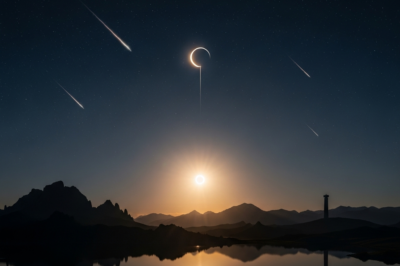
The night sky is preparing to host a rare and breathtaking duality this August, a cosmic coincidence that has seasoned astronomers and amateur stargazers alike marking their calendars with fervor. In a stunning display of celestial mechanics, a partial solar eclipse will coincide with the peak of the Perseid meteor shower, offering a ‘double feature’ that is rarely seen in a single travel window. This event is not merely a visual spectacle; it is a profound reminder of our place in the solar system, bridging the gap between the daytime majesty of our sun and the nocturnal mystery of deep space. For those willing to travel, the vast landscapes of the United States and Canada provide the perfect stage for this performance. From the rugged coastlines of the Atlantic to the high-altitude peaks of the Rockies, the geography of North America offers diverse microclimates and dark-sky preserves that are essential for optimal viewing. As the moon takes a ‘bite’ out of the solar disk during the day and the debris of Comet Swift-Tuttle ignites the atmosphere at night, the experience promises to be a transformative journey into the heart of the cosmos. Understanding why this matters requires a look at the rarity of such timing; while both events occur with relative frequency independently, their synchronization during the height of summer camping season creates a unique opportunity for ‘astro-tourism’ that could see millions flocking to rural areas.
The Science of the Spectacle: Solar Eclipses Meets the Perseids
To truly appreciate what is unfolding this August, one must delve into the physics of these events. A partial solar eclipse occurs when the Moon passes between the Earth and the Sun, but the alignment is not perfectly straight. Instead of the total darkness of a total eclipse, we witness a crescent sun, where the moon obscures a significant portion of the solar surface. This requires specialized solar filters or ISO-certified eclipse glasses to view safely, as even a small sliver of exposed sun can cause permanent retinal damage. Meanwhile, the Perseid meteor shower is a predictable yet spectacular annual event caused by Earth passing through the debris trail left by Comet 109P/Swift-Tuttle. As these tiny fragments of dust and ice enter our atmosphere at speeds exceeding 37 miles per second, they compress the air in front of them, creating the brilliant streaks of light we call ‘shooting stars.’ What makes the Perseids the ‘king’ of meteor showers is their high frequency—often 60 to 100 meteors per hour—and their tendency to produce ‘fireballs,’ which are larger, brighter bursts of light that can last longer than typical meteors. When these two events happen in tandem, the daytime anticipation of the eclipse transitions into the nocturnal excitement of the meteor hunt, creating a 24-hour cycle of astronomical wonder that is technically demanding for photographers and emotionally resonant for all viewers.
Top 5 Locations in the United States for Dual Viewing
The United States offers some of the world’s most accessible dark-sky parks, specifically curated to combat light pollution. First on the list is Glacier National Park in Montana. Known as an International Dark Sky Park, Glacier provides high-altitude clearings where the atmosphere is thin and the air is crisp, ensuring that the partial eclipse is sharp and the Perseids are incredibly bright. The reflection of meteors over Lake McDonald adds a poetic layer to the experience. Second is Craters of the Moon National Monument in Idaho. The volcanic, otherworldly landscape here serves as a fitting backdrop for solar events; the black basalt rocks absorb heat, and the lack of vegetation provides an unobstructed 360-degree view of the horizon. Third, we look to the East Coast at Acadia National Park in Maine. While coastal fog can be a risk, the Cadillac Mountain summit offers the first look at the sun in the U.S., making the eclipse timing particularly special. Fourth is Cherry Springs State Park in Pennsylvania, famous among astronomers for its dedicated ‘field of stars’ where light pollution is strictly regulated, making it arguably the best spot in the Eastern U.S. for the Perseid peak. Finally, Great Basin National Park in Nevada offers some of the darkest skies in the lower 48 states. Its remote location ensures that the subtle ‘earthshine’ during the eclipse and the faintest Perseid trails are visible to the naked eye.
Canada’s Wilderness: Where the Stars Shine Brightest
Canada’s vast geography and lower population density make it a premier destination for celestial observation. Jasper National Park in Alberta stands out as the world’s largest accessible dark-sky preserve. The Canadian Rockies provide a dramatic silhouette for the partial eclipse, and the lack of urban glow means the Milky Way will be visible in stunning detail alongside the Perseid meteors. Grasslands National Park in Saskatchewan offers a different but equally compelling environment; its flat prairies provide an infinite horizon, perfect for watching the moon slowly transit the sun. Moving east, Mont-Mégantic in Quebec is home to a world-class observatory and a dedicated ASTROlab, making it the ideal spot for those who want a guided scientific experience. The park was the first International Dark Sky Reserve in the world. Bruce Peninsula National Park in Ontario offers a unique vantage point over the crystal-clear waters of Georgian Bay, where the eclipse can be viewed reflecting off the water. Lastly, Fundy National Park in New Brunswick provides a coastal experience where the high tides and rugged cliffs create a sense of primordial connection to the lunar cycles driving the eclipse. In these Canadian locations, the cooler August nights often result in more stable atmospheric conditions, reducing the ‘twinkling’ of stars and allowing for steadier telescopic views of the solar disk.
Astro-Photography: Capturing the Sun and the Stars
Capturing both a partial solar eclipse and a meteor shower in one trip requires a diverse set of skills and equipment. For the eclipse, the most critical piece of gear is a high-quality solar filter for your lens. Without it, the sun’s intensity will melt the internal components of your camera sensor. Photographers should aim for a focal length of at least 400mm to get a detailed shot of the lunar silhouette against the solar flares. Bracketing exposures is essential, as the dynamic range between the bright sun and the dark moon is extreme. As night falls, the strategy must shift entirely. To capture the Perseids, a wide-angle lens (14mm to 24mm) with a fast aperture of f/2.8 or wider is necessary. Use a sturdy tripod and a remote shutter release to avoid camera shake. Setting your ISO between 1600 and 3200 and using a 15-20 second exposure will allow the camera to ‘soak up’ the faint light of the meteors without causing the stars to trail due to the Earth’s rotation. The ultimate challenge is the composite: creating a time-lapse that shows the transition from the eclipsed sun to the meteor-streaked night sky, a visual narrative of this specific trip’s unique offerings.
The Economic and Ecological Impact of Astro-Tourism
The rise of ‘astro-tourism’ has significant implications for local economies and environmental conservation. Small towns near dark-sky parks often see a massive influx of revenue during these events, with hotels, campsites, and local eateries booking out months in advance. However, this surge in tourism brings the responsibility of ‘Dark Sky Advocacy.’ Light pollution is a growing global issue that disrupts migratory patterns of birds, affects human circadian rhythms, and erases our cultural heritage of stargazing. Events like the August eclipse and Perseids serve as a catalyst for communities to implement ‘dark-sky friendly’ lighting—fixtures that shield light and point it downward rather than into the atmosphere. Many of the 10 locations listed have active programs to educate visitors on the importance of preserving the darkness. By choosing to visit these areas, tourists are effectively voting with their wallets for the preservation of the night sky, encouraging national park services to maintain these pristine environments for future generations of scientists and dreamers.
Future Outlook and Concluding Thoughts
As we look toward the future, the frequency of such overlapping events remains low, making this August a pivotal moment for the scientific community. These occurrences provide vital data for solar physicists studying the solar corona and for astronomers tracking the density of comet debris trails. But beyond the data, there is the human element. Standing in the shadow of the moon during the day and witnessing the ‘death’ of ancient cometary dust at night humbles us. It reminds us that we live on a planet that is part of a much larger, clockwork-like system. Whether you are in the high plains of Montana or the coastal cliffs of New Brunswick, the message is the same: the universe is vast, beautiful, and occasionally, it puts on a show that demands our undivided attention. This double feature is a call to disconnect from our screens and reconnect with the infinite, ensuring that the wonder of the cosmos remains a central part of the human experience. As you pack your solar glasses and your telescopes, remember that you are participating in an age-old tradition of looking upward to find our way forward.





































Leave a Reply