
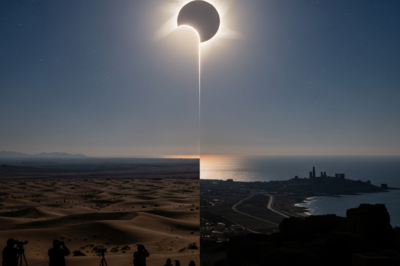
The celestial mechanics of our solar system are preparing to stage one of the most magnificent displays of cosmic alignment in recent memory. On August 12, 2026, the world will witness a total solar eclipse, an event that has captured the human imagination since the dawn of time. For the Middle East and North Africa (MENA) region, this event serves as a precursor to a golden age of eclipses, as the 2026 event will be followed shortly by an even more dramatic total eclipse in 2027. While the path of totality for the 2026 eclipse primarily traverses the northern latitudes, its impact on the MENA region will be profound, offering significant partial visibility that will darken the skies and provide a rare scientific opportunity for millions of residents from Morocco to the Levant. This guide explores the intricate details of the 2026 solar eclipse, focusing specifically on what observers in the Arab world can expect, the science behind the phenomenon, and how this event fits into the broader context of regional astronomical history.
Understanding the Celestial Mechanics: The Science of the 2026 Total Solar Eclipse
A total solar eclipse occurs when the Moon passes directly between the Earth and the Sun, casting a shadow on our planet and temporarily obscuring the Sun’s brilliant disk. The 2026 event is particularly noteworthy because it marks the first total solar eclipse visible in Europe since 1999 and the first in the Iberian Peninsula since 1905. The physics of this event are governed by the alignment of the lunar nodes and the relative distances between the three celestial bodies. During this eclipse, the Moon will be near its perigee, making it appear slightly larger in the sky, which facilitates the complete covering of the solar photosphere. For observers in the MENA region, while most will fall outside the ‘umbra’ (the dark inner shadow where totality occurs), they will reside within the ‘penumbra’ (the lighter outer shadow). This means countries across North Africa will experience a deep partial eclipse, where upwards of 90 percent of the Sun is obscured, leading to a noticeable drop in temperature and a haunting, silvery quality of light that differs significantly from a normal sunset.
The Path of Totality and MENA Visibility: Where to Look
The path of totality for the August 12, 2026, eclipse begins in the Arctic Ocean, crossing over Greenland, western Iceland, and the Atlantic Ocean before reaching the northern coast of Spain. The shadow will sweep across major Spanish cities like Bilbao, Zaragoza, and Palma de Mallorca. For the MENA region, the proximity to this path is crucial. Morocco, being the northwestern-most country in the Arab world, will enjoy the most dramatic views. In cities like Tangier and Tetouan, the magnitude of the eclipse will be exceptionally high. Although the very edge of the umbra technically dissipates in the Mediterranean Sea just north of the African coast, the partial phases in Northern Morocco will reach over 90 percent coverage. Moving eastward through Algeria, Tunisia, and Libya, the percentage of coverage gradually decreases but remains a significant spectacle. Even in Cairo and the Levant, skywatchers will see a substantial portion of the Sun covered by the lunar disk, making it a pan-regional event that unites amateur astronomers and curious citizens alike.
Scientific Significance: Why Researchers are Focusing on North Africa
For the scientific community, the 2026 eclipse represents a vital laboratory for studying the solar corona and the Earth’s ionosphere. Even in areas of partial eclipse, such as those found in the MENA region, researchers can conduct valuable experiments. The sudden reduction in solar radiation provides a unique opportunity to study how the Earth’s upper atmosphere reacts to a rapid ‘switching off’ of its primary energy source. In North Africa, where clear skies are almost guaranteed in August, ground-based observations are expected to be highly successful. Many international research teams are already scouting locations in Morocco and Algeria to set up specialized equipment to measure changes in temperature, atmospheric pressure, and the behavior of animals during the event. Furthermore, the 2026 eclipse serves as a ‘dry run’ for the 2027 total eclipse, which will have a path of totality passing directly through the heart of Egypt and Saudi Arabia. Scientists are using the 2026 event to calibrate instruments and refine data collection techniques in the unique atmospheric conditions of the Sahara and the Mediterranean basin.
The Rise of Astro-Tourism in the Arab World
Astro-tourism is a rapidly growing sector of the global travel industry, and the 2026 eclipse is expected to provide a significant boost to the economies of the MENA region. While Spain will be the primary destination for ‘totality hunters,’ the northern coast of Morocco is positioning itself as a secondary hub for those seeking a unique cultural experience combined with high-magnitude partial eclipse viewing. Travel agencies in Marrakesh and Casablanca are already developing ‘Eclipse Tours’ that combine desert excursions with guided astronomical sessions. This trend highlights a broader shift in the region’s tourism strategy, moving toward niche, high-value experiences that leverage the natural beauty and clear night skies of the North African landscape. Governments are beginning to recognize the potential of their dark-sky reserves, and the 2026 eclipse serves as a high-profile catalyst for infrastructure development in remote areas that offer the best vantage points for celestial observation.
Safety First: Essential Viewing Guidelines for the Public
Regardless of the level of solar coverage, safety remains the paramount concern for anyone observing a solar eclipse. In the MENA region, where the August sun is already intense, the risks are magnified. It is never safe to look directly at the Sun without specialized eye protection, even during a partial eclipse. Standard sunglasses, even those with very dark tints, are insufficient and do not filter out the harmful infrared and ultraviolet radiation that can cause permanent retinal damage, a condition known as solar retinopathy. To view the 2026 eclipse safely, residents must use ISO 12312-2 certified solar viewing glasses. Organizations across the Middle East, including the Arab Union for Astronomy and Space Sciences, are expected to launch public awareness campaigns to distribute these glasses and educate the public on indirect viewing methods, such as pinhole projectors. For photographers and telescope users, specialized solar filters are a requirement to prevent the concentrated light from damaging both the equipment and the observer’s eyes.
The Future Outlook: From 2026 to the ‘Great North African Eclipse’ of 2027
While the 2026 eclipse is a major event, it is often discussed in the same breath as the ‘Great North African Eclipse’ of August 2, 2027. The 2027 event will be one of the longest total eclipses of the 21st century, with totality lasting over six minutes in parts of Egypt. The 2026 event acts as a magnificent prelude, building public interest and scientific momentum. Together, these two events represent a rare ‘double header’ for the MENA region, placing it at the center of the global astronomical map for two consecutive years. This period of intense celestial activity is expected to inspire a new generation of Arab scientists, engineers, and astronomers, echoing the region’s historical golden age of Islamic astronomy when scholars in Baghdad, Cairo, and Cordoba led the world in understanding the heavens. The 2026 eclipse is more than just a fleeting shadow; it is a reminder of our place in the cosmos and a bridge to a future of expanded scientific discovery in the Middle East.
Concluding Thoughts on the 2026 Celestial Spectacle
The solar eclipse of August 12, 2026, promises to be a transformative experience for the MENA region. Although the path of totality narrowly misses the African mainland, the high-magnitude partial eclipse will offer a rare and beautiful sight for millions. From the bustling streets of Tangier to the ancient landmarks of Tunis, the darkening sky will serve as a moment of collective wonder, transcending borders and politics. As the moon’s shadow sweeps across the Mediterranean, it brings with it opportunities for scientific advancement, economic growth through tourism, and a renewed cultural appreciation for the sciences. Preparing for the event today ensures that we can enjoy the spectacle safely and fully appreciate the intricate celestial dance that governs our world. The 2026 eclipse is not just an end in itself, but a spectacular beginning to an era of astronomical prominence for the Arab world, leading directly into the historic total eclipse of 2027.






































Leave a Reply