
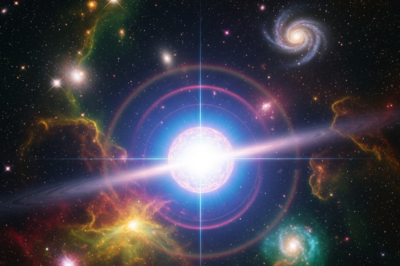
The cosmos has always been a canvas of mysteries, but the latest revelation from the James Webb Space Telescope (JWST) has sent shockwaves through the global scientific community. Astronomers have recently identified a phenomenon so extreme it defies conventional stellar evolution models: a bizarre ‘black hole star’ that radiates with the intensity of 100 billion suns. This discovery, detailed in recent reports and analyzed by leading astrophysicists, represents more than just a bright light in the distance; it is a fundamental challenge to our understanding of how the universe’s most massive structures formed in the wake of the Big Bang. By peering into the deep infrared spectrum, the JWST has captured a glimpse of an era when the universe was in its infancy, revealing objects that were previously thought to be theoretical or entirely impossible. This ‘black hole star’ serves as a beacon, illuminating the dark ages of the early universe and providing a roadmap for the future of astronomical inquiry.
The Nature of the Celestial Giant: What is a Black Hole Star?
To understand the significance of this discovery, one must first grapple with the sheer scale and nature of the object in question. Often referred to in theoretical physics as a ‘Quasi-star,’ these entities are fundamentally different from the stars we see in the night sky today. A typical star, like our Sun, is powered by nuclear fusion at its core, where hydrogen atoms fuse to form helium, releasing energy. However, a ‘black hole star’ is a hypothetical class of extremely massive stars that may have existed very early in the history of the universe. In these objects, the core does not merely undergo fusion; it collapses into a central black hole. Remarkably, the outer layers of the star are so massive and dense that they can withstand the initial energy release of the black hole’s formation, creating a stable, albeit temporary, equilibrium. The brightness observed by the JWST is not from fusion, but from the massive amount of energy generated as matter falls into the central black hole, a process known as accretion. This energy is then radiated through the star’s enormous envelope, resulting in a luminosity that exceeds entire galaxies.
The Unprecedented Technological Triumph of JWST
The identification of this object would have been impossible without the sophisticated suite of instruments aboard the James Webb Space Telescope. Unlike its predecessor, the Hubble Space Telescope, which primarily viewed the universe in visible and ultraviolet light, JWST is optimized for the infrared spectrum. This is crucial because light from the distant, early universe is ‘redshifted’ as the universe expands, stretching the wavelengths into the infrared range. The telescope’s Near-Infrared Camera (NIRCam) and Mid-Infrared Instrument (MIRI) allowed researchers to pierce through cosmic dust clouds that obscure distant objects. By analyzing the specific spectral signatures of this ‘black hole star,’ scientists were able to calculate its distance, mass, and energy output with unprecedented precision. The data suggests that this object resides at a redshift that places it within the first few hundred million years after the Big Bang, a period known as the ‘Cosmic Dawn.’ The ability of JWST to resolve such a distant and ancient object is a testament to the engineering marvel that it represents, proving that we are now in a golden age of observational cosmology.
Luminosity Beyond Comprehension: 100 Billion Times Brighter Than a Star
When scientists state that this object is 100 billion times brighter than a typical star, the scale is difficult to visualize. For context, our Sun is a moderately bright star, yet this newly discovered entity emits as much light as the combined output of several hundred Milky Way-sized galaxies. This extreme luminosity is the result of the sheer efficiency of black hole accretion. While nuclear fusion converts about 0.7% of mass into energy, a rapidly spinning black hole can convert up to 42% of the mass of infalling matter into radiation. This makes the ‘black hole star’ an incredibly potent engine of light. The radiation pressure generated by this process is so intense that it balances the immense gravitational pull of the star’s outer layers, preventing a total collapse. This discovery provides empirical evidence for the existence of ‘super-luminous’ objects in the early universe, which may have played a critical role in reionizing the intergalactic medium and shaping the formation of subsequent generations of stars and galaxies.
Solving the Mystery of Supermassive Black Hole Seeds
One of the most persistent puzzles in modern astronomy is the ‘Impossible Early Black Hole’ problem. Observations have shown that supermassive black holes, millions or even billions of times the mass of the Sun, existed as early as 800 million years after the Big Bang. Under standard growth models, there simply wasn’t enough time for a regular stellar-mass black hole to grow that large. The discovery of the ‘black hole star’ offers a compelling solution. If the first generation of stars could be these ‘quasi-stars’ with massive ‘seeds’ at their center, they would have a significant head start. These objects could potentially collapse directly into medium-sized black holes of tens of thousands of solar masses, which would then merge and grow into the supermassive giants we see in the centers of galaxies today. This ‘direct collapse’ model is gaining significant traction thanks to the JWST’s data, as it provides a mechanism for rapid growth that bypasses the limitations of traditional stellar evolution.
Implications for the Standard Model of Cosmology
The existence of such a massive and bright object so early in the universe’s history forces a re-evaluation of the Standard Model of Cosmology, known as Lambda-CDM. This model predicts a hierarchical structure formation where small things form first and then merge into larger ones. However, the ‘black hole star’ suggests that massive, complex structures could form much faster than previously anticipated. This might imply that the conditions of the early universe—such as the density of dark matter or the temperature of the primordial gas—were slightly different than our current simulations suggest. Furthermore, the feedback from such a bright object would have profound effects on its surroundings, heating up the local gas and potentially suppressing the formation of smaller stars nearby. This discovery is a stark reminder that the universe is far more diverse and energetic than our models often capture, and that we must remain open to revising our most fundamental theories in the face of new observational evidence.
Looking Ahead: The Future of Deep Space Exploration
The discovery of this 100-billion-sun-equivalent object is just the beginning of a new chapter in astronomy. In the coming years, the JWST will continue to survey the deep field, searching for more of these ‘cosmic monsters.’ Scientists are also planning to use ground-based observatories, such as the Extremely Large Telescope (ELT) in Chile, to perform follow-up spectroscopy that can provide even more detail about the chemical composition of these objects. By studying the elements present in the outer layers of ‘black hole stars,’ researchers can learn about the nucleosynthesis processes that occurred during the first billion years of the universe. Moreover, gravitational wave observatories like LISA (Laser Interferometer Space Antenna) might one day detect the ripples in spacetime caused by the formation or merger of these giant black hole seeds. The synergy between infrared observation and gravitational wave detection promises to unveil the ‘dark side’ of the universe in ways we can only currently imagine.
A New Paradigm in Understanding the Universe
In conclusion, the detection of a bizarre ‘black hole star’ 100 billion times brighter than a star by the James Webb Space Telescope is a landmark achievement in the history of science. It bridges the gap between theoretical physics and observational reality, providing a tangible link to the earliest moments of our cosmic history. This discovery not only sheds light on the origins of supermassive black holes but also challenges us to refine our understanding of the early universe’s dynamics. As we continue to process the data from JWST, it is clear that we are no longer just looking at stars and galaxies; we are witnessing the raw, violent, and magnificent birth of the structures that define our existence. The universe has many more secrets to tell, and with tools like the JWST, we are finally equipped to listen.






































Leave a Reply