
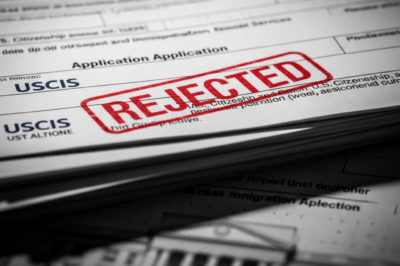
The landscape of American immigration is undergoing a seismic shift as the United States Citizenship and Immigration Services (USCIS) has recently implemented a policy update that grants adjudicators significantly more power to reject visa and green card applications outright. This move, which has sent shockwaves through the international community—particularly among Indian IT professionals and global talent pools—marks a departure from the previous, more lenient approach that allowed applicants the opportunity to correct errors or provide missing documentation. For decades, the US has been the primary destination for the world’s brightest minds, but these new administrative hurdles suggest a tightening of the gates that could redefine the American Dream for millions of aspiring immigrants. The core of this change lies in the removal of the mandatory ‘Request for Evidence’ (RFE) or ‘Notice of Intent to Deny’ (NOID) in cases where the initial filing is deemed incomplete or fails to establish eligibility. This means that even a minor clerical error or a missing supporting document could now lead to an immediate denial, without the applicant ever getting a chance to rectify the mistake.
The End of the RFE Era: Understanding the Policy Shift
For years, the ‘Request for Evidence’ (RFE) served as a critical safety net for immigration applicants. If a USCIS officer found that an application lacked sufficient proof of eligibility or contained technical errors, they would typically issue an RFE, giving the applicant a window of 30 to 90 days to submit the necessary paperwork. This process recognized the inherent complexity of US immigration law, where a single application can involve hundreds of pages of legal documentation, employment history, and personal records. However, under the updated guidelines, USCIS officers now have the ‘full discretion’ to deny applications, petitions, or requests without first issuing an RFE or NOID if the initial evidence fails to establish eligibility. This change is aimed at streamlining the backlog and discouraging ‘placeholder’ filings—applications filed with minimal information just to secure a spot in the queue. While the agency argues this will improve efficiency, critics argue it places an undue burden on applicants, who must now ensure that their ‘front-loaded’ applications are absolutely perfect from the moment they are mailed.
Impact on H-1B Holders and the Indian Diaspora
Perhaps no group is more affected by this policy than the Indian community. India remains the largest source of H-1B visa holders and employment-based green card seekers in the United States. For an Indian engineer or physician, a rejection is not merely a bureaucratic delay; it can be a life-altering event. When an application for an H-1B extension or a green card (I-485) is rejected outright, the applicant’s legal status in the US may terminate immediately. Under associated policies, a denial can also trigger the issuance of a ‘Notice to Appear’ (NTA), which effectively places the individual in deportation proceedings. The pressure to submit a flawless application has never been higher. Legal experts suggest that the complexity of proving ‘specialized knowledge’ for H-1B visas or ‘extraordinary ability’ for EB-1 green cards makes these categories particularly vulnerable to the subjective judgment of an adjudicator who now has the power to say ‘no’ without asking a single follow-up question. This creates a climate of uncertainty that could deter top-tier talent from choosing the US over more immigrant-friendly nations like Canada or Germany.
The Legal Hurdles: I-140, I-485, and the Burden of Proof
To understand the gravity of this change, one must look at the specific forms involved. The I-140 (Immigrant Petition for Alien Worker) and the I-485 (Application to Register Permanent Residence or Adjust Status) are the cornerstones of the green card process. These filings require exhaustive documentation, including birth certificates, marriage licenses, educational evaluations, and detailed employer testimonials. In the past, if a birth certificate was deemed ‘insufficiently clear’ or an employer’s letter lacked a specific phrase required by the Department of Labor, the RFE provided a path to resolution. Now, that same ‘insufficient’ document could result in a denial letter appearing in the mailbox within weeks. Furthermore, the policy shift affects the I-129 form, used for non-immigrant workers. For businesses, this adds a layer of risk to hiring international staff. A company investing thousands of dollars in legal fees and recruitment could see their efforts vanish because an adjudicator decided, in their sole discretion, that the initial filing didn’t meet the ‘preponderance of evidence’ standard.
Economic and Corporate Implications for US Tech
The US economy, particularly the Silicon Valley tech sector, relies heavily on international labor to fill the gap in STEM (Science, Technology, Engineering, and Mathematics) roles. By increasing the risk of summary rejections, the USCIS may be inadvertently stifling innovation. Corporate legal departments are now being forced to spend significantly more time and resources on ‘defensive filing’—over-documenting every single claim to prevent a discretionary denial. This increases the cost of doing business in the US. Small startups, which often lack the massive legal budgets of giants like Google or Microsoft, are the most at risk. If a startup’s lead developer has their visa extension rejected without an RFE, the company could lose its key technical asset overnight, potentially leading to project failures or even the closure of the business. Economic analysts warn that while the policy aims to reduce the USCIS backlog, it may do so by simply thinning the herd of applicants through administrative attrition rather than merit-based selection.
Strategic Recommendations: How Applicants Can Protect Themselves
In this new ‘zero-tolerance’ environment, the strategy for immigration must shift from ‘filing and responding’ to ‘comprehensive front-loading.’ Applicants and their legal counsel must assume that they will not get a second chance. First, every claim made in a petition must be backed by multiple layers of evidence. If a degree is from a foreign university, don’t just include the diploma; include a third-party credential evaluation, transcripts, and even course descriptions if the degree title is non-standard. Second, the use of expert opinion letters has become more vital than ever. For O-1 or EB-1 visas, having industry leaders testify to an applicant’s impact can provide the ‘substantial evidence’ needed to avoid a summary rejection. Third, meticulous proofreading is mandatory. A typo in a priority date or an unsigned form—errors that were previously corrected via a simple RFE—are now potential grounds for immediate termination of the case. Finally, applicants should maintain a ‘Plan B.’ Given the risk of an NTA following a denial, having a clear understanding of one’s legal options for remaining in the country or transitioning to a different visa status is essential for long-term security.
The Future Outlook: Efficiency vs. Fairness
The USCIS maintains that these changes are necessary to ‘restore the rule of law’ and ensure that the agency’s limited resources are not wasted on meritless applications. By discouraging the filing of incomplete petitions, they hope to speed up the processing times for those who do follow the rules. However, the fine line between ‘efficiency’ and ‘denial of due process’ is thin. As the US moves toward more restrictive immigration patterns, the global competition for talent is heating up. Countries like Australia and the UK are actively revising their points-based systems to be more transparent and predictable. If the US process is perceived as a ‘trap’ where minor mistakes lead to deportation, the most talented individuals may simply stop applying. The long-term impact on American exceptionalism remains to be seen, but for now, the message from Washington is clear: there is no room for error in the quest for an American visa. Applicants must be more diligent, more prepared, and more cautious than ever before, as the era of the ‘second chance’ in US immigration has officially come to an end.




































Leave a Reply