
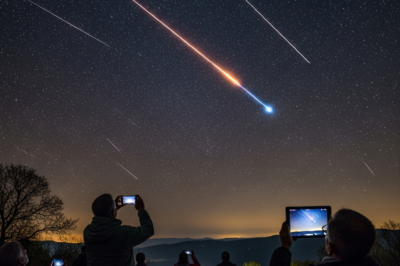
The Celestial Spectacle of 2026: Why the Lyrid Meteor Shower is a Must-Watch Event
As the spring season reaches its peak in 2026, the night sky is preparing to host one of its oldest and most reliable celestial displays: the Lyrid meteor shower. For thousands of years, humans have looked toward the heavens in late April to witness these brilliant streaks of light, which are the remnants of Comet C/1861 G1 Thatcher. In an era where light pollution and unpredictable weather often hinder the amateur astronomer’s experience, the ability to watch the Lyrid meteor shower online has become a revolutionary development. Today, thanks to high-definition cameras and global observatory networks, anyone with an internet connection can witness the cosmic firework show in real-time, regardless of their geographical location or the cloud cover overhead. This year’s display is particularly significant due to the favorable lunar phase and the increasing sophistication of astronomical broadcasting technology, making it a prime opportunity for both seasoned observers and curious newcomers to engage with the wonders of the universe.
The Lyrids are known for their unpredictability and their tendency to produce bright, fast-moving meteors that leave glowing dust trails behind them, known as ‘trains.’ These trains can persist for several seconds, creating a mesmerizing effect that is often captured beautifully by professional-grade telescopes and low-light cameras. By tuning into a livestream, viewers can bypass the physical discomforts of midnight stargazing—such as freezing temperatures and long waits—while still participating in a global community of space enthusiasts. This comprehensive guide will explore the best platforms to watch the 2026 Lyrids online, the science behind this annual phenomenon, and the historical context that makes this meteor shower a cornerstone of astronomical history.
The Science and Origins of the Lyrid Meteor Shower
To truly appreciate the Lyrid meteor shower, one must understand its origin. Every year, as Earth travels along its orbital path around the Sun, it passes through a field of debris left behind by Comet C/1861 G1 Thatcher. This comet is a long-period comet with an orbital cycle of approximately 415 years. It was first officially discovered in 1861 by astronomer A.E. Thatcher, but the debris trail it left behind has been interacting with Earth’s atmosphere for millennia. When these tiny particles of dust and rock, often no larger than a grain of sand, collide with our atmosphere at speeds of nearly 110,000 miles per hour, the friction causes them to incinerate, creating the brilliant flashes of light we recognize as shooting stars.
The Lyrids are named after the constellation Lyra, the Lyre, which contains the bright star Vega. This constellation serves as the ‘radiant’ for the shower, meaning that if you trace the path of the meteors backward, they all appear to originate from this specific point in the sky. However, you don’t need to look directly at the radiant to see the meteors; in fact, they often appear brighter and with longer tails when viewed further away from the radiant point. During a typical peak, observers can expect to see between 15 and 20 meteors per hour. However, the Lyrids are also famous for rare ‘outbursts’ where the rate can suddenly jump to 100 meteors per hour, a phenomenon that occurred most notably in 1803, 1922, and 1982. While an outburst is not guaranteed for 2026, the potential for surprise is what keeps astronomers glued to their monitors.
Top Free Livestreams to Watch the 2026 Lyrids Today
For those looking to catch the action online, several prestigious organizations offer high-quality broadcasts. Leading the charge is the Virtual Telescope Project, managed by astrophysicist Gianluca Masi in Italy. The Virtual Telescope Project is renowned for its high-sensitivity cameras that can detect even the faintest meteors, often missed by the naked eye. Their livestreams usually include expert commentary, explaining the trajectory and characteristics of the meteors as they appear on screen. This provides an educational layer to the visual spectacle, making it ideal for students and families.
Another excellent resource is NASA TV and the official NASA social media channels. NASA often collaborates with various observatories across the United States, such as the Marshall Space Flight Center, to provide feeds from different time zones. These streams are often accompanied by data visualizations showing Earth’s current position in the debris field. Additionally, the Slooh Community Observatory offers a unique interactive experience. While some features require a membership, they frequently host public ‘Star Parties’ for major meteor showers, where viewers can see feeds from telescopes in the Canary Islands and Chile. These southern and northern hemisphere viewpoints ensure that regardless of the time of day, there is always a dark sky somewhere being broadcast to the world.
Why 2026 is a Landmark Year for Meteor Observations
The success of a meteor shower observation depends heavily on the ‘interfering’ light from the Moon. In 2026, the timing of the Lyrid peak coincides with a waning crescent moon, which means the sky will be significantly darker during the peak hours after midnight and before dawn. This is a massive advantage for both physical observers and online streamers, as the lack of moonlight allows the fainter meteors to become visible. In years with a Full Moon, the glare can wash out up to 70% of the activity, but 2026 offers a near-perfect canvas for the Lyrids.
Furthermore, the year 2026 marks an era of improved low-light CMOS sensor technology. The cameras being used for this year’s livestreams are significantly more advanced than those used just a few years ago. They offer higher frame rates and better noise reduction, allowing for a ‘cinematic’ view of the meteors. This technological jump means that the experience of watching online is no longer a ‘second-best’ option; in many ways, the digital view provides a clarity and detail that surpass what can be seen from a typical suburban backyard. The integration of AI-driven detection software also allows some streams to automatically highlight and replay significant meteor entries, ensuring viewers don’t miss a single highlight even if they step away from their screens for a moment.
The Cultural and Historical Significance of the Lyrids
The Lyrids hold the distinction of being the oldest recorded meteor shower in history. Chinese astronomers recorded sightings of the Lyrids as far back as 687 BC, describing them as ‘stars falling like rain.’ This deep historical connection reminds us that when we watch these meteors today, we are witnessing a phenomenon that has fascinated humanity for over 2,700 years. Throughout history, these events were often seen as omens or divine messages. In ancient Greece, the constellation Lyra was associated with the myth of Orpheus and his enchanted lyre, adding a layer of poetic beauty to the scientific event.
In the modern era, the study of the Lyrids contributes to our understanding of cometary evolution. By analyzing the composition of the meteor trails through spectroscopy—a technique often explained during high-end livestreams—scientists can determine the chemical makeup of Comet Thatcher. This research provides clues about the early solar system and the types of materials that were present billions of years ago. Participating in the 2026 observation, even via a computer screen, connects the viewer to this long lineage of human inquiry and discovery.
Technological Advances in Global Meteor Detection Networks
One of the most exciting developments to look for during the 2026 livestreams is the integration of global detection networks like the Global Meteor Network (GMN) and the All-Sky Fireball Network. These projects utilize hundreds of consumer-grade security cameras modified with specialized software to monitor the entire sky simultaneously. During the Lyrid peak, many of these feeds are aggregated into a single dashboard accessible to the public. These networks don’t just provide a visual; they provide data. They can triangulate the exact path of a meteor to determine if any fragments might have reached the ground as meteorites (though Lyrids almost always burn up completely in the atmosphere).
Viewing these aggregated feeds gives a sense of the sheer scale of the event. While a single observer in one location might see 15 meteors in an hour, the global network might detect thousands across the entire planet. This ‘Big Data’ approach to astronomy is a hallmark of the 21st century and is prominently featured in many of the free livestreams available today. It transforms the meteor shower from a local curiosity into a truly planetary event, fostering a sense of global unity as people from every continent watch the same sky.
Conclusion: Embracing the Cosmic Connection
The 2026 Lyrid meteor shower represents a perfect intersection of ancient natural history and modern technological prowess. Whether you choose to sit in your backyard with a blanket or tune into a professional livestream from an observatory halfway around the world, the experience is a reminder of our place in the cosmos. The availability of free, high-quality streams has democratized astronomy, making the beauty of the universe accessible to everyone, regardless of their physical circumstances. As Comet Thatcher’s ancient dust continues to collide with our world, we are invited to pause and reflect on the vast, beautiful, and dynamic system we call home. Don’t miss the opportunity to witness this spectacular light show today; the combination of favorable lunar conditions and cutting-edge streaming technology makes 2026 one of the best years in recent memory to join the global watch party.






































Leave a Reply