
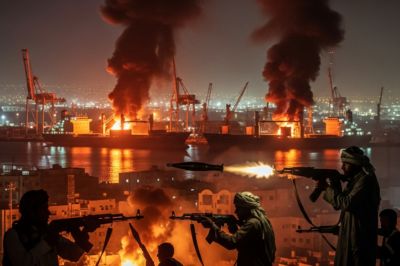
The geopolitical landscape of West Asia has been thrust into a state of heightened volatility as Iranian-backed Houthi rebels have officially renewed their offensive operations against key maritime infrastructure and port cities along the Red Sea coast. This latest development, reported by major international news outlets including The Hindu, represents a significant escalation in a conflict that has already disrupted global trade and threatened the stability of the entire region. As the rebels intensify their campaign, the international community watches with bated breath, fearing that the localized skirmishes are rapidly evolving into a full-scale regional war with catastrophic implications for the global economy. The situation is not merely a regional dispute but a multifaceted crisis involving proxy warfare, religious ideologies, and a struggle for control over some of the world’s most critical shipping lanes. The renewed attacks on port cities like Hodeidah serve as a grim reminder that the conflict in Yemen is far from over and is now being leveraged as a powerful tool in the broader West Asian power struggle.
The Anatomy of Recent Attacks: A Tactical Shift
The recent wave of Houthi attacks marks a distinct shift in the group’s tactical approach. While previous engagements were largely confined to targeting commercial vessels in open water, the focus has now pivoted toward direct strikes on port infrastructure and strategic coastal urban centers. Utilizing a combination of sophisticated kamikaze drones, anti-ship ballistic missiles, and remotely piloted surface vessels, the Houthis have demonstrated an alarming ability to penetrate defensive perimeters established by regional and international forces. These attacks are not random; they are precision-targeted to maximize psychological impact and economic disruption. By targeting port cities, the Houthis are aiming at the jugular of Yemen’s remaining economic activity while simultaneously signaling to the global community that no vessel or facility within their reach is safe. Reports indicate that recent strikes have targeted storage facilities, loading docks, and even naval outposts, forcing many shipping companies to reconsider their presence in the region entirely. The use of advanced Iranian technology, including the Shahed-series drones and specialized missile components, highlights the deep military ties between the rebels and Tehran, making this a pivotal front in the shadow war between Iran and its adversaries.
The Strategic Chokehold of the Bab el-Mandeb
To understand the gravity of the Houthi attacks, one must look at the geography of the region. The Bab el-Mandeb strait, a narrow passage between the Arabian Peninsula and the Horn of Africa, is one of the world’s most vital maritime chokepoints. Millions of barrels of oil and billions of dollars in consumer goods pass through this strait every day on their way to the Suez Canal and European markets. The port cities now under fire, particularly Hodeidah, are the gateways to this strait. By maintaining a constant threat level over these ports, the Houthis effectively hold a veto over a significant portion of global trade. The strategic importance of these locations cannot be overstated. If the Houthis manage to successfully disable or occupy key port facilities, they could potentially block the Red Sea to any traffic they deem hostile, effectively cutting off the primary trade route between Asia and Europe. This leverage is being used to demand an end to military actions in other parts of the Middle East, specifically in Gaza, linking the Yemeni conflict to the broader Israeli-Palestinian struggle in a way that complicates diplomatic resolution efforts.
Iranian Influence and the Weaponization of Proxies
The role of Iran in the Houthi insurgency has transitioned from covert support to overt military backing. Intelligence reports consistently point to the transfer of high-tech weaponry, intelligence sharing, and even on-ground training provided by the Islamic Revolutionary Guard Corps (IRGC). This relationship has transformed the Houthis from a localized tribal militia into a formidable regional actor capable of projecting power far beyond their borders. The ‘Axis of Resistance’ strategy employed by Tehran uses groups like the Houthis to create multiple fronts against its enemies, primarily Israel and the United States, without triggering a direct direct interstate war. By renewing attacks on port cities, the Houthis are acting as a pressure valve for the broader Iranian geopolitical strategy. Each missile launch and drone strike serves to test Western resolve and drain the resources of the US-led coalition, ‘Operation Prosperity Guardian.’ The complexity of this proxy relationship means that a solution to the Red Sea crisis cannot be found in isolation but must involve a comprehensive dialogue concerning Iran’s regional influence and its support for non-state actors.
Economic Fallout: A Global Supply Chain Under Siege
The economic repercussions of the Houthi attacks are being felt across the globe. As insurance premiums for Red Sea transits skyrocket, major shipping conglomerates like Maersk and Hapag-Lloyd have been forced to divert their vessels around the Cape of Good Hope. This detour adds thousands of miles to the journey, increases fuel consumption, and adds weeks to delivery times. The result is a surge in freight costs, which eventually translates into higher prices for consumers. The renewed attacks on port cities exacerbate this situation by threatening the very infrastructure needed for emergency docking and repairs. Furthermore, the disruption to oil and liquefied natural gas (LNG) shipments poses a risk to global energy security, potentially driving up inflation at a time when many economies are already struggling. The port of Hodeidah, which is also a primary entry point for humanitarian aid into Yemen, is now a dangerous zone, jeopardizing the lives of millions who depend on imported food and medicine. The weaponization of trade routes is a tactic that hits the most vulnerable populations first while rattling the confidence of international markets.
The Humanitarian Price of Escalation
Beyond the geopolitical and economic headlines lies a profound humanitarian tragedy. Yemen has long been described by the United Nations as the site of the world’s worst humanitarian crisis. The renewal of attacks on key port cities threatens to sever the last remaining lifelines for the Yemeni people. Port infrastructure is essential for the distribution of grain, fuel, and medical supplies. When these ports become active combat zones, aid agencies are forced to suspend operations, leaving millions at risk of starvation and disease. The civilian population in these port cities lives in a state of constant fear, caught between Houthi military ambitions and the retaliatory strikes from international coalitions. The degradation of port facilities also means that even if a ceasefire were reached tomorrow, the capacity to process aid would be severely diminished for years to come. The international community’s focus on maritime security must be balanced with an urgent need to protect the civilian infrastructure that sustains human life in one of the world’s most impoverished nations.
Future Outlook: Can Diplomacy Prevail?
The path forward is fraught with challenges. Diplomatic efforts led by the UN have struggled to find common ground between the Houthi leadership, the internationally recognized government of Yemen, and the regional powers involved. The Houthis have linked their maritime campaign directly to the cessation of hostilities in Gaza, a condition that places the resolution of the Red Sea crisis outside the immediate control of Yemeni actors. Meanwhile, the military response from the US and UK, while aimed at degrading Houthi capabilities, has yet to deter the group from continuing its attacks. There is a growing consensus that a purely military solution is unfeasible and that a sustainable peace requires a political framework that addresses the underlying causes of the Yemeni civil war. However, as long as the port cities remain targets, the window for diplomacy continues to shrink. The risk of a miscalculation leading to a wider regional conflagration is higher than ever, and the need for a coordinated international response that combines maritime security with robust diplomatic engagement has never been more pressing. The world must decide whether to allow the Red Sea to become a permanent conflict zone or to commit to the difficult work of de-escalation and regional stabilization.



































Leave a Reply