
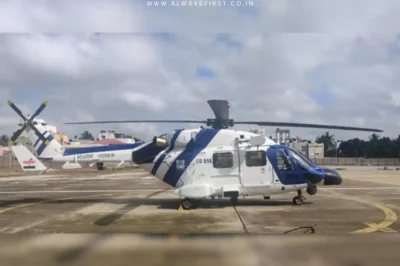
In Shorts:
- HAL’s chairman has stated that the company was not responsible for three out of the four most recent crashes involving its Dhruv Advanced Light Helicopter (ALH).
- The defense comes amid ongoing investigations, with HAL pointing to maintenance and operational factors as the primary causes.
- Despite the incidents, HAL leadership expresses strong confidence in the helicopter’s design and its critical role for the Indian military.
NEW DELHI – The head of Hindustan Aeronautics Limited (HAL), C B Ananthakrishnan, has publicly addressed the recent cluster of incidents involving the Dhruv Advanced Light Helicopter (ALH), pushing back against concerns over the platform’s airworthiness. In a detailed conversation, the chairman sought to clarify the manufacturer’s position, shifting the focus towards operational and maintenance protocols.
The statement comes during a sensitive period for the iconic indigenous helicopter program, which has been a flagship project for India’s defense manufacturing. A series of mishaps, including a recent emergency landing in Maharashtra, have placed the ALH under heightened scrutiny from both the public and defense analysts.
“Out of the four recent accidents, three are not due to any problem of the helicopter,” Ananthakrishnan stated categorically. He elaborated that the investigations into these specific incidents have pointed towards factors beyond the company’s control. “It is because of some other reasons, which I cannot get into the details [of].”
While not divulging specific classified findings, the HAL chief hinted that the causes are largely attributed to external operational circumstances and how the aircraft is maintained post-delivery, rather than any inherent design or manufacturing flaw within HAL’s purview.
Emphasizing the Dhruv’s long and largely successful service history, Ananthakrishnan highlighted its impressive flight record. “We have almost 400 helicopters flying today… they have logged more than 4.5 lakh hours,” he said, framing the recent events as statistical anomalies within an otherwise robust safety log.
The company’s defense underscores a critical aspect of complex military hardware: the distinction between platform failure and incident causation. HAL’s position is that the Dhruv ALH itself remains a reliable and battle-proven asset for the Indian Armed Forces, and the ongoing investigations will validate the mechanical integrity of the helicopters involved.
As the Indian military continues its investigation into each event, all eyes will be on the official findings to either corroborate or challenge HAL’s firm defense of one of India’s most important aerospace achievements.






































Leave a Reply