
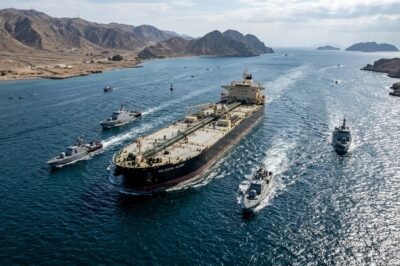
The world’s most critical maritime transit point, the Strait of Hormuz, has once again become the epicenter of global geopolitical tension following a stern declaration from Tehran. As the primary artery for the global energy trade, any disruption to this narrow waterway sends immediate shockwaves through international markets and diplomatic circles. Iran’s recent assertion that the strait will not reopen until specific, albeit loosely defined, conditions are met marks a significant escalation in its long-standing leverage over the international community. This move is not merely a regional dispute; it is a direct challenge to the global economic order and the principle of freedom of navigation. For decades, the specter of a closed Hormuz has been the ultimate deterrent in Iran’s arsenal, a ‘nuclear option’ of conventional warfare that threatens to paralyze the world economy. As tankers sit idle and insurance premiums for maritime freight skyrocket, the international community finds itself at a crossroads, forced to weigh the costs of diplomatic concessions against the risk of a full-scale energy crisis. This development represents a calculated gamble by the Iranian leadership, aiming to force a shift in international policy while navigating a complex web of internal pressures and external sanctions.
The Strategic and Economic Vitality of the Strait of Hormuz
To understand the gravity of the current situation, one must first appreciate the staggering statistics that define the Strait of Hormuz. Located between Oman and Iran, the strait connects the Persian Gulf with the Gulf of Oman and the Arabian Sea. At its narrowest point, the shipping lanes are only two miles wide in either direction, making it a vulnerable chokepoint for the massive oil tankers that traverse it daily. According to data from the U.S. Energy Information Administration (EIA), approximately 21 million barrels of oil per day pass through the strait, accounting for nearly 20% of the world’s total petroleum liquid consumption. This makes it, by far, the most important oil transit channel in the world, eclipsing the Malacca Strait and the Suez Canal in terms of sheer volume and strategic importance.
The economic implications of a prolonged closure are catastrophic. Most of the crude oil exported from Saudi Arabia, the United Arab Emirates, Kuwait, Iraq, and Iran must pass through this waterway. Furthermore, the strait is the primary exit point for liquefied natural gas (LNG) from Qatar, the world’s largest exporter. A total blockage would lead to an immediate and massive spike in global energy prices, potentially pushing oil well beyond the $150-per-barrel mark. Such a price shock would likely trigger a global recession, as transportation costs, manufacturing expenses, and consumer prices would inflate rapidly across every continent. The interconnected nature of modern supply chains means that no nation is immune to the fallout of a Hormuz crisis, making it a matter of urgent national security for major economies ranging from China and India to the European Union and the United States.
Historical Context: The Legacy of Maritime Friction
The current standoff is deeply rooted in a history of maritime conflict in the region, most notably the ‘Tanker War’ phase of the Iran-Iraq War in the 1980s. During that period, both nations targeted each other’s commercial shipping in an attempt to deplete economic resources. The conflict eventually drew in the United States, leading to Operation Earnest Will, where U.S. naval forces escorted Kuwaiti oil tankers to ensure the flow of energy. This historical precedent established the Strait of Hormuz as a primary theater for indirect warfare and a tool for political leverage. Over the years, Iran has repeatedly used the threat of closure as a response to international sanctions, particularly those targeting its energy sector and nuclear program.
Each time tensions rise, the pattern remains remarkably similar: Tehran issues a verbal warning or conducts naval drills, the U.S. Fifth Fleet increases its presence, and global oil markets experience a period of intense volatility. However, the current iteration of this conflict feels different to many analysts. The precision of modern Iranian weaponry, including sophisticated anti-ship missiles and drone swarms, has significantly increased the potential cost of any military intervention. Unlike the 1980s, Iran now possesses the capability to not just harass shipping, but to effectively deny access through asymmetrical warfare. This historical evolution from simple naval posturing to a credible threat of area denial is what makes the current ‘conditions for reopening’ so concerning for global strategists.
The Political Drivers and Iranian Demands
The recent statement from Tehran, delivered via state-linked media and Reuters, emphasizes that the strait will remain ‘restricted’ or ‘closed’ to certain traffic until specific conditions are met. While the exact list of demands remains fluid, they generally center around the lifting of economic sanctions and the recognition of Iran’s regional security interests. Iran argues that its sovereignty is being undermined by foreign naval presence in its backyard and that the ‘freedom of navigation’ is a concept used selectively by Western powers to enforce their own hegemony. By tying the openness of the strait to political concessions, Iran is attempting to break the deadlock of international sanctions that have crippled its domestic economy.
Internally, the Iranian leadership is facing significant pressure to deliver economic relief. The ‘Look to the East’ policy, which prioritizes ties with Russia and China, has provided some buffer, but the fundamental issues of inflation and currency devaluation remain. By playing the Hormuz card, the government aims to project strength to its domestic base and demonstrate that it still holds significant cards in international negotiations. The ‘conditions’ mentioned likely include the unfreezing of overseas assets, the removal of bans on Iranian oil exports, and perhaps a broader regional security agreement that limits the footprint of the U.S. military in the Persian Gulf. This is a high-stakes game of chicken where the domestic survival of the regime is increasingly tied to its ability to disrupt the global status quo.
Security Dimensions: Naval Power and Asymmetrical Warfare
From a military perspective, the Strait of Hormuz is a unique environment that favors asymmetrical tactics. While the United States and its allies possess overwhelming conventional naval power, the geography of the strait allows Iran to utilize a ‘mosquito fleet’ of fast-attack craft, sea mines, and coastal missile batteries. These assets are difficult to target and can inflict significant damage on large, slow-moving oil tankers and even sophisticated warships. The Iranian Revolutionary Guard Corps (IRGC) Navy has spent decades refining these tactics, focusing on saturation attacks that could overwhelm modern defense systems. The threat is not just a total blockade, but the creation of an environment so risky that commercial insurance companies refuse to cover vessels.
If the insurance industry decides that the risk of transit is too high, the strait effectively closes without a single shot being fired. This ‘soft closure’ is perhaps even more dangerous than a hot conflict, as it lacks a clear military target to engage. International naval task forces, such as the International Maritime Security Construct (IMSC), have been established to provide surveillance and protection, but the sheer volume of traffic makes 100% security impossible. The presence of advanced drone technology has further complicated the security landscape, allowing for deniable attacks that can be blamed on non-state actors or technical failures, further muddying the waters of international maritime law and diplomatic response.
International Law and the Right of Transit Passage
The legal status of the Strait of Hormuz is a point of significant contention. Under the United Nations Convention on the Law of the Sea (UNCLOS), the strait is subject to the regime of ‘transit passage,’ which allows vessels of all nations to pass through for the purpose of continuous and expeditious transit. While Iran has signed the convention, it has not ratified it, and it argues that it is only bound by customary international law. Tehran maintains that it has the right to regulate traffic through its territorial waters, especially if it perceives a threat to its national security. This legal ambiguity provides a thin veneer of legitimacy to Iranian actions, allowing it to frame the closure as a lawful exercise of sovereignty rather than an act of aggression.
The international community, led by the U.S. and the UK, rejects this interpretation, insisting that the right of transit passage is an absolute necessity for global trade and cannot be suspended unilaterally. The clash of legal interpretations mirrors the broader clash of political ideologies. For the West, the strait is an international commons that must remain open at all costs. For Iran, it is a strategic asset and a territorial boundary. This legal friction ensures that any incident in the strait is immediately bogged down in competing claims of maritime rights, making a swift diplomatic resolution even more difficult to achieve. The ‘conditions’ for reopening, therefore, are not just about sanctions, but about who gets to define the rules of the sea in the Middle East.
Future Implications: A New Era of Energy Insecurity
The long-term implications of this standoff point toward a fundamental shift in how the world views energy security. For decades, the global economy has relied on the assumption of cheap, uninterrupted flow of hydrocarbons from the Middle East. That assumption is now permanently fractured. Nations like India, China, and Japan, which are heavily dependent on Persian Gulf oil, are likely to accelerate their efforts to diversify energy sources and transit routes. We may see an increased investment in pipelines that bypass the strait altogether, such as Saudi Arabia’s East-West Pipeline or the UAE’s Habshan-Fujairah pipeline. However, these alternatives currently lack the capacity to replace the full volume of the strait.
Ultimately, the threat of closing the Strait of Hormuz serves as a catalyst for the global energy transition. As the geopolitical risk of oil becomes too high, the shift toward renewables and domestic energy production becomes not just an environmental goal, but a national security imperative. In the short term, however, the world remains tethered to this narrow strip of water. The resolution of the current crisis will require a delicate balance of military deterrence and creative diplomacy. If the ‘conditions’ for reopening are not met, and the standoff continues, the world may be entering an era of unprecedented volatility, where a single incident in a 21-mile-wide channel can dictate the economic fate of billions. The Strait of Hormuz is no longer just a waterway; it is a barometer for the stability of the 21st-century global order.



































Leave a Reply