
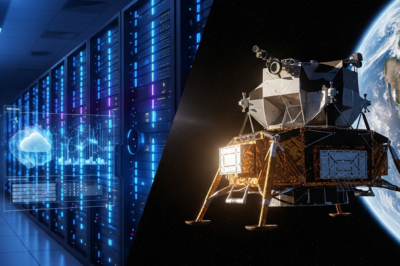
The global financial landscape is currently witnessing a fascinating convergence of digital infrastructure expansion and extraterrestrial exploration, driven by two of the most significant entities in their respective fields: Meta Platforms and NASA. As Meta continues to redefine its identity beyond social media, pivoting heavily into the cloud and AI infrastructure space, NASA is simultaneously pushing the boundaries of the lunar economy through high-stakes contracts for the next generation of lunar landers. These developments are not merely isolated corporate updates; they represent a fundamental shift in where the world’s most significant capital is being deployed. Investors are closely monitoring the ‘stock movers’ that bridge the gap between Silicon Valley’s data centers and the launchpads of Cape Canaveral. This article provides a comprehensive deep dive into Meta’s burgeoning cloud business, the intricacies of NASA’s latest lunar lander contracts, and the broader economic implications for the stock market.
The Evolution of Meta Cloud: From Social Networking to AI Infrastructure Powerhouse
For years, Meta (formerly Facebook) was viewed primarily through the lens of advertising revenue and user engagement metrics. However, the narrative has shifted dramatically. Meta’s massive investment in AI-driven cloud infrastructure has transformed the company into a formidable player in the hardware and data center ecosystem. By developing its own custom silicon, such as the Meta Training and Inference Accelerator (MTIA), the company is reducing its reliance on traditional cloud providers and establishing a proprietary stack that rivals the likes of Amazon Web Services (AWS) and Google Cloud. This shift is driven by the insatiable demand for compute power required to run Large Language Models (LLMs) like Llama 3. The financial markets have reacted with a mixture of awe and caution; while the capital expenditure (CAPEX) for these projects is in the tens of billions, the potential for Meta to monetize its cloud capabilities as a service provider—or at least as a vertically integrated efficiency machine—is a significant driver for its stock performance. We are seeing a new era where Meta is not just a platform for content, but the actual backbone of the AI-driven economy, providing the foundational compute necessary for the next generation of digital interaction.
NASA’s Artemis Program and the Billion-Dollar Lunar Lander Contracts
Simultaneously, the aerospace sector is experiencing a renaissance fueled by NASA’s ambitious Artemis program. The recent updates regarding lunar lander contracts have sent ripples through the industrial and defense segments of the stock market. NASA’s strategy of fostering a commercial lunar economy involves awarding multi-billion dollar contracts to private entities, most notably SpaceX and Blue Origin. The goal is to develop a Human Landing System (HLS) that can safely transport astronauts from lunar orbit to the South Pole of the Moon. These contracts are not just about exploration; they are about establishing a sustainable human presence and a logistical pipeline to our celestial neighbor. The competition between Elon Musk’s SpaceX and Jeff Bezos’ Blue Origin has created a dynamic market environment where innovation is accelerated by commercial rivalry. For investors, these contracts represent long-term revenue streams and the validation of space-based business models that were once considered science fiction. The ‘stock movers’ in this space include not only the primary contractors but also a vast network of sub-contractors providing everything from cryogenic propulsion systems to advanced life-support sensors.
The Intersection of AI, Cloud Computing, and Space Logistics
One might wonder how Meta’s cloud business and NASA’s moon missions are related beyond being trending news. The answer lies in the massive data processing requirements of modern space exploration. NASA’s lunar missions generate petabytes of data that require sophisticated AI and cloud-based analytics to process in real-time. Meta’s advancements in efficient data center design and AI inference can eventually find applications in the terrestrial monitoring of space missions or the management of satellite constellations. Furthermore, both sectors are competing for the same pool of high-end semiconductor talent and manufacturing capacity. When Meta increases its order for NVIDIA H100 GPUs, it tightens the supply chain for the high-performance computing components also needed for aerospace simulations. This interconnectedness means that a supply chain disruption in the tech sector can have delayed but significant impacts on aerospace timelines. The convergence of these two industries is creating a specialized niche for ‘deep tech’ investors who look for companies operating at the edge of physical and digital limits.
Market Sentiment and Stock Movers: Analyzing the Financial Impact
The market’s reaction to these developments has been characterized by high volatility and significant trading volume. Meta’s stock has become a bellwether for the broader AI trade; when the company announces upgrades to its cloud infrastructure, it often triggers a rally across the entire tech sector. Conversely, news regarding NASA’s contract awards often benefits legacy aerospace firms and emerging space startups alike. Analysts are particularly focused on ‘Stock Movers’—companies whose valuations are shifting based on these multi-billion dollar announcements. For instance, companies involved in the construction of modular data centers or the production of specialized aerospace alloys have seen increased investor interest. The financial health of these sectors is also a reflection of broader macroeconomic trends, such as interest rate environments that affect the cost of borrowing for capital-intensive projects like moon landers or global-scale data centers. As we look at the ‘Marketscreener’ data, it becomes clear that the leaders of the new economy are those who can successfully navigate the complexities of both high-level software and heavy-duty hardware.
Geopolitical Implications of the AI and Space Race
Beyond the stock tickers, there is a profound geopolitical layer to Meta’s cloud expansion and NASA’s lunar contracts. The ability to dominate AI infrastructure is increasingly seen as a matter of national security and economic sovereignty. Meta’s open-source approach with Llama models, powered by its massive cloud investment, is a strategic move to set global standards for AI. On the other side, the race to the Moon is not just a scientific endeavor but a quest for strategic positioning in the lunar environment. The contracts awarded by NASA ensure that the United States and its commercial partners remain at the forefront of space law and resource management. Investors are beginning to price in ‘geopolitical resilience’ when evaluating these companies. A company like Meta, which controls its own infrastructure, is less vulnerable to external platform shifts, much like a nation with a robust lunar logistics system is more influential on the global stage. This high-stakes environment ensures that both tech and aerospace will remain primary focuses for institutional investors for the foreseeable future.
Future Outlook: What to Expect in the Coming Quarters
Looking ahead, the trajectory for both Meta and the aerospace contractors remains upward but fraught with technical challenges. For Meta, the next milestone will be the successful integration of its custom AI chips across all its data centers, which could significantly lower operational costs and improve margins. For NASA and its partners, the upcoming flight tests of the HLS prototypes will be critical ‘make-or-break’ moments for the companies involved. Any delay in the Artemis timeline could lead to a cooling of investor enthusiasm in the space sector, while a successful test would likely trigger a massive influx of capital into space-related stocks. We are also likely to see more crossover between these industries, perhaps in the form of cloud-based ‘Space-as-a-Service’ offerings or AI systems specifically designed for autonomous lunar mining. The boundaries between ‘tech’ and ‘industrial’ are blurring, and the most successful investors will be those who can synthesize information from these diverse fields into a coherent market strategy.
Conclusion: A New Frontier for Innovation and Investment
In summary, the news regarding Meta’s cloud business and NASA’s lunar lander contracts serves as a powerful reminder of the scale of human ambition in the 21st century. Whether we are building digital universes in the cloud or physical outposts on the lunar surface, the underlying drivers are the same: a need for massive compute power, sophisticated engineering, and visionary leadership. The stock market will continue to fluctuate as these projects reach new milestones or face unforeseen obstacles, but the long-term trend is clear. The companies that are building the infrastructure of the future—be it on Earth or in space—are the ones that will define the global economy for decades to come. As Meta and NASA continue their respective journeys, the rest of the world will be watching closely, ready to capitalize on the next great leap in technology and exploration.




































Leave a Reply