
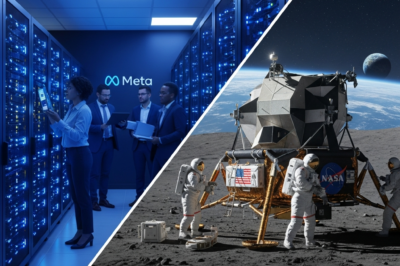
The financial landscape of 2024 is being reshaped by two seemingly disparate but fundamentally linked sectors: the expansion of Big Tech into high-performance cloud infrastructure and the privatization of lunar exploration. This week, market observers and investors focused their attention on a dual narrative that highlights the strategic evolution of Meta Platforms and the competitive intensity surrounding NASA’s Lunar Lander contracts. As Meta pivots toward a more robust cloud-based business model to support its artificial intelligence (AI) ambitions, and as aerospace giants jockey for a piece of the Artemis program, the volatility in the stock market serves as a barometer for the shifting priorities of global industry. These movements are not merely transient trends; they represent a fundamental realignment of how technology and space exploration are funded, executed, and monetized in an era defined by automation and the quest for extraterrestrial resources. To understand the gravity of these shifts, one must look deep into the capital expenditure of Silicon Valley and the procurement strategies of the world’s premier space agency.
Meta’s Strategic Pivot: From Social Media Giant to Cloud Infrastructure Powerhouse
For years, Meta Platforms, the parent company of Facebook, Instagram, and WhatsApp, was viewed primarily through the lens of digital advertising and social networking. However, the dawn of the generative AI era has forced a radical transformation. Meta is no longer just a platform for connecting people; it is rapidly becoming an infrastructure company. The recent surge in market interest regarding Meta’s cloud business stems from its massive investments in data centers and custom silicon. By developing its own AI chips and building out an expansive network of server farms, Meta is positioning itself to offer cloud services that could eventually rival the likes of Amazon Web Services (AWS) and Microsoft Azure, at least for specific AI-driven workloads. This transition is capital-intensive, with the company projecting tens of billions of dollars in capital expenditures. Investors are closely watching how this investment translates into revenue growth beyond the traditional ad-based model. The shift toward a cloud-centric business model is a defensive move against the increasing costs of third-party infrastructure and an offensive play to capture the burgeoning market for AI-as-a-service. As Meta integrates its Llama language models into every facet of its ecosystem, the underlying cloud infrastructure becomes the backbone of its future profitability.
NASA’s Artemis Program and the High Stakes of Lunar Lander Contracts
While Meta builds the digital world, the aerospace sector is competing to build the physical infrastructure of the moon. NASA’s Artemis program, which aims to return humans to the lunar surface, relies heavily on a series of commercial contracts known as the Human Landing System (HLS). The recent announcements regarding these contracts have sent ripples through the aerospace and defense sectors. Companies like SpaceX, Blue Origin, and Dynetics are at the forefront of this modern space race. Unlike the Apollo era, where the government owned and operated the vehicles, the current model emphasizes public-private partnerships. This allows NASA to leverage the innovation and cost-efficiencies of the private sector while providing these companies with the guaranteed funding needed to develop cutting-edge technology. The recent focus on stock movers within this category highlights the market’s reaction to milestone achievements and contract modifications. For instance, when NASA awards additional funding for lander development or deepens its partnership with a specific contractor, the stock prices of the companies involved—and their vast networks of subcontractors—react instantaneously. This is not just about national pride; it is about establishing a sustainable lunar economy that includes mining, research, and potentially a gateway to Mars.
The Financial Impact: Analyzing the Stock Movers of the Week
MarketScreener and other financial analysis platforms have highlighted a specific group of ‘stock movers’ tied to these developments. In the technology sector, Meta’s stock has experienced fluctuations as analysts weigh the long-term benefits of infrastructure spending against short-term margin pressures. When a company spends forty billion dollars on data centers, the market demands proof of utility. Similarly, in the aerospace sector, companies like Lockheed Martin, Northrop Grumman, and Boeing are often influenced by their involvement in the broader lunar ecosystem. However, the real ‘movers’ are often the mid-cap aerospace firms that provide specialized components for the landers, such as propulsion systems, thermal shielding, and autonomous navigation software. The volatility seen this week is a reflection of the high-risk, high-reward nature of these industries. A successful test fire of a rocket engine or a breakthrough in chip architecture can add billions to a company’s market capitalization overnight. Conversely, any delay in NASA’s timeline or a miss in Meta’s cloud revenue projections can lead to sharp sell-offs. For the modern investor, the key is understanding the synergy between these two frontiers: the digital cloud and the celestial vacuum.
Technological Convergence: Where Cloud Computing Meets Space Exploration
It is a mistake to view Meta’s cloud ambitions and NASA’s lunar contracts as entirely separate entities. In reality, they are converging. Space exploration today requires an immense amount of data processing power. From simulating lunar landings to processing high-resolution imagery of the moon’s South Pole, the need for high-performance computing (HPC) is critical. This is where companies like Meta, Google, and Amazon come in. The cloud infrastructure being built to power social media AI is the same infrastructure that will power the next generation of space telemetry. Furthermore, the development of ‘edge computing’ in space—where data is processed on the lunar surface rather than being sent back to Earth—relies on the same chip technology and architectural innovations being pioneered in Silicon Valley. We are seeing a symbiotic relationship where advancements in terrestrial cloud business models provide the tools necessary for interplanetary expansion. As NASA continues to outsource its technological needs to the private sector, the line between a ‘tech company’ and an ‘aerospace company’ continues to blur.
The Geopolitical Implications of Commercial Tech and Space Dominance
Beyond the stock market and technical specifications, there is a profound geopolitical layer to these developments. The race to dominate the cloud and the race to settle the moon are both matters of national security and economic sovereignty. Meta’s move to internalize its cloud business reduces its dependence on global supply chains and establishes a sovereign AI capability for the United States. Similarly, NASA’s reliance on domestic private companies for lunar landers ensures that the U.S. remains the leader in space, even as nations like China and India accelerate their own lunar programs. The contracts awarded by NASA are strategic tools used to foster a domestic industrial base that can compete on a global scale. For investors, this means that the companies involved are often ‘too important to fail’ in the eyes of the government, providing a level of systemic support that is rare in other industries. The ‘movers’ we see in the market are often responding to these subtle shifts in government policy and international competition, making the analysis of these stocks as much a study of geopolitics as it is of financial statements.
Future Outlook: What to Expect in 2025 and Beyond
As we look toward the latter half of the decade, the trajectories of Meta and NASA appear set on a collision course with destiny. Meta will likely continue to expand its cloud offerings, perhaps even spinning off its infrastructure division into a standalone business unit to compete directly with Amazon. On the space front, the first crewed Artemis landings will serve as the ultimate validation of the commercial lander model. The stock market will continue to be the theater where these dramas play out, with ‘stock movers’ being defined by their ability to execute on these grand visions. For the average consumer, this means better AI tools and a front-row seat to the exploration of the cosmos. For the investor, it means a period of unprecedented opportunity and risk. The convergence of cloud computing and space exploration represents the next great leap in human history, and the financial markets are simply the first to feel the tremors of this seismic shift. As the digital and physical frontiers expand, the companies that can successfully navigate both will be the ones that define the next century of global progress.






































Leave a Reply