
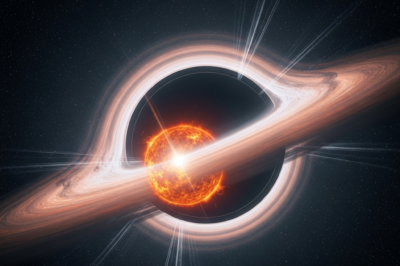
In a staggering display of cosmic violence and technological prowess, NASA has announced the detection of a rare astronomical phenomenon: a supermassive black hole ‘devouring’ a nearby star, an event captured and analyzed with unprecedented precision thanks to the integration of advanced Artificial Intelligence. This event, formally known in the scientific community as a Tidal Disruption Event (TDE), represents one of the most extreme physical processes in the known universe. When a star wanders too close to a black hole’s gravitational well, the tidal forces—the difference in gravity’s pull on the near and far sides of the star—become so intense that the star is literally ripped apart. This process, often referred to as ‘spaghettification,’ transforms a once-stable sun into a stream of superheated gas that spirals into the abyss. While TDEs have been observed before, this latest discovery stands out because of the role AI played in sifting through petabytes of data to identify the faint, flickering signatures of a star’s final moments, marking a significant milestone in the marriage of astrophysics and machine learning.
The Physics of Destruction: Understanding Tidal Disruption Events
To truly grasp the significance of this discovery, one must first understand the sheer scale of the physics involved. A Tidal Disruption Event occurs when a star passes within the ‘tidal radius’ of a supermassive black hole. At this proximity, the black hole’s gravity overcomes the star’s own self-gravity. The result is catastrophic. The star is stretched into a long, thin filament of plasma. As this material falls toward the black hole, it collides with itself, generating immense heat and friction. This creates a brilliant flare of electromagnetic radiation—spanning X-rays, ultraviolet, and visible light—that can briefly outshine an entire galaxy. However, these flares are often fleeting and buried within the ‘noise’ of millions of other celestial objects. This is where the challenge lies for astronomers. The universe is crowded, and distinguishing a genuine TDE from a variable star, a supernova, or an active galactic nucleus requires constant vigilance and high-speed data processing. The energy released during these events provides a unique ‘laboratory’ for scientists to study gravity in its most extreme form, offering insights into the mass and spin of black holes that are otherwise invisible to our telescopes.
AI: The New Eye in the Sky for NASA
The sheer volume of data generated by modern observatories, such as the Transiting Exoplanet Survey Satellite (TESS) and the Neowise mission, is far beyond the capacity of human researchers to analyze in real-time. NASA’s latest breakthrough utilized a sophisticated AI framework designed to recognize the specific light-curve patterns associated with a star being torn apart. These machine learning models are trained on thousands of simulated and historical examples of TDEs, learning the subtle nuances of how the brightness of a star decays over weeks and months as it is consumed. By using ‘Convolutional Neural Networks’ and ‘Anomaly Detection’ algorithms, the AI can scan the sky, flag potential events within seconds, and alert ground-based telescopes to pivot and capture the event in higher resolution. In this specific instance, the AI acted as an early-warning system, identifying the ‘devouring’ process much earlier than traditional methods would have allowed. This speed is crucial because the most scientifically valuable data often comes from the very beginning of the disruption, when the star first breaks apart and the initial ‘shock’ of the accretion process begins.
Dissecting the Discovery: What the Data Reveals
The specific TDE identified in this report has provided a treasure trove of information regarding the environment surrounding supermassive black holes. By analyzing the spectra of light emitted during the event, NASA scientists have been able to determine the chemical composition of the doomed star and the rate at which the black hole is ‘feeding.’ Interestingly, the AI-assisted analysis revealed that the black hole did not consume the entire star at once. Instead, a significant portion of the stellar material was ejected back into space at relativistic speeds, creating a massive ‘outflow’ of gas that creates its own light signature. This discovery challenges some previous models that assumed most of the star would be swallowed. The data also suggests that the black hole in question is rotating at a high velocity, which warps the surrounding space-time and affects how the stellar debris is pulled in. These insights are not just academic; they help us understand the life cycles of galaxies. Since most galaxies, including our own Milky Way, harbor a supermassive black hole at their center, understanding how these monsters feed is essential to understanding how galaxies grow, merge, and evolve over billions of years.
The Global Context and Historical Significance
The detection of TDEs has come a long way since the first theoretical predictions in the 1970s and 80s. For decades, these were purely mathematical constructs, until the first X-ray observations in the 1990s confirmed their existence. However, those early detections were often ‘after-the-fact’ discoveries found in archived data. The current era, characterized by ‘Time-Domain Astronomy,’ focuses on catching these events as they happen. NASA’s collaboration with international partners, including the European Space Agency (ESA) and various ground-based observatories in Hawaii and Chile, has created a global network of ‘eyes’ that never sleep. This specific AI-led discovery is a testament to the power of open-access data and international cooperation. By sharing AI models and data sets across borders, the scientific community is accelerating the pace of discovery. This event is being hailed as a ‘gold standard’ for future observations, proving that we no longer need to rely on luck to witness the most violent acts in the cosmos. It represents a shift from reactive science to proactive discovery, where algorithms hunt for the unknown while humans focus on the complex interpretation of the results.
Future Outlook: The Convergence of Tech and Space
Looking ahead, the role of AI in space exploration is only set to expand. With the upcoming launch of the Vera C. Rubin Observatory and the continued operation of the James Webb Space Telescope (JWST), the ‘data deluge’ will grow exponentially. NASA is already working on next-generation AI that can not only detect TDEs but also predict them by monitoring the orbits of stars in high-density galactic centers. This predictive capability would allow us to watch the entire process from ‘T-minus zero,’ providing a front-row seat to the fundamental laws of physics in action. Furthermore, the techniques developed for this black hole discovery are being adapted to other areas of science, such as detecting Earth-sized exoplanets and tracking potentially hazardous asteroids. The synergy between computer science and astrophysics is creating a new discipline altogether—’Astro-informatics’—which will likely be the primary driver of astronomical breakthroughs in the 21st century. As we refine these tools, our window into the ‘dark’ parts of the universe—the black holes, dark matter, and dark energy—will finally begin to open wide.
Conclusion: A New Chapter in Cosmic Exploration
The discovery of a black hole devouring a star through the lens of AI is more than just a spectacular news headline; it is a profound demonstration of human ingenuity. We have reached a point where our machines can help us perceive events occurring millions of light-years away, involving forces so great they defy our everyday intuition. This event serves as a reminder of the dynamic and often violent nature of the universe we inhabit. It also underscores the importance of continued investment in both space hardware and software. As NASA continues to peel back the layers of the cosmos, the combination of our best telescopes and our smartest algorithms will ensure that no star falls in silence. We are finally entering an era where the mysteries of the deep dark are being illuminated by the light of artificial intelligence, bringing the most distant and dangerous corners of space within our intellectual reach.







































Leave a Reply