
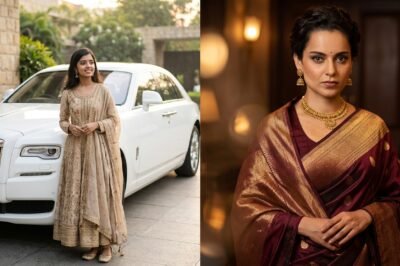
The intersection of traditional artistry and ultra-luxury consumerism has recently sparked a firestorm of debate across the Indian digital landscape, highlighting a deep-seated societal paradox regarding success and humility. When Maithili Thakur, a beloved folk singer celebrated for her soulful renditions of bhajans and classical music, shared a glimpse of her new Rolls-Royce, she likely expected a moment of celebration. Instead, she was met with a wave of scrutiny that questioned whether a practitioner of ‘pure’ and ‘traditional’ arts should indulge in such overt displays of wealth. This controversy took a significant turn when Bollywood actress and politician Kangana Ranaut stepped into the fray, delivering a scathing defense of Thakur. Ranaut’s assertion that ‘people get hurt if they see us living well’ taps into a complex psychological and sociological phenomenon where the public often demands a performance of poverty or extreme modesty from those who represent cultural or spiritual heritage. This incident is not merely about a car; it is a reflection of the evolving dynamics of the Indian dream, the digital economy, and the shifting boundaries of celebrity culture in the 21st century.
The Genesis of the Rolls-Royce Controversy
The controversy began when Maithili Thakur, who has built a massive following by bridging the gap between ancient musical traditions and modern digital platforms, posted images with her new luxury vehicle. For many of her followers, the sight of a young girl from a humble background in Bihar, known for her simple attire and spiritual focus, standing next to a symbol of global elite status like a Rolls-Royce, created a jarring cognitive dissonance. Critics on social media were quick to point out the perceived contradiction, suggesting that her ‘brand’ of spirituality and traditionalism was inconsistent with the acquisition of a car that costs several crores. This backlash highlights a specific brand of classism where artists are expected to remain within the socio-economic confines of the genres they represent.
Maithili Thakur has always been perceived as a ‘daughter of the soil,’ a title that often carries the heavy burden of remaining static in one’s lifestyle. The criticism aimed at her suggests that there is an unspoken rule in the public consciousness: if you sing of the gods and the folk traditions of the rural heartland, you must mirror the perceived austerity of those subjects. However, this perspective ignores the reality of Maithili’s professional journey, which involves years of rigorous training, consistent content creation, and a global touring schedule that has earned her legitimate financial success. The backlash represents a struggle to reconcile the ‘divine’ nature of her art with the ‘materialistic’ nature of her rewards.
Kangana Ranaut’s Scathing Critique of the Critics
Never one to shy away from a cultural debate, Kangana Ranaut utilized her platform to defend Maithili Thakur, framing the criticism as a manifestation of collective insecurity and jealousy. Ranaut’s statement, ‘People get hurt if they see us living well,’ strikes at the heart of what she perceives as a ‘crab mentality’ prevalent in Indian society. She argued that the public often finds it difficult to digest the success of self-made individuals, especially those who come from non-urban, traditional backgrounds. By backing Maithili, Kangana is also reinforcing her own narrative as a self-made outsider who has consistently challenged the status quo of the elite.
Ranaut’s defense also touches upon the gendered and regional aspects of this criticism. She pointed out that if a male pop star or a legacy Bollywood actor were to purchase the same vehicle, the reaction would likely be one of admiration or indifference. However, when a young woman from a traditional background achieves the same feat, she is subjected to moral policing. Kangana’s intervention elevated the conversation from a simple celebrity gossip piece to a broader discussion on the right to prosperity and the dismantling of the ‘starving artist’ trope. Her support suggests that the celebration of Maithili’s success should be seen as a victory for traditional arts, proving that they are viable and lucrative in the modern world.
Challenging the Stereotype of the ‘Poor Artist’
The romanticization of poverty in the arts is a long-standing tradition that often does more harm than good to the practitioners themselves. For decades, Indian folk and classical artists were expected to live lives of relative obscurity and financial struggle, with their only reward being the ‘purity’ of their craft. This narrative is now being aggressively challenged by the new generation of artists who leverage technology to monetize their talents. Maithili Thakur is a prime example of this shift. By using YouTube and social media to reach millions directly, she has bypassed the traditional gatekeepers who previously controlled the earnings of folk musicians.
When the public reacts negatively to an artist’s wealth, they are often mourning the loss of a certain ‘aesthetic of struggle’ that they find comforting. There is a deep-seated belief that luxury corrupts the soul and that an artist must suffer to produce authentic work. However, this logic is rarely applied to other professions. No one expects a successful tech entrepreneur or a top-tier surgeon to live in poverty to prove their dedication to their field. The demand for Maithili to remain ‘simple’ is, in essence, a demand for her to remain subservient to the audience’s expectations of her class and origin.
The Economics of Modern Folk Music and Digital Success
To understand the scale of Maithili Thakur’s success, one must look at the changing economics of the Indian music industry. The digital revolution has democratized access to audiences, allowing folk music to find a global listener base that was previously unreachable. Maithili’s channels boast millions of subscribers, and her videos regularly garner tens of millions of views. In the current digital economy, these metrics translate into significant revenue through ad sharing, brand endorsements, and live performance demands. Her purchase of a Rolls-Royce is a testament to the fact that folk music is no longer a niche, low-paying genre but a powerhouse of the Indian entertainment economy.
- Direct Monetization: Artists now earn directly from platforms like YouTube, Facebook, and Instagram, cutting out the middleman.
- Global Reach: The Indian diaspora provides a massive, high-spending audience for traditional and spiritual music.
- Brand Value: Traditional artists are becoming influencers, attracting luxury brands that want to tap into the ‘authentic India’ market.
- Financial Literacy: Younger artists are more savvy about investing their earnings and building long-term wealth.
The realization that a bhajan singer can afford the same luxuries as a Silicon Valley executive is a radical shift in the Indian economic narrative. It signals the end of the era where ‘traditional’ was synonymous with ‘impoverished.’ This shift, while empowering for the artists, is clearly unsettling for a segment of the population that still views the social hierarchy through an archaic lens.
Understanding ‘Middle-Class Guilt’ and Classism
The backlash against Maithili Thakur also reveals a fascinating layer of middle-class guilt and class-based gatekeeping. There is an irony in the fact that many of the people criticizing her for her luxury car are likely aspiring to the same level of comfort and status in their own lives. However, they view their own aspirations as legitimate ‘growth’ while viewing hers as ‘selling out.’ This is often because Maithili represents a bridge to their own roots, and her entry into the world of ultra-luxury feels like a betrayal of the ‘purity’ they project onto their cultural heritage.
Furthermore, there is a subtle element of regional bias. Artists from rural Bihar or small-town India are often expected to perform their ‘small-town-ness’ perpetually. When they transcend those boundaries and enter the space of global luxury, it disrupts the comfortable narrative that the urban elite holds about the rural ‘other.’ Kangana Ranaut’s defense is particularly resonant here because she has frequently spoken about how her own success and lifestyle were mocked by the established Bollywood ‘lutyens’ elite when she first arrived from Himachal Pradesh. The ‘hurt’ that Kangana describes is the discomfort of those who believe that certain luxuries are reserved for a specific class of people.
Conclusion: Redefining the Indian Dream and Future Implications
The controversy surrounding Maithili Thakur and the spirited defense by Kangana Ranaut marks a pivotal moment in the Indian cultural discourse. It signifies a refusal to allow the public to dictate the personal and financial boundaries of an artist based on their genre or background. As more artists from diverse and traditional fields achieve mainstream financial success, the public will have to confront its own biases regarding wealth and authenticity. The idea that one can be both a devout practitioner of traditional music and a consumer of modern luxury is a reality that is here to stay.
In the future, we can expect more such clashes as the lines between traditionalism and modernism continue to blur. The success of individuals like Maithili Thakur will likely inspire a new generation of artists to pursue their craft with the knowledge that it can provide not just spiritual fulfillment, but also a life of high-quality comfort. Ultimately, the ability of an artist to thrive financially should be seen as a sign of a healthy and appreciative culture, rather than a cause for grievance. As Kangana Ranaut aptly put it, the ‘hurt’ felt by the observers is a reflection of their own limitations, not a flaw in the artist’s journey. The Indian dream is expanding, and it now includes the sight of a folk singer driving a Rolls-Royce with her head held high.







































Leave a Reply