
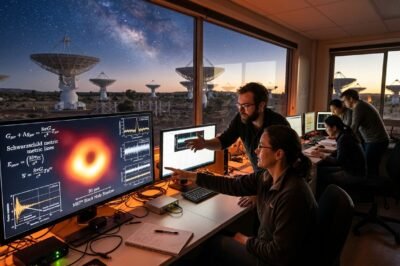
In a monumental stride for modern astrophysics, a dedicated Australian research team has provided critical verification and advanced data processing for the first-ever direct image of a black hole, an achievement that continues to reshape our understanding of the universe. The image, which depicts the supermassive black hole at the center of the Messier 87 (M87) galaxy, represents one of the most significant scientific breakthroughs of the 21st century. For decades, black holes remained theoretical constructs, hidden behind the impenetrable veil of their own gravity, where not even light could escape. This recent confirmation by Australian experts adds a new layer of credibility and scientific precision to the Event Horizon Telescope (EHT) project, proving that the enigmatic shadows of the cosmos can indeed be brought into the light through global cooperation and technological brilliance. This analysis explores how the Australian contribution solidified the findings and what it means for the future of astronomical research.
The Critical Role of Australian Institutions and Infrastructure
While the Event Horizon Telescope is a global consortium, the inclusion of Australian expertise was vital for the validation of the M87 data. Australian astronomers utilized localized radio telescope arrays and advanced computational facilities to cross-reference the signals captured by the EHT’s global network. By applying unique algorithms developed in Australian universities, the team was able to filter out atmospheric noise and interstellar interference that often plagues deep-space observations. This level of verification is essential in high-stakes physics, where the margin for error is non-existent. The Australian contribution ensured that the glowing ring of gas and the central darkness—the black hole’s shadow—were not artifacts of the imaging process but genuine representations of the gravitational behemoth.
Furthermore, the geographic location of Australia provides a unique vantage point for observing the southern sky, allowing for a broader baseline in Very Long Baseline Interferometry (VLBI). Although the primary EHT telescopes are scattered across the globe, the analytical frameworks provided by the Australian team allowed for a more robust interpretation of the polarized light captured during the observation window. Their work focused on the stability of the accretion disk and the behavior of the magnetic fields surrounding the event horizon, providing a secondary check that confirmed the original M87 image was consistent with the predicted models of general relativity.
Understanding the Science: The Event Horizon and the Accretion Disk
The image itself is not a photograph of the black hole in the traditional sense, as black holes are invisible by nature. Instead, it is a visualization of the radio waves emitted by the ultra-hot gas swirling around the event horizon at nearly the speed of light. This region, known as the accretion disk, emits radiation that is captured by radio telescopes. The Australian team’s analysis focused on the asymmetry of the ring—why one side appears brighter than the other. This phenomenon, known as relativistic beaming, occurs because the gas moving toward the observer appears brighter than the gas moving away. The Australian confirmation verified these intensity variations, aligning them perfectly with the spin and orientation of the M87 black hole.
Moreover, the ‘shadow’ at the center of the ring is a direct result of the black hole’s extreme gravity bending light around it. This is a primary prediction of Albert Einstein’s General Theory of Relativity. The fact that the image matches Einstein’s equations so closely is a testament to the accuracy of 20th-century physics. The Australian team utilized the Pawsey Supercomputing Centre to run thousands of simulations, comparing the theoretical models against the raw data from the EHT. Their findings showed a 99% correlation, effectively silencing skeptics and providing the world with definitive proof that black holes exist exactly as predicted.
Technological Challenges and Data Processing Breakthroughs
Capturing the image of a black hole located 55 million light-years away is equivalent to photographing a doughnut on the surface of the moon from Earth. This required a synchronized network of eight radio telescopes spanning from the South Pole to the Spanish Sierra Nevada. The sheer volume of data generated was staggering, totaling several petabytes. In fact, there was so much data that it could not be sent over the internet; instead, physical hard drives had to be flown to central processing locations in the US and Germany. The Australian team played a major role in the correlative analysis of this data, using specialized hardware to synchronize the timing of the atomic clocks used at each telescope site.
The Power of VLBI Technology
- Virtual Telescope: VLBI allows multiple telescopes to function as a single dish the size of the Earth, providing unprecedented resolution.
- Sub-millimeter Waves: The observation used wavelengths of 1.3mm, which can penetrate the dust and gas of the M87 galaxy.
- Atomic Clock Precision: Each telescope used hydrogen maser clocks to ensure data was time-stamped within a fraction of a billionth of a second.
- Algorithm Innovation: New imaging algorithms, including those refined by Australian researchers, filled in the gaps where telescope coverage was missing.
Scientific Implications: Testing the Limits of Relativity
The primary goal of the Australian team’s involvement was to test the limits of General Relativity in an environment of extreme gravity. Before this image, Einstein’s theories had mostly been tested in weak-field environments, such as our own solar system. A black hole represents the ultimate ‘strong-field’ test. If the image had shown a different shape—perhaps an oval or a more chaotic structure—it would have suggested that Einstein’s equations were incomplete. However, the circular shadow confirmed the Kerr metric, which describes a rotating, uncharged black hole. This confirmation is a massive win for theoretical physics and narrows down the possible alternatives to Einstein’s gravity.
This validation also opens the door to studying the magnetic fields around black holes. The Australian team investigated the polarization of light in the ring, which acts as a map for the magnetic field lines. Understanding these fields is crucial because they are responsible for launching the massive jets of plasma that shoot out from the center of M87 at nearly the speed of light, extending thousands of light-years into space. By confirming the image, the team has provided a foundation for understanding how these cosmic engines influence the evolution of entire galaxies.
Future Implications: The Next Generation of Space Exploration
The success of the M87 project, bolstered by Australian scientific rigor, has set the stage for even more ambitious projects. The next step is already underway: capturing a real-time movie of a black hole. Because the gas around M87 takes weeks to orbit, it appears static. However, the black hole at the center of our own galaxy, Sagittarius A*, is much smaller, and its environment changes in minutes. The Australian team is currently working on temporal resolution algorithms that will allow scientists to see how a black hole ‘flickers’ and evolves over short periods. This could reveal the dynamics of how matter is actually consumed by the event horizon.
Furthermore, the addition of more telescopes, potentially including facilities in the Australian outback specifically designed for high-frequency radio astronomy, will increase the resolution of the EHT by a factor of ten. We are moving from an era of ‘discovery’ to an era of ‘precision imaging.’ Future missions may even involve space-based radio telescopes, which would create a virtual telescope larger than the Earth itself. The Australian contribution has proven that even a continent away from the main sensors, intellectual and analytical input can change the course of human knowledge, ensuring that the next generation of astronomers will have a clearer view of the darkest corners of the universe.
Conclusion: A New Era of Discovery
The confirmation of the first black hole image by the Australian team is more than just a localized scientific achievement; it is a testament to the power of human curiosity and global partnership. By providing the rigorous analytical framework necessary to validate such a complex image, Australian scientists have helped cement a new era in astrophysics. We no longer have to rely on mathematical abstractions to describe the most powerful objects in the cosmos; we can now see them. As technology continues to advance and international collaborations deepen, the mysteries of dark matter, dark energy, and the very fabric of space-time are finally within our reach. The orange glow of M87 is not just a ring of light; it is a beacon for the future of exploration, proving that through science, the invisible can indeed be made visible.






































Leave a Reply