
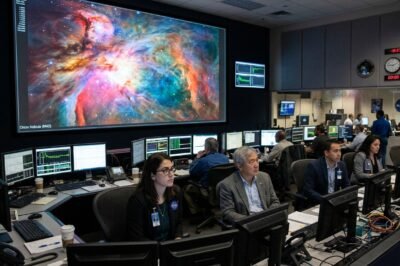
The Cosmic Canvas: Why NASA’s Recent Release Captivated the World
In an era where digital content is consumed at a lightning-fast pace, few things have the power to stop a casual scroller in their tracks like the sheer, unadulterated beauty of the cosmos. NASA’s recent release of high-resolution nebulae images, as highlighted by Inshorts, is not just a triumph of aesthetic photography but a monumental achievement in human engineering and scientific communication. These images, showcasing gas clouds in various shapes—from butterfly wings to celestial pillars—represent more than just ‘stunning pics’; they are a visual record of the universe’s most violent and creative processes. For the general public, they provide a sense of wonder and a brief escape from terrestrial concerns, but for the scientific and financial communities, they represent a return on investment for billions of dollars in aerospace technology. This analysis delves deep into the mechanisms that allow us to see these distant structures and explores the broader implications of such data-rich visual storytelling in the 21st century.
The impact of these images is far-reaching, influencing everything from educational curriculum to the burgeoning private space sector. When NASA shares these visuals, it isn’t just about sharing a photo; it is about providing the world with a status update on our capabilities as a species. The intricate shapes of these nebulae, sculpted by stellar winds and gravitational forces, offer a masterclass in fluid dynamics and atomic physics on a scale that is nearly impossible to comprehend. By translating invisible wavelengths of light into a palette that the human eye can interpret, NASA bridges the gap between high-level science and public accessibility, ensuring that the mysteries of the universe remain a shared human heritage rather than the exclusive domain of academics in ivory towers.
The Science of Nebulae: Stellar Nurseries and Cosmic Graveyards
Nebulae, often described as the magnificent clouds of gas and dust scattered throughout the vastness of space, represent the alpha and omega of the universe. These structures are not merely aesthetic wonders; they are the primary sites where stars are born and where they meet their eventual demise. By utilizing advanced spectroscopic analysis, NASA scientists can determine the exact chemical composition of these clouds, which are primarily composed of hydrogen and helium, enriched by heavier elements forged in the hearts of previous generations of stars. When we look at these stunning pictures, we are witnessing the recycled materials of the cosmos, pulled together by the invisible hand of gravity over millions of years.
The shapes we observe—ranging from the iconic pillars to intricate bubbles and hourglass silhouettes—are the result of intense radiation and stellar winds from nearby stars. As young stars ignite within these dense regions, they emit ultraviolet light that ionizes the surrounding gas, causing it to glow with ethereal brilliance. This process, known as photo-ionization, creates the breathtaking colors we see in NASA’s latest releases. Red hues typically signify the presence of hydrogen, while blues and greens point to oxygen and sulfur. Understanding these variations is crucial for astrophysicists who aim to map the life cycles of galaxies and the chemical evolution of the universe at large.
Technological Marvels: The Role of JWST and Hubble in Capturing Light
Capturing these images is a feat of modern engineering that bridges the gap between raw data and visual storytelling. The James Webb Space Telescope (JWST) has revolutionized this field by operating in the infrared spectrum, allowing it to peer through the thick dust clouds that often shroud stellar nurseries. While its predecessor, the Hubble Space Telescope, provided decades of visible and ultraviolet data, Webb’s ability to detect thermal signatures enables us to see the ‘protostars’ hidden deep within the nebulae. This technological synergy provides a multi-wavelength view of the cosmos, offering a more complete picture of the physical processes at play than ever before.
Beyond the telescopes themselves, the data processing required to create these ‘stunning pics’ is an intensive endeavor involving international collaboration. Raw data from space is transmitted via the Deep Space Network as binary code, which is then translated by specialized software into the images we recognize. This involves assigning specific colors to different wavelengths of light that are invisible to the human eye. This process is not a work of fiction but a scientific translation that allows us to visualize the thermal and chemical complexity of deep space. The investment in these technologies represents billions of dollars in global capital, highlighting the economic value placed on the pursuit of fundamental knowledge and the advancement of imaging sensors.
Market Implications of Space Exploration and Data Visualization
The release of high-resolution cosmic imagery has profound implications for the global economy, particularly within the burgeoning ‘NewSpace’ sector. As public interest in space exploration surges driven by visual engagement, private corporations such as SpaceX, Blue Origin, and Northrop Grumman see increased valuation and investor confidence. The technology developed for space imaging often finds its way into terrestrial markets, including medical imaging, autonomous vehicle sensors, and environmental monitoring systems. For instance, the algorithms used to sharpen images of distant nebulae are being adapted to improve the accuracy of cancer detection in radiological scans, creating a direct link between astronomical research and healthcare profitability.
Furthermore, the ‘democratization’ of space data through platforms like Inshorts and social media creates a fertile ground for educational technology (EdTech) startups. There is a multi-million dollar market for interactive planetarium software, VR space tours, and digital curriculum that utilizes NASA’s open-source imagery. This cultural fascination translates into a pipeline for STEM talent, ensuring a future workforce capable of maintaining the aerospace industry’s growth. Investors are increasingly looking at space-adjacent industries as long-term hedges, recognizing that the infrastructure built for missions like the JWST serves as the foundation for the next industrial revolution: the commercialization of low Earth orbit and beyond.
The Psychological and Cultural Impact of High-Resolution Cosmic Photography
The human response to these images is one of profound insignificance mixed with a sense of connection. In an era often dominated by localized geopolitical strife and economic volatility, the sight of a nebula spanning hundreds of light-years provides a necessary perspective. Psychologists have noted the ‘overview effect’—a cognitive shift reported by astronauts—now being experienced by the general public through these high-fidelity visual representations. This global shared experience fosters a sense of planetary stewardship, which is increasingly relevant in discussions surrounding climate change and international cooperation.
Culturally, NASA’s nebulae photos have become icons of the 21st century, influencing art, fashion, and design. The ‘galaxy print’ trend in textile manufacturing and the usage of cosmic aesthetics in cinematography highlight how science permeates popular culture. By making complex astrophysical data accessible and beautiful, NASA performs a vital public relations service that justifies the continued allocation of taxpayer funds to scientific endeavors. It transforms abstract mathematics into a visual language that transcends borders, making the mysteries of the universe a common heritage for all of humanity.
Decoding the Shapes: From Butterfly to Pillars of Creation
One of the most fascinating aspects of the recent NASA release is the sheer diversity of shapes found in these nebulae. Each silhouette tells a unique story about the forces at work within the interstellar medium. The ‘Butterfly’ nebula, for example, is a planetary nebula formed when a dying star ejects its outer layers in a bipolar fashion. The ‘wings’ are actually streams of superheated gas moving at speeds exceeding 600,000 miles per hour. This symmetrical expansion provides clues about the magnetic fields of the progenitor star and its possible binary companion. Analyzing these geometries allows researchers to build 3D models of stellar expulsion, providing a roadmap for what might eventually happen to our own solar system in five billion years.
On the other hand, structures like the ‘Pillars of Creation’ in the Eagle Nebula represent a different stage of cosmic evolution. These dense columns of cool interstellar gas and dust act as shields for the young stars forming inside them. The ‘shapes’ are constantly being sculpted by the intense radiation of nearby massive stars in a process called photoevaporation. As the gas is eroded, the densest pockets remain, appearing as towering structures against the backdrop of the glowing nebula. By comparing images taken decades apart, astronomers can witness the ‘real-time’ evolution of these structures, a testament to the dynamic and violent nature of the cosmos that belies its serene appearance in photographs.
Future Horizons: What NASA’s Next Visual Release Means for Global Science
The ongoing release of such imagery is a precursor to a new era of discovery that will be defined by the upcoming launch of the Nancy Grace Roman Space Telescope and the continued operation of current observatories. We are moving toward a future where the ‘shapes’ of the universe will be mapped with such precision that we can identify potentially habitable exoplanets within the very nebulae we currently admire. The data gleaned from these stunning pictures will continue to fuel scientific papers for decades, challenging our current understanding of dark matter, dark energy, and the expansion rate of the universe. For the average observer, these images are a source of wonder; for the scientist, they are a rigorous laboratory of the extreme.
In conclusion, the stunning pics of nebulae shared by NASA serve as a bridge between the complex world of theoretical physics and the curious minds of the public. They represent the peak of human achievement in both technology and artistic interpretation. As we continue to gaze into the deep reaches of space, we are not just looking at distant objects; we are looking at our own origins and our potential future. The financial, technological, and cultural ripples of these discoveries will continue to expand, much like the nebulae themselves, shaping the trajectory of human civilization as we reach for the stars. The next decade promises even more clarity, potentially answering the ultimate question of our place in the cosmic tapestry.





































Leave a Reply