
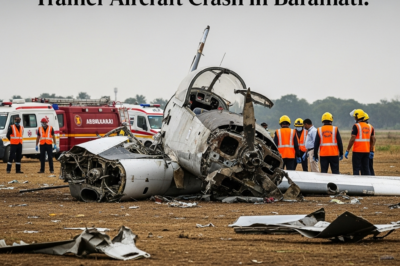
The Sudden Descent: Unpacking the Baramati Trainer Aircraft Crash
The serene agricultural landscapes of Baramati were once again shattered by the sound of a mechanical failure as a trainer aircraft plummeted into a local field, marking a distressing trend in the region’s aviation safety record. This latest incident, involving a small trainer plane, has sent shockwaves through the aviation community and local residents alike. The crash occurred during what was supposed to be a routine training sortie, highlighting the inherent risks associated with flight instruction and the critical need for stringent maintenance protocols. Emergency services were quick to respond to the scene near the Kadbanwadi village area, where the wreckage lay twisted amidst the crops. While the pilot and the trainee were reported to have survived with injuries, the psychological impact on the burgeoning pilot community in Baramati is profound. This event does not exist in a vacuum; it follows a string of similar mishaps that have raised questions about the airworthiness of the fleet used by private flight academies in the area and the level of oversight provided by regulatory bodies. As the Directorate General of Civil Aviation (DGCA) launches a formal investigation, the focus shifts to the systemic issues that may be contributing to these recurring accidents. Baramati, known for its political significance and its growing status as an educational hub, is now finding itself in the headlines for all the wrong reasons, necessitating a deep dive into the infrastructure that supports its flight schools.
A Troubling Pattern: Comparing Recent Incidents in the Region
This latest crash is particularly alarming because it represents the second major aviation incident in the Baramati vicinity in a relatively short span of time, trailing closely behind the high-profile accident involving the aircraft of Maharashtra’s Deputy Chief Minister, Ajit Pawar. While the nature of the two incidents differs—one involving a VIP transport and the other a training vessel—the geographical commonality cannot be ignored. Baramati has become a preferred location for flight training due to its relatively clear skies and the presence of established academies like Redbird Flight Training Academy. However, the frequency of technical snags and forced landings in this corridor suggests that either the density of air traffic is exceeding the local management capacity or that the maintenance standards of the trainer aircraft are falling short of international benchmarks. In previous months, other trainer planes have encountered engine failures and landing gear malfunctions in the same district, leading to temporary suspensions of flight operations for certain schools. The juxtaposition of a trainee pilot’s struggle with a seasoned official’s emergency landing underscores a broader vulnerability in the regional airspace that demands immediate rectification. Experts argue that the cumulative data of these ‘near-misses’ and ‘hard landings’ points toward a fatigue in the local aviation ecosystem that must be addressed before a fatal tragedy occurs.
The Ajit Pawar Context: Political Pressure and Safety Audits
The mention of Ajit Pawar in relation to these accidents is more than just a chronological marker; it represents the political and administrative weight behind the aviation sector in Baramati. Following the emergency involving the Deputy CM, there was an intensified call for safety audits across all helipads and airstrips in Maharashtra. The fact that another crash has occurred despite this heightened awareness suggests a gap between policy directives and ground-level execution. Baramati is Ajit Pawar’s political stronghold, and his personal brush with aviation danger was expected to be a catalyst for sweeping reforms in local flight operations. Instead, the recurring crashes suggest that the systemic issues—ranging from outdated engine components to inadequate pre-flight inspections—remain unresolved. The political optics of these crashes are significant; they put pressure on the state government to ensure that the rapid expansion of pilot training facilities does not come at the cost of human life. There is now an increasing demand from local leaders and safety advocates for a transparent, third-party audit of all flight schools operating out of the Baramati airstrip to ensure that political patronage does not shield academies from rigorous safety compliance.
Technical Breakdown: Why Trainer Aircraft are Vulnerable
To understand why these crashes are happening, one must look at the mechanics of the aircraft involved. Most training academies utilize Cessna 152 or Cessna 172 Skyhawk models, which are celebrated for their stability but are often decades old. These aircraft undergo rigorous daily use, often flying six to eight hours a day with multiple take-offs and landings, which are the most stressful phases of flight for an airframe. In the Baramati context, initial reports often point toward ‘power loss’ or ‘engine stalling’ during the climb phase. Several factors can contribute to this: fuel contamination, carburetor icing, or mechanical wear and tear that escapes routine visual inspections. Furthermore, trainee pilots are, by definition, less experienced in handling emergency procedures. When an engine falters at low altitude, the window for a successful forced landing is incredibly small. The topography of Baramati, characterized by open fields, provides a landing ‘buffer’ that has likely prevented fatalities in recent cases, but relying on the terrain is not a sustainable safety strategy. The DGCA’s investigation will likely scrutinize the logbooks of the aircraft to see if scheduled overhauls were performed and if the spare parts used were genuine and certified. Digital flight data monitoring, which is standard in commercial aviation, is often lacking in these smaller trainers, making the reconstruction of the accident rely heavily on pilot testimony and physical wreckage analysis.
Regulatory Oversight: Is the DGCA Doing Enough?
The Directorate General of Civil Aviation (DGCA) is the apex body responsible for air safety in India, and its role in the Baramati incidents is under intense scrutiny. Following a series of incidents last year, the DGCA had briefly suspended the operations of certain flight training organizations (FTOs) in Baramati and other parts of the country. However, the resumption of flights and subsequent crashes suggest that the corrective measures may have been superficial. Critics argue that the DGCA is understaffed and lacks the resources to conduct frequent, unannounced spot checks on the hundreds of trainer aircraft scattered across India’s numerous FTOs. There is also the issue of ‘safety culture’ within the academies themselves. In a bid to maximize profits and ensure students complete their required flying hours quickly, there is a risk that minor technical issues are overlooked or deferred. The Baramati crash serves as a reminder that the regulatory framework needs to evolve from being reactive to proactive. Implementing mandatory ‘Safety Management Systems’ (SMS) for all flight schools, similar to those required for commercial airlines, could be a step forward. This would involve a non-punitive reporting system where instructors and students can report technical glitches without fear of retribution, ensuring that small problems are fixed before they lead to a crash.
The Human Element: Impact on the Next Generation of Pilots
Beyond the mechanical and regulatory aspects, the human cost of these accidents is significant. India is currently facing a massive demand for commercial pilots to staff its rapidly expanding airlines. Flight schools in Baramati and across the country are the primary feeder for this demand. However, a series of accidents can have a chilling effect on aspiring aviators and their families. The trauma of surviving a crash can end a career before it even begins, and for the student community, seeing their peers go down in fields creates an atmosphere of anxiety rather than learning. There is also the question of the quality of instruction. Are instructors being pushed too hard? Is the syllabus focusing enough on ‘unusual attitude recovery’ and ’emergency landings’? The psychological readiness of a trainee to handle a crisis is just as important as the mechanical reliability of the plane. Enhancing simulator training before students ever take to the skies could mitigate some of these risks, allowing them to practice engine-out scenarios in a controlled environment. The future of India’s aviation prowess depends on the robustness of its training ground; if Baramati remains a ‘crash zone,’ the credibility of the entire Indian pilot certification process could be called into question on the international stage.
Conclusion: A Call for Comprehensive Aviation Reform
The second aircraft crash in Baramati since the Ajit Pawar incident is a clear signal that the current state of flight training safety is untenable. It is no longer enough to treat these as isolated events caused by ‘technical failure’ or ‘pilot error.’ Instead, there must be a holistic review of the infrastructure, maintenance standards, and regulatory oversight governing small-scale aviation. The investigation into this latest crash must be thorough and its findings made public to restore confidence in the sector. We need a mandate for newer, modern trainer aircraft equipped with advanced safety features like glass cockpits and airframe parachutes. Furthermore, the collaboration between local authorities and aviation experts needs to be strengthened to ensure that the growth of Baramati as an aviation hub is matched by an equivalent growth in safety and emergency response capabilities. Only through a transparent, safety-first approach can we ensure that the skies over Maharashtra remain safe for the next generation of pilots who are eager to take flight.





































Leave a Reply