
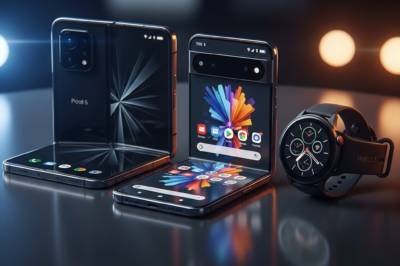
The technology world is currently standing on the precipice of a monumental shift as Google prepares to host its most significant hardware event in recent history on August 12. While traditionally Google has reserved its major hardware announcements for the autumn months of October, the upcoming showcase represents a strategic pivot designed to capture market attention ahead of the busy holiday season and front-run its primary competitors. This event is not merely a product launch; it is a declaration of Google’s maturity as a hardware manufacturer. The headline act, the Pixel 11 series, alongside the innovative Pro Fold and the Pixel Watch 5, signals a comprehensive overhaul of the Android ecosystem. By integrating cutting-edge artificial intelligence with custom-designed silicon, Google aims to provide a cohesive experience that bridges the gap between software capability and hardware performance. Investors and tech enthusiasts alike are looking to this event as a bellwether for the future of mobile computing, where AI is no longer a background feature but the core engine driving every interaction. As we peel back the layers of leaks and official teasers, it becomes clear that Google is no longer content with being the ‘other’ choice in the flagship market; it is positioning itself to lead.
The Pixel 11 Series: Engineering a New Standard in Mobile Hardware
The centerpiece of the August 12 event is undoubtedly the Pixel 11 series. According to internal reports and supply chain insights, this generation represents a departure from previous iterations through its reliance on the Tensor G5 chipset. Unlike its predecessors, which were heavily based on Samsung’s Exynos designs, the G5 is rumored to be Google’s first fully custom-designed processor, manufactured using TSMC’s advanced 3nm process. This transition is critical because it allows Google to optimize the silicon specifically for its own machine learning models, significantly improving energy efficiency and reducing the thermal throttling issues that occasionally plagued earlier models. The Pixel 11 is expected to feature a radical new design language characterized by a more refined ‘camera bar’ and a shift toward flatter edges, following current industry trends toward industrial minimalism. Furthermore, the display technology is set for an upgrade, with M14 OLED materials sourced from Samsung Display, promising peak brightness levels that could exceed 3,000 nits. This makes the Pixel 11 one of the most legible devices in direct sunlight. Photography, the traditional stronghold of the Pixel brand, will see the introduction of new primary sensors with larger physical dimensions, allowing for better low-light performance and more natural bokeh. The integration of a dedicated ISP (Image Signal Processor) within the Tensor G5 will enable real-time 8K video processing with HDR, a feat that requires immense computational power and thermal management.
The Google Pro Fold: A Masterclass in Industrial Design
The original Pixel Fold was a bold first step, but the Google Pro Fold, expected to be unveiled alongside the Pixel 11, is where the company aims to perfect the form factor. The ‘Pro’ branding suggests a more premium approach, focusing on thinning the chassis while maintaining a robust hinge mechanism. Reports suggest that the Pro Fold will be the thinnest foldable in several major markets, rivaling the sleekness of traditional slab phones when closed. The hinge has been completely redesigned to allow the device to fold completely flat without a visible gap, utilizing aerospace-grade materials to ensure longevity over thousands of folds. One of the most anticipated features of the Pro Fold is the shift in aspect ratio. Google is moving away from the wider ‘passport’ style to a taller, more conventional exterior screen, which makes the device easier to use with one hand for everyday tasks. Inside, the massive canvas will benefit from an under-display camera and a significantly reduced crease, thanks to a new ultra-thin glass (UTG) composition. Software optimization is where the Pro Fold will likely shine; Google has been working tirelessly to ensure that its ‘Large Screen’ Android initiatives provide seamless multitasking, allowing users to drag and drop elements between apps with intuitive gestures. With the Tensor G5 powering the device, users can expect to run demanding AI workloads on the large internal display, such as real-time language translation in a dual-screen mode, effectively turning the Pro Fold into a portable interpreter.
Pixel Watch 5: The Pinnacle of Android Wearables
In the wearable space, the Pixel Watch 5 is set to solidify Google’s acquisition of Fitbit by offering the most comprehensive health-tracking suite ever seen in a smartwatch. The design of the Watch 5 is expected to include a second, larger size option to cater to users who found the previous 41mm design too diminutive. This larger model will not only house a bigger screen but also a significantly larger battery, addressing the primary criticism of previous Pixel Watch generations. Under the hood, the Watch 5 will likely utilize a new ultra-low-power co-processor that handles always-on display tasks and sensor polling without draining the main battery. The health sensors are receiving a major upgrade, with rumors of an FDA-cleared ECG that can detect more types of arrhythmias and a new sweat-based stress monitoring system. Google is also expected to lean heavily into ‘AI coaching,’ where the watch analyzes sleep patterns, activity levels, and heart rate variability to provide personalized daily recommendations. Integration with the broader Pixel ecosystem will be tighter than ever; for instance, the Watch 5 could act as a sophisticated remote shutter for the Pixel 11’s camera, providing a high-resolution preview on the wrist. The inclusion of UWB (Ultra-Wideband) technology will also allow the watch to act as a precise digital key for cars and smart home locks, enhancing the ‘ambient computing’ vision that Google has long championed.
AI Integration: Gemini at the Heart of Every Device
The August 12 event is expected to be as much a software event as it is a hardware one. Google’s Gemini AI is the glue that binds the Pixel 11, Pro Fold, and Watch 5 together. We are likely to see the debut of ‘Gemini Nano 2,’ a revised version of Google’s on-device large language model that is significantly more capable than the current version. On the Pixel 11 series, this will manifest in ‘Circle to Search’ enhancements, where the AI can summarize entire documents or translate complex technical jargon instantly. For the Pro Fold, Gemini will enable advanced productivity features like ‘Magic Composer’ in emails and the ability to generate complex spreadsheets from voice commands. On the Pixel Watch 5, Gemini will act as a proactive assistant, summarizing notifications and suggesting replies based on the context of previous conversations. The emphasis here is on privacy; by processing these AI tasks locally on the Tensor G5 chip, Google can offer powerful intelligence without the latency or privacy concerns associated with cloud-based processing. This ‘AI-first’ approach is what Google believes will differentiate its products from Apple’s upcoming ‘Apple Intelligence,’ as Google has the advantage of owning the world’s most comprehensive knowledge graph and search engine data to train its models.
Strategic Timing: Why August is the New October for Google
The decision to hold this event on August 12 is a calculated move by Google’s leadership. For years, the Pixel lineup was released in October, often finding itself overshadowed by the initial hype of the September iPhone launch. By moving the event to August, Google gains several strategic advantages. First, it allows the company to capture the back-to-school market, a critical demographic for hardware sales. Second, it gives the Pixel 11 and Pro Fold a full month of exclusive media coverage before Apple unveils its next generation of devices. This ‘first-mover’ advantage in the second half of the year is crucial for building momentum and securing carrier partnerships. Furthermore, it allows Google to set the narrative for the year’s AI features. By showcasing Gemini’s deep hardware integration in August, Google forces Apple and Samsung to react to its innovations rather than the other way around. Industry analysts suggest that this shift also helps Google manage its supply chain more effectively, avoiding the year-end logistics crunch that often hampers product availability during the holiday season. It is a sign that Google is finally thinking like a top-tier hardware manufacturer, prioritizing market timing and strategic positioning alongside technical excellence.
Conclusion: The Hardware-Software Synergy
In conclusion, the August 12 event represents the culmination of years of internal development at Google. The transition to the custom Tensor G5 chip, the refinement of the foldable form factor with the Pro Fold, and the expansion of the wearable ecosystem with the Pixel Watch 5 all point to a company that has found its stride. By focusing on the synergy between hardware and software, Google is creating an ecosystem that is increasingly difficult to leave. The Pixel 11 series is not just a smartphone; it is a portal into the most advanced AI services on the planet. The Pro Fold is not just a foldable; it is a vision of the future of productivity. And the Watch 5 is not just a timepiece; it is a personal health companion. As the tech industry watches closely on August 12, the stakes could not be higher. If Google can deliver on the promises of performance, design, and AI integration, it may well disrupt the status quo and establish itself as the dominant force in the premium Android space for years to come. The era of ‘The Google Phone’ has truly arrived, and the world is ready to see what happens when the software giant finally masters the art of the machine.






































Leave a Reply