
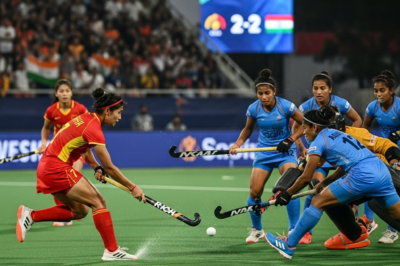
The 2026 Women’s Hockey World Cup has officially commenced with a spectacle of high-octane drama and tactical prowess, as two of Asia’s most formidable powerhouses, India and China, battled to a 2-2 draw in their opening fixture. This match was not just a season opener; it was a statement of intent from both nations, showcasing the immense growth of women’s hockey in the Asian continent. For the Indian Eves, the match was a rollercoaster of emotions, featuring early setbacks, a gritty comeback, and a frantic finish that left fans at the edge of their seats. The draw earns both teams a vital point in a Group of Death where every goal and every defensive clearance could eventually decide the fate of their quarter-final ambitions. As the sun set over the stadium, the lights illuminated a field of battle where neither side was willing to yield an inch, resulting in a stalemate that felt more like a hard-fought victory for the spirit of the game. This encounter sets the tone for a tournament that promises to be one of the most competitive in the history of the sport, with India and China proving they are ready to challenge the traditional European dominance in international hockey.
The Significance of the 2026 Women’s Hockey World Cup Opener
The encounter between India and China at the 2026 Women’s Hockey World Cup represents more than just a typical group stage match. Historically, these two nations have shared a fierce rivalry that has transitioned from regional dominance in the Asian Games and Asian Champions Trophy to the global stage. Entering this tournament, both teams carried the weight of expectation. India, having seen a massive resurgence in the sport over the last decade, aimed to capitalize on their recent successes in the Pro League. China, on the other hand, bolstered by legendary coaching and a rigorous youth development program, brought a disciplined, structured approach to the pitch. The 2-2 result is a reflection of how closely matched these sides have become. In past iterations of the World Cup, one might have expected a more lopsided affair, but the modern game has seen a leveling of the playing field. The tactical depth displayed by both coaches suggests that the gap between the top five nations and the rest of the world is shrinking rapidly. This draw serves as a warning to other teams in the pool: neither India nor China will be pushovers, and their path to the knockout stages is very much alive.
First Half Analysis: Tactical Chess and Opening Blows
The match began with an electric pace that caught the Indian defense slightly off guard. China’s strategy was clear from the first whistle: high-press and quick transitions. Within the first ten minutes, the Chinese strikers utilized their speed to exploit the channels, forcing the Indian goalkeeping unit into early action. China struck first through a brilliantly executed field goal that resulted from a lapse in India’s marking inside the circle. The goal silenced the vocal Indian supporters for a moment, but it acted as a catalyst for the Women in Blue. India’s midfield, led by the experienced Salima Tete, began to find their rhythm, distributing the ball with more precision and looking for the overhead passes to bypass the dense Chinese defensive block. Despite several entries into the opponent’s circle, India struggled with their final touch in the first quarter. However, the second quarter saw a shift in momentum. India began to dominate possession, utilizing the width of the pitch to stretch the Chinese defense. The tactical battle between India’s creative flair and China’s rigid defensive structure was a sight to behold, with both teams showcasing world-class conditioning and stick skills that kept the ball moving at a lightning-fast pace.
India’s Resurgence: Key Performers and Turnaround Moments
As the match moved into the third quarter, India’s persistence finally paid off. The team earned a series of penalty corners, testing the Chinese goalkeeper who had been phenomenal up until that point. It was a drag-flick from the top of the D that finally broke the resistance, leveling the score at 1-1. This goal injected a fresh surge of energy into the Indian camp. The forward line, featuring the likes of Deepika and Sangita Kumari, started finding more space behind the Chinese full-backs. India’s second goal was a masterpiece of teamwork, involving a quick interchange of passes in the midfield that culminated in a clinical finish from the edge of the small circle. For a significant portion of the second half, India looked like they might run away with the game. Their defensive line, anchored by Udita, became much more disciplined, neutralizing the Chinese counter-attacks before they could reach the danger zone. The ability of the Indian team to pivot from a defensive stance to an all-out attack within seconds is a testament to the modern coaching philosophy that emphasizes versatility and physical endurance.
China’s Defensive Resilience and Counter-Attacking Prowess
China is known for their resilience, and they did not let the Indian lead dampen their spirits. Even when trailing 2-1, the Chinese side maintained their structure, refusing to panic. They relied on their disciplined zonal marking to frustrate Indian attackers and waited for the opportune moment to strike. That moment came late in the fourth quarter. As India pushed for a third goal to put the game to bed, China intercepted a loose ball in the midfield and launched a devastating counter-attack. A series of quick passes saw them penetrate the Indian circle, and a scramble in front of the goal resulted in the equalizer. The 2-2 scoreline was a harsh reminder of how quickly fortunes can change in international hockey. China’s ability to stay in the game despite being under heavy pressure for long periods speaks volumes about their mental toughness. Their defensive unit, particularly their goalkeeper, made several crucial saves in the dying minutes to ensure they walked away with a point. This resilience is what makes China a dark horse in the 2026 World Cup, as they have the capability to absorb pressure and punish teams on the break.
Statistical Deep Dive: Possession, Penalty Corners, and Efficiency
Looking at the statistics, the match was incredibly balanced, though India enjoyed a slight edge in total possession (54% to 46%). India also led the count in circle entries, tallying 18 compared to China’s 12. However, the most telling statistic was penalty corner conversion. India earned six penalty corners but managed to convert only one, highlighting an area that will need immediate attention from the coaching staff before their next encounter against a top-tier European side. China, conversely, was more efficient with their opportunities. While they had fewer shots on goal, their conversion rate was higher, demonstrating a clinical nature in the final third. The tackle success rate for both teams was hovering around 70%, indicating a high level of technical proficiency and clean play. The physical data from the match also showed that players covered an average of 6.5 kilometers, with several midfielders exceeding 7.5 kilometers, reflecting the incredible fitness levels required for the modern game. These numbers suggest that while India has the creative edge, China’s efficiency and defensive discipline make them an equally dangerous opponent.
Tournament Implications: What this Draw Means for Pool Standings
This 2-2 draw has significant implications for the Pool standings. With both teams sharing the spoils, the pressure now shifts to their upcoming matches against the other teams in their group. For India, a win in their next match is almost mandatory to keep their hopes of topping the group alive and avoiding a potentially difficult crossover match. For China, this result provides a solid foundation to build upon, knowing they can compete with the best in the world. The point gained here could be the difference between finishing second or third in the group, which dramatically alters the path to the semi-finals. The coaching staff of both teams will likely spend the next 48 hours analyzing the footage to identify the gaps that led to the conceded goals. In a tournament of this magnitude, the margin for error is razor-thin. Both India and China have shown they have the talent to reach the podium, but they must now find the consistency to turn draws into wins. The 2026 World Cup is just getting started, and if this opener is anything to go by, we are in for a historic journey in the world of women’s hockey.
A Strong Concluding Thought
In conclusion, the 2-2 draw between India and China was a fitting start to the 2026 Women’s Hockey World Cup. It was a match that showcased the beauty of the sport—its speed, its tactical complexity, and its emotional intensity. India will take pride in their ability to fight back and dominate large portions of the game, while China will be satisfied with their tactical execution and late-game heroics. As both teams move forward, they carry the momentum of a world-class performance. For the fans, this was a reminder that Asian hockey is in a golden era, capable of delivering world-class entertainment and high-level competition. The road to the final is long and fraught with challenges, but after today’s performance, both India and China have firmly established themselves as contenders that no one can afford to overlook. The spoils were shared today, but the quest for global glory has only just intensified.






































Leave a Reply