
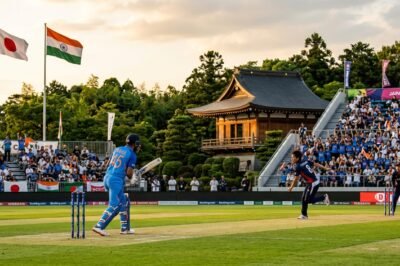
The roar of a cricket crowd is a sound usually associated with the dusty plains of Mumbai, the lush outfields of Lord’s, or the bouncy tracks of Melbourne. However, a new frontier is emerging in the Far East, where the Land of the Rising Sun is beginning to embrace the gentleman’s game with an unexpected fervor. The prospect of an Indian T20 International (T20I) side landing on Japanese soil is not merely a scheduling quirk; it represents a seismic shift in the global sporting hierarchy. For decades, cricket in Japan has lived in the long, formidable shadow of baseball, a sport that dominates the national consciousness. Yet, the strategic inclusion of cricket in the upcoming 2028 Los Angeles Olympics has ignited a spark that could soon become a blaze. When one considers the sheer commercial and emotional gravity that the Indian cricket team carries, their involvement in a Japanese fixture becomes a catalyst for transformation. This isn’t just about bat and ball; it is about cultural exchange, economic revitalisation, and the expansion of a sporting empire into one of the world’s most sophisticated markets. The ripples of such an event would be felt far beyond the boundary ropes of the Sano International Cricket Ground, potentially altering the trajectory of Japanese sports for generations to come. As the Board of Control for Cricket in India (BCCI) looks to expand its global footprint, Japan stands as the ultimate untapped goldmine, ready to be integrated into the mainstream cricketing fold through the sheer power of a single, high-profile exhibition.
The Global Gravity of the Indian Cricketing Brand
To understand why an India T20I is so significant for Japan, one must first acknowledge the unparalleled influence of Indian cricket on the global stage. India is not just a participant in the sport; it is its primary economic engine. The presence of the Indian national team brings with it a massive entourage of sponsors, media houses, and a global viewership that numbers in the hundreds of millions. For the Japan Cricket Association (JCA), hosting even a secondary Indian squad would mean an overnight influx of capital and attention that years of grassroots development could not achieve alone. This ‘India Factor’ acts as a legitimizing force. When the Men in Blue take to the field in a non-traditional cricket nation, the International Cricket Council (ICC) takes notice, and more importantly, the local government and private sectors take notice. The commercial viability of cricket in Japan is intrinsically linked to its ability to attract high-profile opponents, and there is no higher profile than India.
Furthermore, the technical expertise that an Indian tour provides is invaluable. Indian cricketers are masters of the T20 format, and their presence provides Japanese players with a firsthand look at the standards required to compete at the highest level. Strategic partnerships between the BCCI and the JCA could lead to exchange programs, where Japanese players train in Indian academies, further cementing the bond between the two nations. This relationship would not just be one-sided; it offers India a chance to soft-power its way into a new market, using sports as a bridge to deepen diplomatic and cultural ties with a key Asian ally.
The Baseball Parallel: Bridging the Cultural Gap
One of the most fascinating aspects of cricket’s growth in Japan is its structural similarity to baseball, the nation’s most popular sport. Japanese athletes already possess the fundamental skills required for cricket: hand-eye coordination, sprinting speed, and a disciplined approach to training. The transition from the diamond to the pitch is not as arduous as one might think. In fact, many of Japan’s current top cricketers are former baseball players who found their skills translated perfectly to the shorter formats of cricket. An India T20I would serve as the ultimate showcase for these athletes, demonstrating to the Japanese public that their inherent sporting talents can lead to success on a global cricketing stage. By framing cricket as a ‘cousin’ of baseball, the JCA can dismantle the perception that cricket is an alien, Commonwealth-only pursuit.
Moreover, the Japanese ethos of ‘Kaizen’ or continuous improvement is perfectly suited to the strategic nuances of cricket. The intricate field placements, the variety of bowling styles, and the psychological battle between the bowler and the batter resonate with the Japanese appreciation for technical mastery and discipline. If a high-profile match against India were to be televised nationally, it would highlight these similarities, potentially drawing in millions of baseball fans who are looking for a new, albeit familiar, sporting challenge. The success of the Japanese national team in recent ICC regional qualifiers has already proven that the talent is there; all that is missing is the high-stakes exposure that an Indian tour would provide.
Infrastructure: Transforming Sano into a Global Cricket Hub
For Japan to host a team of India’s caliber, the infrastructure must be world-class. Currently, the Sano International Cricket Ground serves as the heart of Japanese cricket. Often referred to as Japan’s ‘Cricket City,’ Sano has made incredible strides in developing facilities that meet international standards. However, the arrival of an Indian team would necessitate an upgrade of unprecedented proportions. We are talking about high-definition broadcasting capabilities, expanded seating capacities, and state-of-the-art practice facilities. This push for infrastructure development would have a lasting legacy, providing Japan with a stadium that could host regular international fixtures, thus making the country a viable neutral venue for other Asian cricketing nations.
- Development of turf pitches capable of withstanding varied weather conditions.
- Implementation of floodlights for night matches to cater to global broadcasting time zones.
- Establishment of high-performance centers for elite athlete training.
The investment required for such upgrades would likely come from a mix of government grants and private sponsorships. Japanese corporations, known for their global reach, have already begun to dip their toes into cricketing waters. Companies like Sony and Nissan are already heavily involved in global cricket sponsorship; seeing the sport flourish in their home market would be a natural progression. An India T20I acts as the proof-of-concept these giants need to commit long-term funding to the sport domestically.
The Roadmap to the 2028 Los Angeles Olympics
The inclusion of cricket in the 2028 Olympics is perhaps the single most important factor in Japan’s recent cricketing push. In Japan, Olympic sports receive significantly more funding and recognition from the government and the Japanese Olympic Committee (JOC). For cricket to be taken seriously as a national sport, it must be seen as a pathway to Olympic glory. A T20I against India would serve as a crucial benchmark for the Japanese team as they prepare for the Olympic cycle. It provides the pressure-cooker environment that only international matches can offer, testing the temperament of the players against the world’s best. If Japan can hold its own, or even show flashes of brilliance against an Indian side, it would send a powerful message to the JOC that cricket is a sport worth investing in.
This Olympic dream also fuels the grassroots movement. Young Japanese children, who traditionally look to baseball or football for professional careers, now have the prospect of representing their country on the world’s greatest sporting stage. The visibility of an India T20I would act as a massive recruitment tool. Seeing stars like Hardik Pandya or Suryakumar Yadav playing on Japanese soil would inspire a new generation of local cricketers. The JCA’s ‘Cricket Blast’ program, which introduces the sport to primary school children, would see an exponential rise in participation numbers following such an event. The goal is clear: to build a sustainable ecosystem that can produce Olympic-ready athletes by 2028.
Economic Impact and the Diaspora Connection
One cannot overlook the role of the Indian diaspora in Japan. With a growing population of Indian professionals in tech hubs like Tokyo and Yokohama, there is an inherent, ready-made fanbase for any visiting Indian team. These expatriates represent a demographic with high disposable income and a deep emotional connection to the sport. A match featuring India would be a guaranteed sell-out, creating a festival-like atmosphere that would introduce the ‘vibe’ of Indian cricket to the local Japanese population. The economic impact would extend to tourism, hospitality, and local businesses in Sano and beyond, proving that cricket is a viable commercial product in the Japanese market.
This diaspora also acts as a bridge for talent. Many members of the Japanese national team are of South Asian descent, bringing with them a legacy of cricketing knowledge. By integrating the diaspora’s passion with the local Japanese athletic prowess, the JCA is creating a unique hybrid model of development. An India T20I would be the ultimate celebration of this multicultural sporting identity, showcasing how cricket can bring different communities together under one flag. The synergy between the Indian tech community and Japanese innovation could even lead to technological advancements in how the game is analyzed and broadcasted, further modernizing the sport.
Conclusion: A New Chapter for the Gentleman’s Game
In conclusion, the prospect of an India T20I in Japan is far more than a simple game of cricket; it is a catalyst for a national sporting revolution. It represents the intersection of tradition and modern ambition, where the ancient values of the gentleman’s game meet the high-tech, fast-paced world of Japanese society. By leveraging the commercial power of the Indian brand, the cultural similarities with baseball, and the looming opportunity of the 2028 Olympics, Japan is poised to become the next great cricketing frontier. The journey will not be without its challenges—infrastructure needs to be built, a culture needs to be fostered, and a new generation of players needs to be trained. However, the blueprint is there, and the enthusiasm is growing. One day, we may look back at a single T20 match as the moment the sun finally rose on Japanese cricket, changing the map of the sport forever. As the world watches, Japan stands ready to step onto the pitch and claim its place in the global cricketing family, proving that the spirit of the game knows no borders and that with the right catalyst, any nation can achieve greatness.







































Leave a Reply