
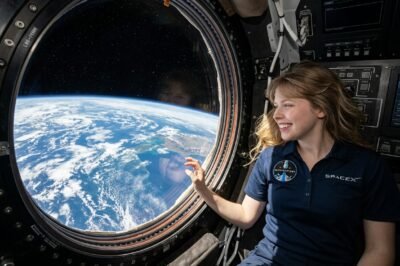
The dawn of a new era in space exploration was not marked solely by the roar of Falcon 9 engines, but by the perspective of a young woman peering through a glass dome at a world she once fought to survive in. When Hayley Arceneaux, a physician assistant at St. Jude Children’s Research Hospital and a bone cancer survivor, shared a breathtaking photograph of Earth from the SpaceX Inspiration4 mission, it wasn’t just a display of celestial beauty. It was a profound symbol of human resilience and the democratization of the cosmos. Floating 585 kilometers above the surface—higher than the International Space Station and the Hubble Space Telescope—Arceneaux’s view encapsulated the fragile, borderless majesty of our planet. This moment, captured and shared with a global audience, serves as a pivotal point in the narrative of civilian spaceflight, transitioning from the exclusive domain of government-trained astronauts to a frontier accessible to ordinary people with extraordinary stories. In this analysis, we delve deep into the significance of her journey, the technical marvels of the Dragon capsule, and what this means for the future of humanity among the stars. The image shared by Arceneaux represents more than just a photographic achievement; it signifies the breaking of physical and social barriers that have long defined the space-faring community.
The Context of the Inspiration4 Mission
The Inspiration4 mission, launched in September 2021, represented a seismic shift in aerospace history. Funded and commanded by billionaire entrepreneur Jared Isaacman, the mission was designed to prove that private citizens could undergo the rigors of space travel and successfully orbit the Earth without professional astronauts on board. Unlike previous “space tourist” hops that merely touched the edge of space for a few minutes, Inspiration4 spent three full days in high Earth orbit. This was a sophisticated orbital maneuver that required intense training, yet the crew consisted of four people from diverse backgrounds: a billionaire pilot, a geoscientist, a data engineer, and a medical officer—Hayley Arceneaux. This mission was not just a joyride; it was a carefully orchestrated flight that demonstrated the capability of SpaceX’s Dragon capsule to function as a home and a laboratory for a multi-day journey. The crew participated in rigorous training including centrifuge runs, zero-G flights, and high-altitude climbs to prepare for the G-forces and psychological pressures of space travel.
The mission name, Inspiration4, reflected the four pillars of the crew seats: Leadership, Hope, Generosity, and Prosperity. Hayley Arceneaux was selected to represent “Hope,” a fitting title for someone who had faced a life-threatening illness as a child and returned to the institution that saved her life to help others. The success of this mission proved that the Falcon 9 and Dragon systems were robust enough to carry non-professional crews, opening the doors for future commercial space stations and private research missions. The orbital altitude achieved by the crew—roughly 360 miles—was higher than any human has traveled since the final Hubble servicing mission in 2009. This elevation provided a unique vantage point, allowing the crew to see the curvature of the Earth in a way that ISS astronauts, who orbit closer to the surface, rarely experience.
Hayley Arceneaux: A Beacon of Resilience and Hope
Hayley’s presence on the mission was perhaps its most poignant element. At age ten, she was diagnosed with osteosarcoma, a type of bone cancer, and underwent intensive treatment at St. Jude Children’s Research Hospital. The treatment involved the replacement of part of her femur with an internal prosthetic, a procedure that would traditionally disqualify a person from government astronaut programs due to the strict physical requirements. Decades later, she returned to St. Jude as a physician assistant, only to be selected as the “Hope” seat for Inspiration4. Her journey made her the youngest American in space at the time, the first person with a prosthetic limb in space, and the first pediatric cancer survivor to reach orbit. Her photo of Earth is thus colored by her personal victory over illness, reflecting a world that she now views from a position of absolute triumph and gratitude.
Beyond her personal milestones, Arceneaux served as the mission’s Chief Medical Officer. During the flight, she was responsible for monitoring the health of her crewmates and overseeing medical experiments. This role showcased that specialized medical knowledge is as vital in space as pilot skills. Her ability to operate in a microgravity environment with a prosthetic limb provided critical data to researchers on how physical disabilities affect spaceflight performance. This is a crucial step toward NASA’s and private companies’ goals of making space travel inclusive. Arceneaux often spoke about how she wanted to show her patients at St. Jude that the sky is not the limit, and her photos of Earth from the Dragon cupola served as a visual promise that their dreams could take them anywhere, regardless of their medical history.
Technical Mastery: The Dragon Cupola and the View of a Lifetime
One of the most striking technical features of the Inspiration4 mission was the modification of the SpaceX Crew Dragon spacecraft, named “Resilience.” Since the mission did not need to dock with the International Space Station, the docking adapter at the nose of the capsule was replaced with a massive glass cupola. This single piece of curved acrylic offered the crew a 360-degree panoramic view of the vacuum of space and the curvature of the Earth. The “stunning view” shared by Arceneaux was captured through this very window, which is currently the largest continuous window ever flown in space. From a technical standpoint, the cupola is an engineering marvel, designed to withstand the extreme pressures, radiation, and temperatures of space while providing optical clarity for photography and observation. It allowed the crew to see the entire disc of the Earth against the black void, a perspective usually reserved for Apollo-era moon travelers.
The engineering of the cupola required SpaceX to rethink the thermal protection system and the structural integrity of the Dragon’s nose. Because the cupola is exposed to the harsh vacuum and the friction of re-entry (protected by the nose cone cover), it had to be tested to extreme safety margins. For the crew, the cupola was more than just a window; it was a sanctuary where they spent hours observing the lightning storms over the oceans, the glow of the atmosphere, and the shimmering city lights at night. Arceneaux’s photography from this vantage point highlights the technical success of SpaceX in creating a spacecraft that is not just a transport vehicle, but a viewing platform. The images she shared were high-definition reminders of the technological progress made in the private space sector over the last decade, moving away from small, thick portholes to expansive vistas.
The Scientific and Philanthropic Legacy
While the imagery was the most visible output, the mission’s core was rooted in philanthropy and science. Inspiration4 set a goal to raise $200 million for St. Jude Children’s Research Hospital, a target they ultimately surpassed with the help of a massive donation from Elon Musk and public contributions. The mission turned space exploration into a vehicle for humanitarian aid, proving that the immense wealth and technology involved in space travel can have direct, positive impacts on life on Earth. Furthermore, the crew conducted numerous medical experiments to study the effects of microgravity on the human body, particularly focusing on the “fluid shift” and radiation exposure at higher altitudes. Hayley, as the medical officer, oversaw the collection of biological samples and the use of an ultrasound device to study organ movement in zero-G.
The scientific data gathered from Arceneaux and her crewmates provides invaluable insights for future long-duration missions, such as those to Mars, where civilian-like physiology will be the norm rather than the exception. Because the crew were not career astronauts, their bodies provided a “baseline” for how average humans respond to space. They tracked their heart rates, sleep patterns, and cognitive performance throughout the three-day mission. The philanthropic success was equally historic, as the mission became the largest single fundraising event for St. Jude. Arceneaux’s shared photos were part of this outreach strategy, engaging the public’s imagination to drive donations and awareness for pediatric cancer research. This fusion of high-stakes science and high-impact charity has set a new template for private space missions moving forward.
The Impact on Global Perspective and Environmental Awareness
Arceneaux’s photo contributes to the “Overview Effect,” a cognitive shift reported by astronauts who see the Earth from space. This perspective highlights the planet’s fragility and the absolute absence of national borders or political divisions. By sharing this view, she invited millions of people into that shift. The coverage by outlets like The Times of India underscores how this resonates globally. In an age of climate crisis and geopolitical tension, such images act as a unifying force. Arceneaux’s captioning and social media presence throughout the mission humanized the experience, making the “high ground” of space feel like a place where humanity’s shared destiny is more visible than its divisions. She described the Earth as having a “glow” and emphasized how thin and protective the atmosphere appeared from that height.
The psychological impact of seeing Earth as a single, interconnected system cannot be overstated. For Arceneaux, who had faced the finite nature of life during her battle with cancer, the view from space was a confirmation of the beauty and resilience of life itself. The widespread sharing of her photograph on social platforms allowed people who may never travel to orbit to share in a moment of cosmic perspective. This environmental and philosophical awareness is a key byproduct of the new space age. As more civilians like Arceneaux reach orbit, the Overview Effect will become a more common part of the human experience, potentially leading to a more collaborative and environmentally conscious global society. Her photo serves as a digital postcard from the future, reminding us that the Earth is a precious island in a dark ocean of space.
The Future of Civilian Space Tourism and Accessibility
The success of Hayley Arceneaux and the Inspiration4 crew has paved the way for more inclusive space exploration. It proved that having a medical history or a physical “imperfection” like a prosthetic limb is not an absolute barrier to space travel. We are entering a decade where space stations may be private, and “work-from-space” could become a reality for researchers and creators. Arceneaux’s stunning view is the opening shot of a film where the protagonists are no longer just military pilots, but nurses, teachers, and survivors. Companies like Axiom Space and Blue Origin are already looking at the Inspiration4 model to design their own orbital missions. The era of the professional astronaut as the sole gatekeeper of space is ending, replaced by a more diverse group of explorers who bring different perspectives to the experience.
Key implications for the future include:
- Increased medical diversity in astronaut selection, allowing those with manageable conditions to fly.
- The development of more “viewer-centric” spacecraft designs, prioritizing the human experience of space.
- The growth of the commercial space economy, including tourism, research, and entertainment.
- Continued collaboration between private aerospace firms and charitable organizations.
As we look at the photo Hayley shared, we are looking at the potential for a new economy and a new culture centered around the final frontier.
Conclusion: A New Horizon for Humanity
In conclusion, the image shared by Hayley Arceneaux is much more than a high-resolution photograph of our home planet. It is a testament to the progress of aerospace technology, the power of charitable giving, and the unyielding spirit of a woman who looked cancer in the eye and then looked down upon the Earth from the heavens. As we look forward, the implications are clear: space is opening up. The barriers are falling, and the view that Arceneaux shared is a promise that one day, many more will get to see that same thin blue line protecting everything we know and love. Her story reminds us that even when grounded by the heaviest of challenges, the potential for ascent is limitless. The Times of India’s highlighting of this moment reflects a global fascination with a future where the stars are within reach for everyone. Hayley Arceneaux did not just go to space; she brought the world with her, through a cupola window and into a future of hope.





































Leave a Reply