
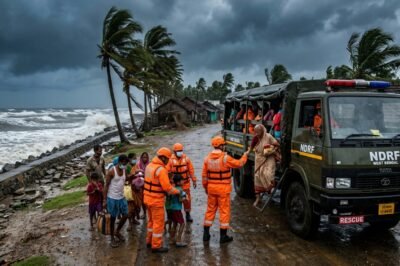
The Bay of Bengal is currently witnessing the birth of the season’s first significant cyclonic storm, aptly named Remal, which is poised to challenge the resilience of the eastern Indian coastline and the low-lying plains of Bangladesh. As the India Meteorological Department (IMD) issues increasingly urgent warnings, the coastal regions of West Bengal and its international neighbor are bracing for a high-impact event scheduled for landfall on the evening of May 26. This atmospheric disturbance, which evolved from a persistent low-pressure area into a deep depression and finally a severe cyclonic storm, marks a critical juncture in the pre-monsoon weather patterns of the Indian subcontinent. For residents, business owners, and government authorities alike, the memories of past tempests like Amphan in 2020 and Yaas in 2021 loom large, casting a shadow of anxiety over the fragile deltaic plains. The precision of modern forecasting tools has allowed for a crucial multi-day lead time, yet the raw power of a tropical cyclone remains an unpredictable force of nature that can shift its trajectory with minimal notice. As the storm gains momentum over the unusually warm tropical waters, its potential to disrupt millions of lives, destroy critical infrastructure, and upend the delicate ecological balance of the Sundarbans is coming into sharp focus. This detailed analysis explores the meteorological complexities, the socio-economic ramifications, and the logistical challenges posed by Cyclone Remal as it marches toward its inevitable rendezvous with the coast.
The Meteorological Evolution of a Severe Cyclonic Storm
The genesis of Cyclone Remal can be traced to a low-pressure area that formed over the East-Central Bay of Bengal during the third week of May. According to the India Meteorological Department (IMD), this system rapidly intensified into a depression and subsequently into a deep depression by May 24. By the early hours of May 25, the system reached the status of a cyclonic storm, characterized by a well-defined center of circulation and organized convective bands. The sea surface temperatures (SST) in the Bay of Bengal have been recorded at a staggering 30 to 32 degrees Celsius, which is significantly higher than the 26.5-degree threshold required for cyclogenesis. This thermal energy acts as high-octane fuel for the storm, allowing it to maintain and even increase its intensity as it moves northward toward the Bengal coast.
Meteorologists have noted that the vertical wind shear—the change in wind speed and direction with height—has remained relatively low in the central Bay, creating a conducive environment for the storm’s vertical growth. The IMD’s Global Forecasting System (GFS) and the European Centre for Medium-Range Weather Forecasts (ECMWF) models have shown high consensus regarding the storm’s trajectory. The consensus points toward a landfall between Sagar Island in West Bengal and Khepupara in Bangladesh. As the storm approaches the coast, it is expected to undergo a final burst of intensification. The current forecasts predict wind speeds of 110-120 kmph, with gusts potentially reaching 135 kmph at the time of landfall. This categorization places Remal firmly in the ‘Severe Cyclonic Storm’ bracket, necessitating the highest level of alert for maritime and coastal activities.
Path of Destruction: Predicted Landfall and Regional Impact
The predicted path of Cyclone Remal suggests a direct hit on the world’s largest mangrove forest, the Sundarbans. This UNESCO World Heritage site acts as a natural buffer, but its fragile ecosystem is at extreme risk from storm surges and saltwater intrusion. The IMD has highlighted that the districts of South 24 Parganas, North 24 Parganas, and East Midnapore in West Bengal are in the direct line of fire. In Bangladesh, the districts of Satkhira, Khulna, and Bagerhat are expected to bear the brunt of the storm’s fury. The timing of the landfall, expected on the night of May 26, is particularly concerning as it may coincide with high tide, significantly amplifying the height of the storm surge.
A storm surge of 1.5 to 2 meters is anticipated, which could inundate low-lying coastal areas and breach embankments. These embankments, many of which were repaired following previous cyclones, remain a point of vulnerability for the local populace. The heavy rainfall associated with the cyclone is another major concern. The IMD has issued a ‘Red Alert’ for several districts, predicting extremely heavy rainfall exceeding 200mm in 24 hours. This level of precipitation is likely to cause localized flooding in urban centers, including Kolkata, and severe waterlogging in agricultural fields, which could lead to long-term soil salinity issues if seawater is allowed to linger.
Economic and Infrastructure Risks for West Bengal and Bangladesh
The economic implications of Cyclone Remal are profound and multi-faceted. The primary sector, particularly agriculture and aquaculture, is most at risk. In West Bengal, the ‘Boro’ paddy harvest is in its final stages, and many farmers have been unable to secure their crops in time. Additionally, the betel leaf (paan) industry, which is a significant source of livelihood in East Midnapore and South 24 Parganas, faces catastrophic losses as the high winds can easily demolish the fragile ‘Boroj’ or shade structures used for cultivation. Shrimp farming, a major export earner for both India and Bangladesh, is also threatened by the potential for pond flooding and the mixing of saline and fresh water.
Infrastructure risks extend to the power and telecommunications sectors. High-velocity winds are notorious for uprooting electric poles and snapping transmission lines, leading to prolonged blackouts. In the wake of Cyclone Amphan, some rural areas were without power for weeks; authorities are desperate to avoid a repeat of that scenario. Transportation is already seeing disruptions, with the Netaji Subhash Chandra Bose International Airport in Kolkata considering a suspension of flight operations during the peak storm period. The Eastern and South Eastern Railways have already canceled numerous coastal train services, and the movement of ferry services in the Hooghly River has been completely halted to prevent accidents at sea.
Preparedness and Disaster Management Strategies
In response to the looming threat, the governments of West Bengal and Bangladesh have activated their disaster management protocols. The National Disaster Response Force (NDRF) has deployed over 12 teams across the coastal districts of West Bengal, equipped with tree cutters, inflatable boats, and medical supplies. The Indian Coast Guard and the Indian Navy have been placed on high alert, with ships and aircraft positioned for search and rescue operations. In Bangladesh, the Cyclone Preparedness Programme (CPP) has mobilized thousands of volunteers to facilitate the evacuation of residents from vulnerable coastal villages to multi-purpose cyclone shelters.
The administrative machinery in West Bengal has opened 24/7 control rooms at the state and district levels. Chief Minister Mamata Banerjee has held high-level meetings to ensure that essential supplies, including dry food, drinking water, and medicines, are stockpiled in adequate quantities. Evacuation remains the top priority, with a focus on moving the elderly, children, and pregnant women to safer locations. Public address systems are being used continuously in coastal villages to warn people about the storm’s intensity and to urge them to move to concrete shelters. The synergy between the IMD’s technical data and the ground-level execution by district magistrates will be the determining factor in minimizing the loss of human life.
Climate Change and the Rising Frequency of Intense Storms
Cyclone Remal is not an isolated event but part of a documented trend of increasing cyclonic intensity in the Bay of Bengal. Historically, the Arabian Sea was considered less active than the Bay of Bengal, but both basins are now seeing a rise in the frequency of ‘Severe’ and ‘Very Severe’ cyclonic storms. Climate scientists attribute this to the rising temperature of the Indian Ocean, which is warming at a faster rate than other tropical oceans. This excessive heat provides the latent energy required for storms to undergo rapid intensification, a process where a storm’s wind speed increases by at least 35 knots within 24 hours.
The impact of climate change is also visible in the changing landfall patterns. Storms are maintaining their intensity for longer periods even after hitting land, due to the increased moisture-holding capacity of the warmer atmosphere. This means that inland areas, which were previously considered safe from the worst effects of a cyclone, are now experiencing heavy rainfall and gale-force winds. The recurrent nature of these disasters leaves little time for coastal communities to recover, leading to a cycle of poverty and forced migration. Cyclone Remal serves as a grim reminder that climate adaptation and the building of resilient infrastructure are no longer optional but essential for the survival of the millions living in the Ganges-Brahmaputra delta.
Financial Markets and Supply Chain Implications
From a financial perspective, Cyclone Remal presents several risks that investors and market analysts are closely monitoring. The insurance sector is likely to see a surge in claims related to property damage, crop loss, and business interruption. Historically, large-scale cyclones in the region have led to a temporary dip in the stocks of general insurance companies. Furthermore, the FMCG (Fast-Moving Consumer Goods) sector may face supply chain disruptions, as the movement of goods into and out of the Kolkata port is restricted. The port itself is a vital hub for trade with Nepal and Bhutan, and any damage to its infrastructure could have regional trade implications.
Essential commodity prices often see a spike in the aftermath of a cyclone due to hoarding and transport bottlenecks. The state government has issued warnings against price gouging, but the reality of damaged roads and flooded warehouses often leads to inflationary pressure on vegetables and seafood. On the flip side, the reconstruction phase following the storm often leads to a temporary boost in demand for cement, steel, and construction materials, as the government and private individuals begin the arduous task of rebuilding homes and public utilities. Market participants are advised to keep a close eye on the logistics and power sectors over the coming week.
Conclusion: Navigating the Future of Coastal Resilience
As Cyclone Remal makes its final approach toward the shores of West Bengal and Bangladesh, the immediate focus remains on the preservation of life and the mitigation of immediate suffering. However, the long-term implications of such recurring natural disasters cannot be ignored. The arrival of Remal on May 26 is a testament to the volatile era of weather extremes we have entered. While the integration of satellite technology and ground-level disaster management has significantly reduced the death tolls compared to the tragedies of the 20th century, the economic cost of these storms continues to escalate, threatening to derail the development goals of the region.
The path forward must involve a fundamental shift in how we approach coastal urban planning and rural development. Strengthening embankments with nature-based solutions like mangrove restoration, improving the accuracy of hyper-local weather alerts, and creating a decentralized grid for power and water are critical steps. Cyclone Remal will eventually pass, but the lessons it leaves behind must be used to build a more resilient Bengal. For now, the eyes of the nation remain on the brave residents of the coast and the first responders who stand ready to face the elements. The next 48 hours will define the recovery trajectory for millions, reminding us once again of our profound vulnerability to the shifting moods of the ocean.






































Leave a Reply