
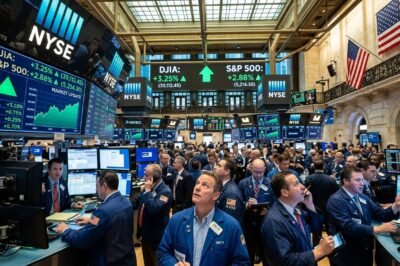
The financial world is no stranger to the pendulum of market sentiment, but the recent fluctuations on Wall Street have tested the nerves of even the most seasoned institutional investors and retail traders alike. After a harrowing session that saw the Dow Jones Industrial Average suffer its most significant single-day point wipeout in more than twelve months, the markets have responded with a characteristic, albeit aggressive, display of resilience. The bounce-back, characterized by a broad-based rally across the S&P 500, the Nasdaq Composite, and the Dow itself, serves as a poignant reminder of the ‘buy the dip’ mentality that has come to define the modern trading era. Investors, initially spooked by a confluence of hawkish central bank signals and disappointing earnings data, appeared to have regained their footing, scouring the wreckage for undervalued blue-chip stocks and high-growth technology plays. This surge is not merely a technical correction but a complex interplay of psychological reassurance and strategic positioning, as market participants weigh the risks of persistent inflation against the underlying strength of the American corporate sector. As the opening bell rang today, the atmosphere was one of cautious optimism, a stark contrast to the funereal silence that dominated the previous afternoon’s closing minutes. Analysts are now closely watching whether this recovery has the legs to sustain a long-term uptrend or if it represents a brief relief rally in an otherwise bearish turn of the tide.
The Anatomy of the Wipeout: Understanding the Scale of the Decline
To understand the scale of the recovery, one must first dissect the magnitude of the preceding collapse. The Dow Jones Industrial Average plummeted by over a thousand points in a single session, a move that erased weeks of gains and sent the CBOE Volatility Index, often referred to as the VIX or Wall Street’s ‘fear gauge,’ into a vertical climb. The primary driver behind this sudden liquidation was a combination of hotter-than-expected consumer price index data and a series of lukewarm guidance reports from major retail and technology firms. When the realization set in that the Federal Reserve might maintain its restrictive monetary policy for longer than previously anticipated, the ‘soft landing’ narrative was briefly cast into doubt. This triggered a cascade of sell orders, amplified by algorithmic trading platforms that are programmed to exit positions when certain technical support levels are breached. The breadth of the sell-off was particularly concerning to analysts, as it wasn’t confined to a single sector; instead, it was a systemic exit that affected everything from energy to healthcare. The psychological impact of seeing the Dow lose such a significant percentage of its value in mere hours cannot be overstated, as it forced a total reassessment of risk parity strategies across the board. Furthermore, the volume of trading during the sell-off suggested that institutional players were rebalancing their portfolios, moving away from equities and into the perceived safety of short-term government bonds.
The Mechanics of the Recovery: Why Investors Bought the Dip
As the dust settled on the previous day’s carnage, a different set of market mechanics began to take over. Historically, significant drawdowns in the US equity markets have been viewed by opportunistic investors as entry points rather than exits. This phenomenon, colloquially known as ‘buying the dip,’ was on full display as the markets opened for the subsequent session. Value investors, who had been sitting on significant cash piles waiting for a correction, finally saw the valuations they had been targeting. Large-cap technology stocks, which had been trading at historically high price-to-earnings multiples, suddenly looked more attractive after a 5-10% haircut. Furthermore, technical analysts pointed to the fact that the S&P 500 had touched its 200-day moving average, a critical long-term support level, during the depth of the sell-off. This touchpoint acted as a psychological floor, encouraging a wave of automated and manual buying. The resulting influx of capital helped to stabilize prices and provided the momentum necessary for the indices to turn green within the first hour of trading. The recovery was also supported by a series of corporate share buyback announcements, which signaled to the market that executives believed their own stocks were undervalued following the crash.
The Federal Reserve and Economic Data Influence on Market Sentiment
A central pillar of the market’s recovery is the evolving interpretation of Federal Reserve policy. While the initial sell-off was fueled by fears of ‘higher for longer’ interest rates, the subsequent jump in stock prices suggests that the market is beginning to digest the reality of the economic cycle. Investors are now looking beyond the immediate inflation prints and focusing on the broader health of the US economy. Recent labor market data, while showing signs of cooling, remains robust enough to support consumer spending, which accounts for approximately two-thirds of the US GDP. Market participants are betting that the Fed will eventually find a balance between taming inflation and preventing a deep recession. The rebound reflects a collective belief that while the path to 2% inflation may be ‘bumpy,’ the overall trajectory of corporate earnings remains positive. This nuanced view has allowed investors to overlook short-term volatility in favor of long-term growth prospects, effectively decoupling the daily price action from the immediate noise of macroeconomic headlines. During today’s trading, several Fed officials gave speeches that, while cautious, did not introduce new reasons for panic, which further helped to soothe the jagged nerves of market participants who had been bracing for a more hawkish tone.
Sector Performance: Tech Giants and AI Leading the Charge
The recovery was not uniform across all industries, and a closer look at sector performance reveals a great deal about current market priorities. The technology sector, led by the so-called ‘Magnificent Seven,’ was instrumental in dragging the broader indices back into positive territory. Companies involved in artificial intelligence, cloud computing, and semiconductor manufacturing saw the most significant inflows, as these sectors are perceived to have the most resilient earnings profiles in a high-rate environment. In addition to tech, the energy sector showed remarkable strength, buoyed by stabilizing crude oil prices and a renewed focus on domestic production. Conversely, defensive sectors like utilities and consumer staples, which usually perform well during periods of uncertainty, saw more modest gains, suggesting that the current rally is driven by a return to ‘risk-on’ sentiment rather than a flight to safety. This rotation back into growth-oriented sectors indicates that the market’s appetite for risk has not been permanently dampened by the previous day’s volatility. The resurgence of AI-focused stocks particularly suggests that investors are still willing to pay a premium for innovation and future-proof business models, even amid broader economic instability.
Global Market Ripple Effects and the Strength of the US Dollar
The US market does not exist in a vacuum, and the ‘wipeout and jump’ cycle had significant repercussions across the global financial landscape. As the Dow Jones fell, European indices like the FTSE 100 and the DAX followed suit, reflecting the interconnected nature of global capital flows. However, the subsequent rebound in New York provided a much-needed lift to Asian markets, particularly the Nikkei and the Hang Seng, which had been bracing for a prolonged downturn. The resilience of the American consumer and the strength of the US dollar continue to be the primary engines for global economic sentiment. When Wall Street sneezes, the rest of the world catches a cold; but when it recovers as quickly as it did this week, it sends a signal of stability to international investors. This global feedback loop reinforces the importance of the US equity market as the ultimate arbiter of global financial health. Furthermore, the volatility in the US has caused some emerging markets to see temporary capital outflows, though the quick recovery has stemmed the tide of a broader exit. International investors are currently balancing their portfolios by keeping a significant portion of their assets in US equities, viewing the American market as a bastion of relative stability compared to the geopolitical uncertainties facing Europe and parts of Asia.
Technical Analysis: Identifying Support and Resistance Levels
From a technical perspective, the recent jump in US stocks has provided clear insights into where the market sees value. Traders have been closely monitoring the Relative Strength Index (RSI), which hit oversold territory during the Dow’s thousand-point drop, signaling that a bounce was imminent. The current rally has successfully reclaimed several key moving averages, including the 50-day and 100-day simple moving averages, which often serve as indicators of medium-term trend direction. However, the market is now approaching a significant resistance zone. For the S&P 500, the previous all-time high represents a major hurdle that will require sustained buying volume to overcome. Analysts suggest that if the indices can consolidate their current gains without another sharp pullback, the path toward new record highs remains open. On the other hand, failure to break through these resistance levels could result in a ‘double top’ formation, a bearish signal that could lead to further testing of recent lows. The volume of trade during this recovery session has been significantly higher than the average, suggesting that the move is backed by real conviction from institutional buyers rather than just a technical glitch. This high-volume bounce is a classic sign of an ‘accumulation’ phase where big players are absorbing the selling pressure from weaker hands.
Future Implications: Navigating the Road Ahead for Investors
Looking forward, the question on every investor’s mind is whether this jump marks the beginning of a sustained uptrend or merely a temporary respite in a broader corrective phase. While the immediate recovery is encouraging, the underlying factors that caused the initial wipeout, namely inflation and interest rate uncertainty, have not been fully resolved. Market participants must remain vigilant, as the transition from a period of easy money to one of fiscal discipline is rarely a linear process. However, the sheer speed and volume of the rebound suggest that there is still a significant amount of liquidity in the system and a high level of confidence in the long-term viability of US corporations. The recent volatility should be viewed as a reminder of the importance of diversification and the need for a disciplined investment strategy. As we move into the next quarter, earnings quality will likely become the primary differentiator between winners and losers, and the markets will continue to react to every data point with heightened sensitivity. For now, the bulls have regained control, but the shadow of the recent wipeout serves as a cautionary tale for those who might become too complacent in an increasingly complex financial world. Investors are advised to maintain a balanced outlook, focusing on companies with strong balance sheets and consistent cash flow, as these will likely weather any future storms with greater ease than their more speculative counterparts.






































Leave a Reply