
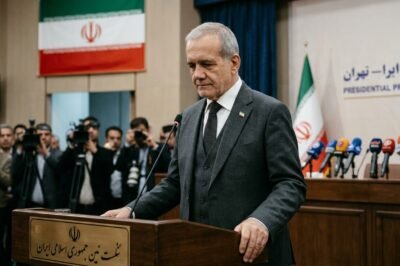
In a move that has sent ripples through both diplomatic circles and global financial markets, Iranian President Masoud Pezeshkian recently signaled a potential shift in the Islamic Republic’s long-standing approach to international engagement. Speaking to a televised audience, Pezeshkian revealed that Supreme Leader Ayatollah Ali Khamenei has granted the current administration a degree of “authority” to pursue dialogue with the West, specifically regarding the lifting of stifling economic sanctions. This announcement comes at a critical juncture for Iran, which finds itself navigating a labyrinth of domestic economic crises and a volatile regional landscape characterized by heightened tensions with Israel and the ongoing fallout from various proxy conflicts. The news, first reported by investingLive and other major financial outlets, suggests that the reformist-leaning president may have more room to maneuver than his predecessors, provided he remains within the ideological boundaries set by the clerical establishment. For investors and geopolitical analysts, the statement is more than just rhetoric; it is a potential signal that Tehran is seeking a pragmatic exit strategy from its current isolation, aiming to stabilize its currency and reintegrate into the global energy market.
The nuances of Iranian politics often dictate that the President acts as the administrative face of the country, while the Supreme Leader holds the ultimate authority over all matters of state, including foreign policy and nuclear ambitions. Pezeshkian’s claim that he has been granted a mandate for dialogue is a rare public acknowledgment of the Supreme Leader’s involvement in the tactical details of diplomacy. Historically, such permissions are only granted when the regime feels that its survival or stability is at risk, often referred to as “heroic flexibility.” In the current context, the Iranian economy is gasping under the weight of hyperinflation, a plummeting Rial, and restricted access to international banking systems. By signaling a willingness to talk, Pezeshkian is attempting to manage expectations both at home and abroad, suggesting that the path to economic recovery must inevitably pass through the gates of international diplomacy and a potential return to the negotiating table over Iran’s nuclear program.
The Significance of Supreme Leader Ayatollah Ali Khamenei’s Endorsement
In the complex hierarchy of the Islamic Republic, no significant move in foreign policy can occur without the explicit or implicit blessing of Ayatollah Ali Khamenei. The Supreme Leader’s decision to grant Pezeshkian “authority” on dialogue is a calculated risk designed to test the waters of international diplomacy without fully committing the regime to a specific outcome. This endorsement is particularly significant given the failure of the 2015 Joint Comprehensive Plan of Action (JCPOA) following the unilateral withdrawal of the United States in 2018. The subsequent “maximum pressure” campaign left many within the Iranian hardline establishment deeply skeptical of any future agreements with Western powers. Therefore, Pezeshkian’s public statement serves as a shield against domestic hardline critics who might otherwise view any attempt at dialogue as a betrayal of revolutionary principles. By framing the dialogue as a mission sanctioned by the Supreme Leader, the President is effectively insulating himself from the political crossfire of the Majlis (Parliament), which remains dominated by conservative factions.
Furthermore, this authorization suggests a realization at the highest levels of the Iranian government that the status quo is unsustainable. While Iran has managed to pivot toward Moscow and Beijing in recent years, the economic benefits of these alliances have not been sufficient to offset the damage caused by Western sanctions. The Supreme Leader’s move can be interpreted as a strategic recalibration, allowing the reformist administration to explore the possibility of a “sanctions-relief-for-cooperation” framework. However, analysts warn that this authority is likely conditional and limited. The Supreme Leader has historically preferred a “neither war nor peace” stance, and any dialogue initiated by Pezeshkian will be closely monitored to ensure it does not compromise Iran’s regional influence or its advancements in nuclear technology. This creates a narrow corridor for diplomacy, where any perceived overstep by the government could lead to a swift withdrawal of the Leader’s support.
Economic Desperation and the Quest for Sanctions Relief
The primary driver behind this sudden openness to dialogue is undoubtedly Iran’s precarious economic situation. For years, the Iranian public has endured the twin burdens of government mismanagement and international sanctions. Inflation rates have consistently hovered near 40-50%, eroding the purchasing power of the middle class and pushing millions into poverty. The Iranian Rial has seen a catastrophic loss of value against the US dollar, making basic imports and healthcare increasingly unaffordable. By mentioning the Supreme Leader’s green light, Pezeshkian is directly addressing these economic anxieties, positioning his government as the one capable of breaking the deadlock that has frozen the nation’s growth. The hope is that even the prospect of dialogue could provide a psychological boost to the markets, temporarily stabilizing the Rial and encouraging domestic investment.
From a fiscal perspective, Iran’s reliance on clandestine oil sales—primarily to China—has provided a lifeline, but these transactions often come with significant discounts and high transaction costs due to the need to bypass the SWIFT banking network. A formal lifting of sanctions would allow Iran to export its oil at market prices and, more importantly, access billions of dollars in frozen assets held in foreign banks. For the global energy market, the reentry of Iranian crude into the official supply chain would be a major event. Estimates suggest that Iran could potentially add upwards of 1.5 million barrels per day to the market relatively quickly. This potential surge in supply is a key reason why energy traders are closely monitoring Pezeshkian’s statements, as any breakthrough in dialogue could lead to a downward pressure on global oil prices, impacting everything from Brent futures to the profitability of Western shale producers.
The Nuances of Dialogue: Strategic Patience or Genuine Reform?
When Pezeshkian speaks of “dialogue,” it is essential to define what that means in the Iranian context. It does not necessarily imply a wholesale rapprochement with the United States or a change in the regime’s fundamental ideology. Instead, it is more likely to involve a series of targeted negotiations aimed at specific concessions. These could include the release of dual-national prisoners, limitations on uranium enrichment levels, or a reduction in the provision of military hardware to proxies in exchange for the unfreezing of assets or the issuance of oil waivers. This “step-for-step” approach is seen as more palatable to the Supreme Leader than a comprehensive grand bargain, which has proven elusive for decades. The challenge for Pezeshkian will be to convince Western interlocutors, especially the Biden-Harris administration or a future US leadership, that Iran is acting in good faith and not merely using dialogue as a tactic to buy time.
Critics of the Iranian regime argue that this newfound interest in dialogue is merely a form of “strategic patience.” By engaging in low-level talks, Iran can project an image of moderation to the international community, potentially driving a wedge between the United States and its European allies. If the West perceives Iran as being open to negotiation, it becomes much harder to build a consensus for further sanctions or military action. Within Iran, the debate rages between those who believe in genuine reform and those who see diplomacy as a tool of survival. Pezeshkian, who campaigned on a platform of expertise and pragmatic governance, must navigate these conflicting views. His ability to deliver tangible economic results will be the ultimate litmus test for whether this “authority” from the Supreme Leader leads to a permanent shift in policy or remains a fleeting diplomatic overture.
Market Reactions and Global Energy Implications
The financial world has reacted with cautious optimism to the headlines originating from Tehran. On news of Pezeshkian’s comments, regional stock indices showed signs of stabilization, and there was a slight cooling in the geopolitical risk premium that has been baked into oil prices since the start of the conflict in Gaza. InvestingLive reports suggest that hedge funds and institutional investors are beginning to recalibrate their portfolios to account for the possibility of a de-escalation in the Middle East. However, the market remains wary. The history of Iranian-Western relations is littered with false starts and broken promises. Therefore, while the rhetoric is positive, investors are looking for concrete actions—such as a meeting between high-level officials or a report from the International Atomic Energy Agency (IAEA) indicating improved cooperation—before committing to a long-term bullish outlook on regional stability.
The impact on the energy sector cannot be overstated. Iran holds some of the world’s largest proven oil and gas reserves. If the “authority for dialogue” leads to a removal of secondary sanctions on the energy sector, the global landscape would change overnight. European countries, still looking for alternatives to Russian gas, would be particularly interested in Iranian supplies. Furthermore, the development of Iran’s massive South Pars gas field requires Western technology and investment that has been blocked for years. Companies like TotalEnergies and Eni, which have previously sought to develop Iranian resources, would likely monitor the diplomatic progress with great interest. The potential for a “Green Canal” for humanitarian and energy trade could serve as the first step in a broader economic reintegration that would have profound implications for global trade routes and the petrodollar system.
Regional Geopolitics: Israel, the West, and the Resistance Axis
Any discussion of Iranian dialogue is inseparable from the broader regional context. The “Axis of Resistance”—comprising Hezbollah in Lebanon, Hamas in Gaza, the Houthis in Yemen, and various militias in Iraq and Syria—remains the backbone of Iran’s regional strategy. The Supreme Leader is unlikely to trade away these assets easily, as they provide Iran with strategic depth and a deterrent against Israeli or American aggression. This creates a significant hurdle for any dialogue with the West, which views Iran’s regional activities as a primary threat to international security. Pezeshkian’s government will have to balance the need for economic relief with the military and ideological commitments of the Islamic Revolutionary Guard Corps (IRGC), which operates largely independently of the presidency.
Israel, in particular, remains highly skeptical of any diplomatic opening between Tehran and the West. Prime Minister Benjamin Netanyahu has consistently warned that Iran uses negotiations as a smokescreen to continue its nuclear weapons program. Any move by the US to ease sanctions in exchange for dialogue is likely to meet fierce opposition from the Israeli government and its supporters in the US Congress. This geopolitical friction means that Pezeshkian is not just negotiating with the West, but is also indirectly managing a crisis with Israel that could boil over at any moment. The success of his diplomatic mission depends on whether he can decouple the nuclear and economic files from the regional conflict, a feat that has eluded every Iranian administration since 1979.
Conclusion: Future Implications and the Path Forward
The revelation that President Pezeshkian has been granted authority for dialogue by the Supreme Leader marks a pivotal moment in Iranian politics. It suggests that the internal pressure from economic hardship has reached a level where even the most conservative elements of the regime recognize the need for a change in tactics. However, the path forward is fraught with obstacles. Domestically, Pezeshkian must contend with a powerful security apparatus and a skeptical parliament. Internationally, he faces a deeply polarized American political landscape and a Middle East on the brink of wider conflict. The success of this initiative will depend on the government’s ability to offer credible concessions that satisfy Western security concerns while maintaining the core interests of the Iranian state.
For the global economy, the stakes are incredibly high. A successful dialogue could lead to the reintegration of a major regional power into the global market, lowering energy costs and opening new avenues for trade. Conversely, a failure of these talks could embolden hardliners in Tehran, leading to further escalation and potentially a direct military confrontation. As we look toward the coming months, the world will be watching closely for any signs of a formal meeting or a breakthrough in nuclear monitoring. Whether Pezeshkian can translate this “authority” into a lasting peace remains to be seen, but the very fact that the Supreme Leader has opened the door to dialogue is a development that cannot be ignored by anyone invested in the future of the Middle East and global financial stability.




































Leave a Reply